

When you’re pricing out a power station for whole-home backup, the math eventually splits into two paths: one large unit with enough capacity to cover your essentials, or two smaller units you can split across circuits or combine when you need the extra headroom. Both work. They just fail differently, cost differently, and suit different households — so here’s how to actually decide instead of defaulting to whichever option is cheaper this week.
The case for one big unit
A single large power station is simpler to manage: one battery to monitor, one app, one warranty, one thing to keep charged. Cost per watt-hour also tends to improve as capacity goes up within the same product line — you’re not paying for a second inverter, a second case, and a second display just to get more stored energy. If your home backup needs are well-defined (a fridge, some lighting, a router, a sump pump) and don’t change much season to season, sizing one unit correctly the first time is the lower-friction path.
The tradeoff is a single point of failure. If that one unit needs warranty service or fails outright, you have zero backup until it’s fixed or replaced — not reduced backup, none.
The case for two smaller units
Two smaller power stations give you redundancy: if one needs service, you still have partial backup instead of nothing. You can also split them across different rooms or circuits — one covering the kitchen fridge and router, another dedicated to a home office or a medical device — without running extension cords across the house. And if your needs grow later, adding a third unit is usually cheaper than replacing a maxed-out single unit with a bigger one.
The tradeoffs: you’re managing two apps, two charge cycles, and in some cases two different warranty clocks if you bought them at different times. Combined capacity for the same total watt-hours also usually costs more than one larger unit from the same brand, since you’re paying for two inverters and two enclosures.
Can you actually combine two units for more power when you need it?
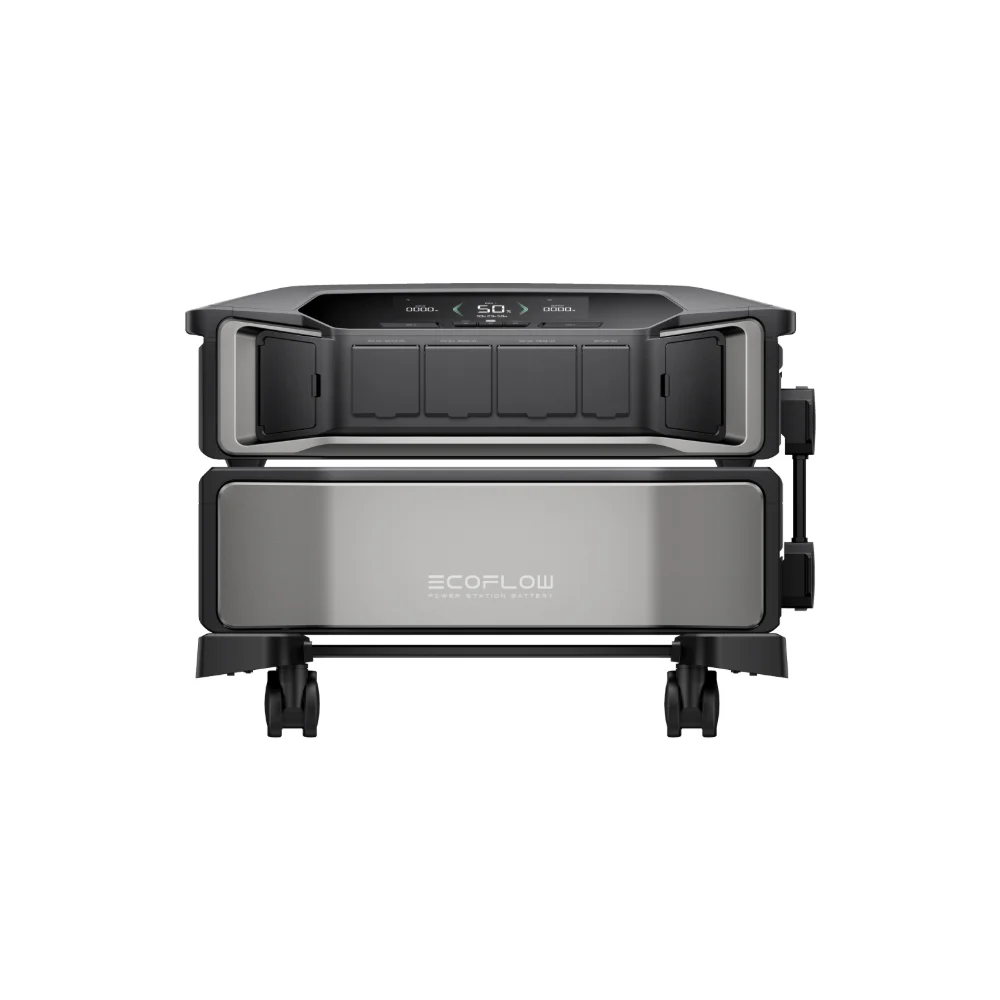
Yes, but only if you do it the way the manufacturer intends. EcoFlow’s own guidance lays out two supported methods: a smart expansion battery connected via a dedicated cable (compatible with specific models like the DELTA 2, DELTA Max, DELTA Pro, and RIVER 2 Pro), which lets the main unit’s battery management system safely control both as one system; and, for flagship units, a Double Voltage Hub that synchronizes two full power stations to unlock higher combined output and 240V power for larger appliances.
What EcoFlow explicitly warns against is improvising this yourself — connecting two units’ AC outputs together without manufacturer-approved hardware risks short circuits, equipment damage, fire, and injury. If you want combined output from two units, that capability has to be built into the specific models you buy; it’s not something you can safely rig between two random power stations from different brands or generations.
A practical way to decide
- Pick one big unit if: your backup needs are stable and well-defined, you want the simplest possible setup, and you’re comfortable with a single point of failure in exchange for a lower cost per watt-hour.
- Pick two smaller units if: you want redundancy, you need to power things in two separate locations in the house, or you plan to grow capacity incrementally rather than replacing a maxed-out unit later.
- Buy into an expansion-compatible ecosystem if: you want the flexibility of both approaches — start with one unit, add a manufacturer-approved expansion battery later instead of guessing your needs correctly on day one.
A Third Option: Neither Approach, Just a Bigger Backup Plan
Before committing to either a single large unit or a split multi-unit setup, it’s worth stepping back and asking whether a battery-only approach is even the right category of solution for your household’s backup needs at all. For genuinely whole-home, multi-day backup, a standby generator solves a different part of the problem than any battery power station configuration — higher continuous output, indefinite runtime as long as fuel holds out, at the cost of installation complexity, ongoing maintenance, and noise. Our comparison of power stations vs. standby generators for home backup covers that broader fork in the decision tree before you get into the one-big-vs-two-smaller question this article focuses on. And if budget is the primary constraint driving you toward a smaller setup regardless of the one-vs-two question, our guide to home backup power on a budget covers a leaner starting point that applies to either configuration.
How Household Size and Layout Should Influence Your Choice
The math above treats capacity as the main variable, but your home’s physical layout matters too. A single-story home or apartment with everything centrally located favors one larger unit, since distance and cord-running aren’t a real constraint. A multi-story home, or one with the fridge, home office, and bedroom spread across a large footprint, makes a stronger case for distributed smaller units — running extension cords across multiple floors or long distances from a single central unit gets impractical fast, and voltage drop over long cord runs becomes a real (if often overlooked) consideration for higher-draw appliances. If your household includes someone with a genuine medical necessity for continuous power — a refrigerated medication, a CPAP machine, home medical equipment — a dedicated smaller unit assigned specifically to that need, independent of your general household backup capacity, adds a layer of certainty a shared single-unit setup doesn’t.
FAQ
Do two smaller units really cost more than one big one for the same total capacity?
Usually, yes, because you’re paying for two inverters and enclosures instead of one. The gap varies by brand and capacity tier, so compare the actual watt-hour-per-dollar figure on the specific models you’re considering rather than assuming a fixed rule.
Can I mix brands between two units for redundancy?
You can own units from two different brands for separate, independent backup (one covers the fridge, another covers the office) without any issue. What you can’t safely do is electrically combine their outputs into one supply without manufacturer-approved hardware — that’s a brand-specific, same-ecosystem feature.
Is an expansion battery the same as buying a second full power station?
No — an expansion battery adds capacity but relies on the main unit’s inverter and battery management system. It’s usually cheaper than a second full unit, but it doesn’t give you the redundancy of two independently functioning power stations.
Does a single large unit take up meaningfully more physical space than two smaller ones combined?
Not usually by a huge margin, since a single large unit is more space-efficient per watt-hour than two separate enclosures, but placement flexibility is the bigger factor — two smaller units can be positioned near where they’re actually needed, while one large unit sits in a single spot with cords running to everything else.
If I already own one power station, should my next purchase be a matching second unit or a different capacity?
It depends on what gap you’re filling. If you’re adding redundancy or covering a second location, a similar or smaller matching unit makes sense. If your existing unit is undersized for your actual needs, a larger replacement or a complementary higher-capacity second unit may serve you better than simply duplicating what you already have.
How do I decide this for a household that might grow (new baby, aging parent moving in, more medical equipment)?
Lean toward the more flexible option — either an expandable single-unit system or a multi-unit setup you can add to — rather than sizing exactly to today’s needs, since backup power requirements tend to grow with household changes rather than shrink.
Bottom line
There’s no universally correct answer here — it comes down to whether you value simplicity and cost-efficiency (one big unit) or redundancy and flexibility (two smaller ones). If you’re not sure which you’ll need, buying into a product line with a manufacturer-supported expansion battery gives you room to grow into the second option later without having guessed wrong on day one.
For the fundamentals on sizing either approach correctly, see our power station warranty comparison before you commit to a brand and ecosystem.
This post may include affiliate links — if you buy through them, we may earn a small commission at no extra cost to you. It doesn’t change what we cover or how we rank anything.