
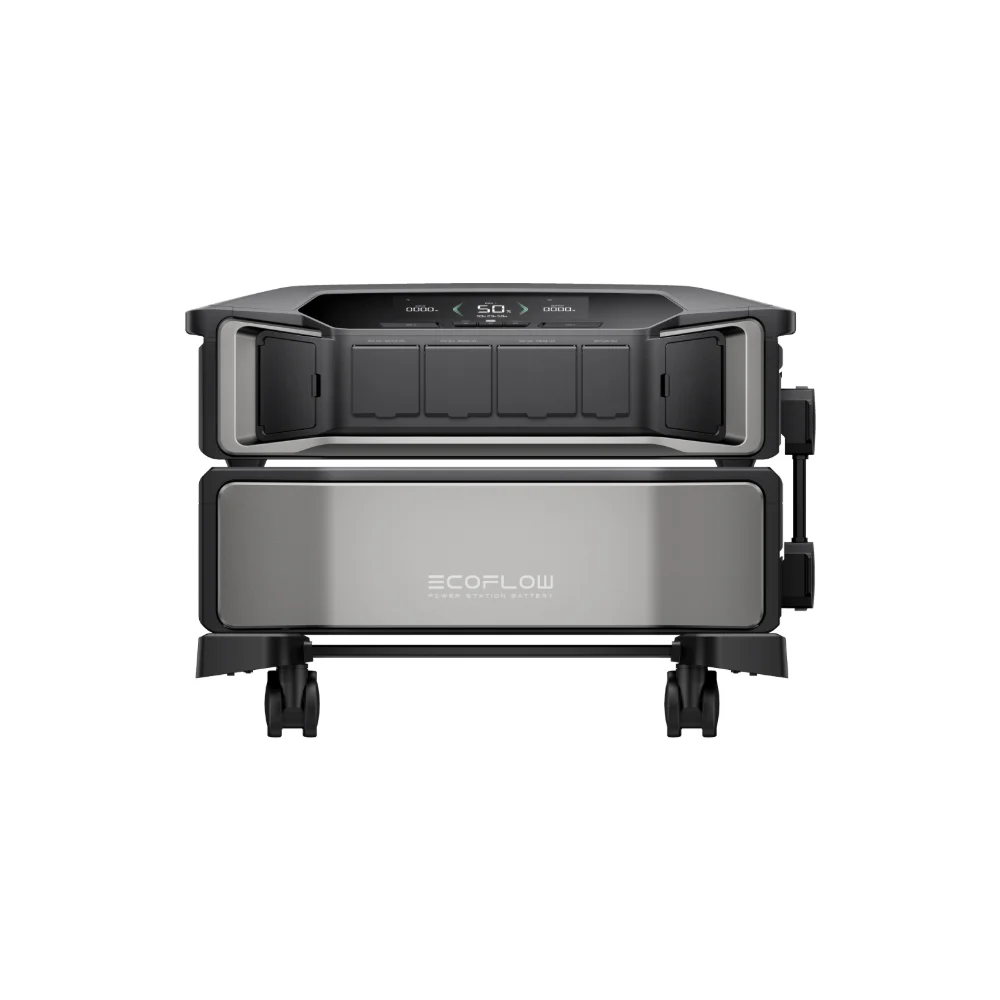

Read this first: an oxygen concentrator is life-sustaining medical equipment. Nothing in this article is medical advice, and no consumer power station should be treated as your only backup plan for a device you depend on to breathe. This is general information about power consumption and battery sizing math, meant to help you have a more informed conversation with your durable medical equipment provider and physician — not to replace that conversation.
How much power an oxygen concentrator actually draws
The number varies enormously by device type, which is the first thing worth understanding before any sizing math means anything:
| Concentrator type | Typical power draw |
|---|---|
| Portable pulse-dose concentrator | ~40-130W (120-150W while charging on AC) |
| Stationary 5-liter concentrator | ~200-350W (specific models: Inogen At Home 275W, CAIRE Companion 5 up to 350W, Philips EverFlo 350W average, Drive DeVilbiss 5L 310W average) |
| Stationary 10-liter concentrator | ~500-600W (React Health Platinum 10L: 585W typical) |
That’s roughly a 15x range from the smallest portable unit to the largest stationary one — which is exactly why “how big a power station do I need” doesn’t have a single answer without knowing your specific device’s actual draw, ideally measured directly with a watt meter rather than assumed from a category average.
Runtime math: what a given battery capacity actually gets you
UDPOWER’s guide uses a straightforward formula — battery capacity in Wh × 0.90 (accounting for inverter and conversion losses) ÷ your concentrator’s measured wattage — to estimate runtime. Applied to real numbers: a 1,190Wh unit running a 350W stationary concentrator lasts roughly 3.1 hours; a 2,083Wh unit on the same load reaches about 5.4 hours, dropping to roughly 3.2 hours if the concentrator is a higher-draw 10-liter unit at 585W. Generatorchecker’s guide, using a slightly more conservative 0.70 derate factor, found a 4,096Wh unit (EcoFlow DELTA Pro 3) provides about 8.2 hours for a stationary concentrator or roughly 23.9 hours for a lower-draw portable unit.
Scaled up to daily and multi-day needs, Generatorchecker’s sizing targets get sobering fast: an 8-hour backup for a stationary concentrator needs roughly 4,000Wh minimum, a full 24 hours needs around 12,000Wh (realistically requiring an expandable battery system), and a 72-hour outage exceeds what a battery-only setup can reasonably provide for a stationary unit at all. Portable concentrators are far more forgiving — roughly 1,400Wh for 8 hours, 4,100Wh for 24 hours.
Why a battery should never be your only plan
This is the part that matters most: Generatorchecker’s guide is explicit that oxygen concentrators are life-critical equipment, and recommends keeping a minimum 72-hour supply of backup oxygen tanks alongside any battery system — not instead of it. A battery can fail, run out faster than expected if your device draws more than measured, or simply not be sized for the outage you actually get. Backup oxygen tanks don’t depend on a battery holding charge or an inverter functioning correctly, which is exactly why they’re treated as the more fundamental fallback rather than a battery-and-generator setup on its own.
What to actually do before you buy anything
Three concrete first steps come before any power station purchase: measure your specific concentrator’s actual wattage draw (with a plug-in watt meter, or from your device’s manual/manufacturer specs, since even “5-liter” units vary by 75W+ between brands); talk to your durable medical equipment provider and physician about a documented backup plan, which for many patients already includes backup oxygen tanks as the primary fallback; and only then size a battery system to your device’s real numbers rather than a generic estimate, building in a safety margin rather than cutting it close.
If you do add battery backup
For anyone whose physician-approved backup plan includes battery power as a supplement, an expandable power station system — one that accepts add-on battery modules to scale capacity over time — tends to make more sense for stationary concentrators than a single large fixed unit, since it lets you scale toward that steep 4,000-12,000Wh range without buying the largest single unit on day one. Pure sine wave output is non-negotiable for this use case; a modified sine wave inverter can cause a compressor-based concentrator’s motor to run hot or fail, which is the opposite of what you want from backup power for breathing equipment.
FAQ
Can I just buy the biggest power station and not worry about the math?
Bigger capacity helps, but it’s not a substitute for measuring your specific device’s draw and having a physician-reviewed backup plan — a concentrator that draws more than you assumed can shorten runtime in ways a bigger battery alone doesn’t fully solve.
Do power stations work with portable concentrators that have their own internal battery?
Yes — many portable concentrators can be charged from a power station’s AC or DC output like any other device, which is generally simpler than powering a stationary unit directly.
Is solar charging reliable enough for this use case?
Solar can extend a battery’s usefulness during a multi-day outage, but weather-dependent charging is not something to rely on as a sole backup plan for life-sustaining equipment — it’s a supplement to stored capacity and backup oxygen tanks, not a replacement for either.
Who should I actually talk to about a backup plan?
Your durable medical equipment (DME) provider and your prescribing physician — they can advise on backup oxygen tank supply, device-specific power requirements, and whether your situation calls for anything beyond consumer battery equipment.
Bottom line
The math is doable — measure your device’s actual watts, apply a 0.70-0.90 derate to whatever battery capacity you’re considering, and you’ll get a realistic runtime estimate. But the math is only one part of a real plan for life-sustaining equipment. Talk to your DME provider and physician first, keep backup oxygen tanks as your foundation, and treat any battery system as a supplement built around your device’s real numbers.
This post may include affiliate links — if you buy through them, we may earn a small commission at no extra cost to you. It doesn’t change what we cover or how we rank anything. This article is for general informational purposes only and is not medical advice — consult your durable medical equipment provider and physician before relying on any power station for life-sustaining medical equipment.
Sources externes citées
- UDPOWER — How Many Watts Does an Oxygen Concentrator Use?
- Generatorchecker — Oxygen Concentrator on Battery Power: Sizing Guide for Power Outages