
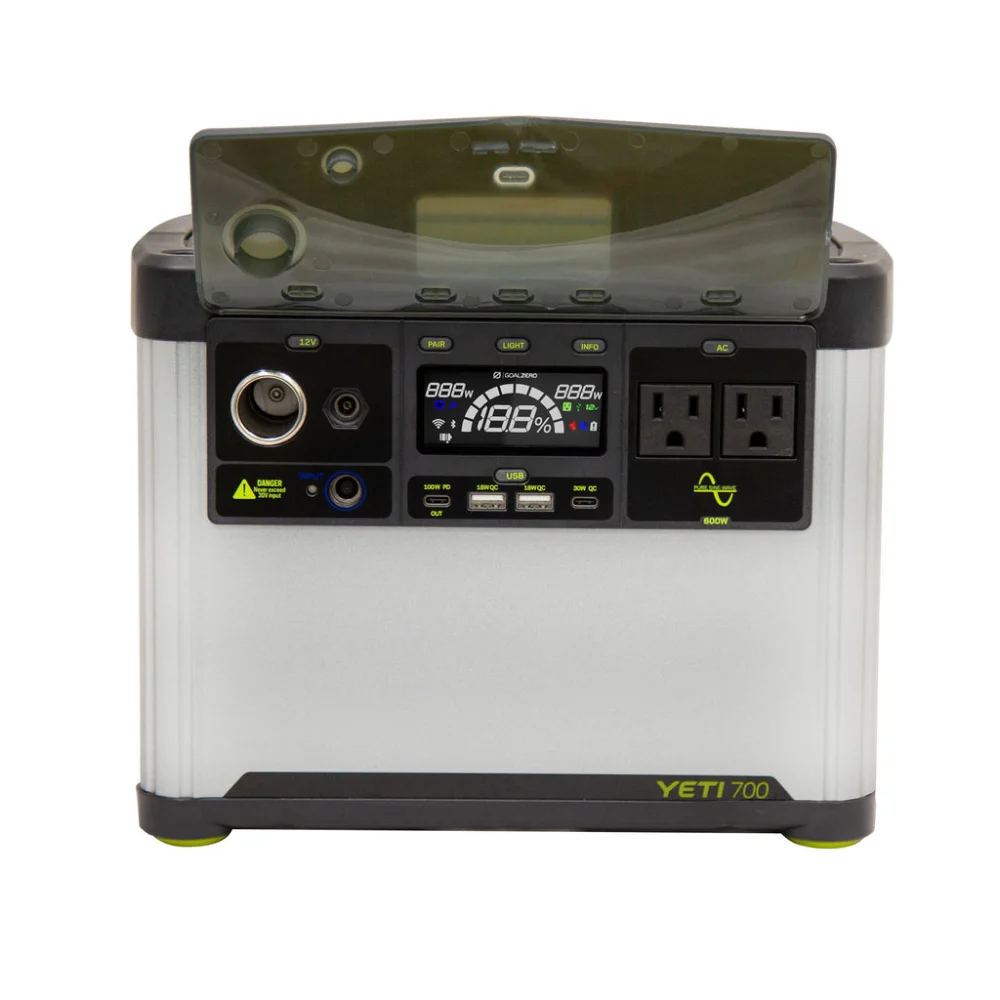

These two occupy a similar price bracket but come from very different design philosophies — Goal Zero built its reputation on rugged, outdoor-focused simplicity, while Anker SOLIX has pushed hard on raw power-per-dollar. Independent lab testing gives a clearer picture of which approach actually holds up than either brand’s own marketing does.
Quick comparison
| Spec | Goal Zero Yeti 700 | Anker SOLIX C1000 Gen 2 |
|---|---|---|
| Capacity | 677Wh claimed / 560Wh measured (83% usable) | 1,024Wh |
| Continuous output | 600W | 2,000W |
| Surge output | 1,000W | 2,400W+ |
| Weight | 21.2 lbs | 24.9 lbs |
| AC recharge time | 2.5 hours | ~48 minutes |
| Weather resistance | IPX4 rated, tested to -4°F | Not officially IP-rated |
| Price | ~$800 list | $529.99 |
Where the Yeti 700 actually wins
Independent testing from OutdoorGearLab credits the Yeti 700 with genuinely rugged build quality: an IPX4 water-resistance rating and construction tested to withstand temperatures down to -4°F, plus a collapsible handle that reviewers specifically praised for portability. For anyone doing serious cold-weather or wet-condition outdoor work — hunting camps, winter fieldwork, environments where a power station might actually get rained on or dropped in snow — that combination of tested weather resistance and cold tolerance is a real, verifiable advantage that Anker’s C1000 doesn’t officially claim to match.
Where the C1000 wins decisively
On raw capability, the gap is large. OutdoorGearLab’s own review is direct about this, noting the Anker SOLIX C1000 Gen 2 “delivers more than triple the power output” at a lower price than the Yeti 700 — and the numbers back that up: nearly double the capacity, more than 3x the continuous output, and roughly 3x faster AC recharge time. The Yeti 700 scored just 58/100 overall in OutdoorGearLab’s testing, ranking 11th of 14 units tested, with specific criticism for slow charge speed, a comparatively low surge rating, and a practical annoyance — only 2 AC outlets spaced closely enough that larger plugs can’t be used simultaneously.
What “holds up better” actually depends on
If “holds up” means physical durability and weather resistance in genuinely harsh outdoor conditions, the Yeti 700’s tested IPX4 rating and cold-weather construction give it a real, specific edge that Anker doesn’t officially match on paper. If “holds up” means delivering reliable, sufficient power across a range of real uses — running more devices, recharging faster, having headroom for higher-draw equipment — the C1000’s numbers are simply better across nearly every functional metric, at a lower price. Both use LiFePO4 battery chemistry rated for 4,000+ cycles, so long-term battery cycle life itself isn’t a meaningful differentiator between them.
Who should actually buy each one
The Yeti 700 makes sense specifically for buyers prioritizing verified weather sealing and cold-weather reliability over raw power — true outdoor/field use where the unit might face real rain, snow, or rough handling, and where 600W continuous output genuinely covers your needs (lights, small electronics, phone and radio charging). The C1000 Gen 2 makes more sense for nearly everyone else: home backup, camping with real appliance needs, faster recharge between uses, and significantly more headroom for anything with a real power draw — all at a lower price than the Yeti 700.
FAQ
Is Goal Zero’s brand reputation for ruggedness still deserved?
Based on the tested IPX4 rating and cold-weather construction, yes for weather resistance specifically — but that reputation doesn’t extend to raw power output or charging speed, where OutdoorGearLab’s testing found the Yeti 700 falling behind current competitors.
Does the C1000’s lack of an official IP rating mean it’s fragile?
Not fragile, but it means Anker hasn’t submitted it for formal water/dust ingress certification the way Goal Zero has for the Yeti line — treat it with standard care around moisture rather than assuming splash resistance.
Why does the Yeti 700 cost more despite lower specs?
Goal Zero’s pricing reflects its established outdoor-gear brand positioning and the genuine engineering investment in weather sealing and cold-weather testing, not raw power-per-dollar value, which is where newer competitors like Anker have focused instead.
Would the Yeti 700 survive being left out in genuine rain, while the C1000 wouldn’t?
Based on the tested IPX4 rating, the Yeti 700 has a real documented edge here. Without an equivalent test on the C1000, treat it as needing more deliberate protection from direct water exposure.
Bottom line
For most buyers, the Anker SOLIX C1000 Gen 2’s power, speed, and price advantage make it the stronger overall pick — a conclusion independent testing backs directly. The Yeti 700 earns its higher price only for buyers who specifically need verified weather sealing and cold-weather durability over raw capability.
This post may include affiliate links — if you buy through them, we may earn a small commission at no extra cost to you. It doesn’t change what we cover or how we rank anything. Goal Zero products are not currently available through our affiliate partner; pricing and availability should be confirmed directly with an authorized retailer.
Sources externes citées
- OutdoorGearLab — Goal Zero Yeti 700 Review