
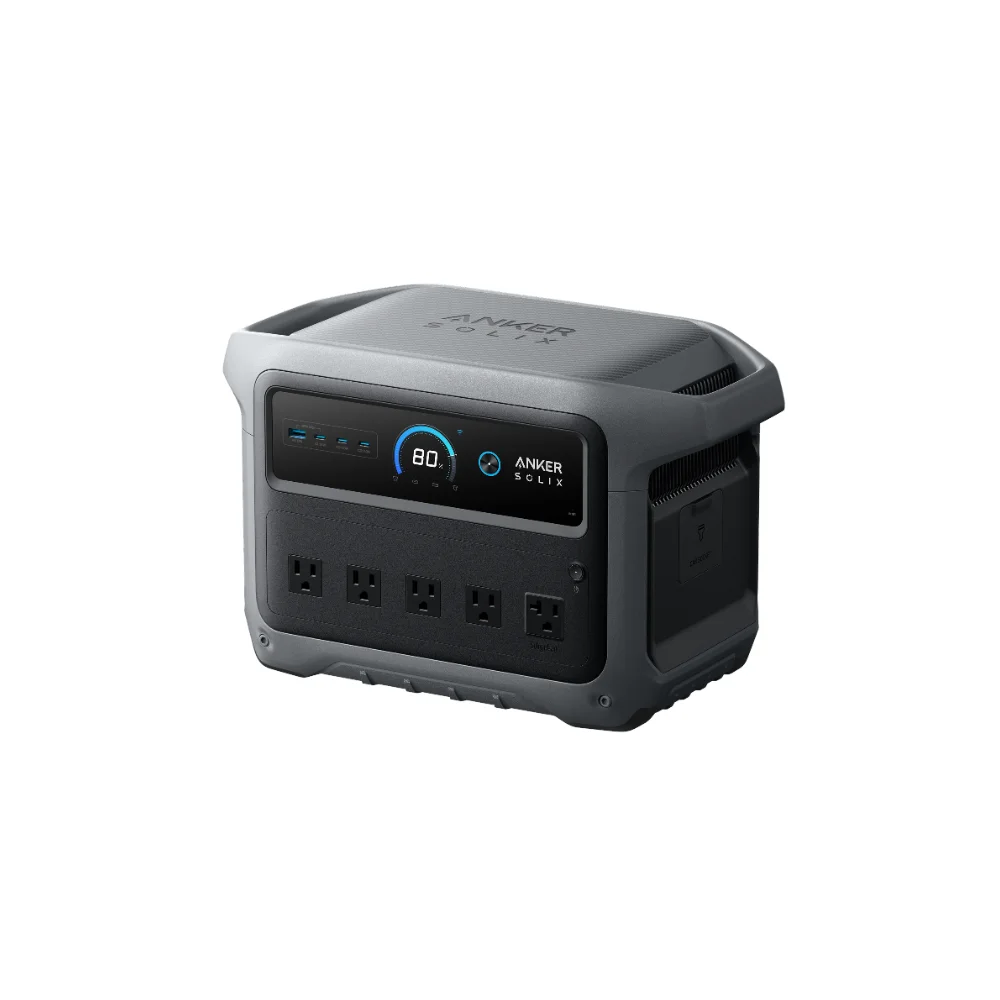
Nobody warns first-time buyers about this, and it’s caused more return-and-reorder headaches than any other issue I’ve come across researching this niche: solar panels and power stations don’t all use the same connector, and “it looks like it should fit” is not the same as “it’s actually compatible.” Let’s fix that gap.
This article may include affiliate links — if you buy through them we may earn a small commission at no extra cost to you, but our recommendations are based on our own independent research.
The Main Connector Types You’ll See
- MC4: the near-universal standard on the solar panel side, waterproof, common on most folding and rigid panels.
- XT60: common on power station solar inputs, rated up to 60A. There’s also an XT60i variant with an extra signaling pin some stations use to unlock higher charge rates.
- Anderson (SB50 and similar): common on higher-current setups, used by brands like Goal Zero on the station side.
- DC barrel connectors (DC5521, DC7909, DC8020): common on the power station side for lower-power solar inputs, especially on Jackery-style units.
Why “It Fits” Isn’t Enough
A connector that physically plugs in isn’t automatically the right match. Voltage range, current limit, and polarity all need to line up too. My take: this is the part that actually causes damage or undercharging, not the connector shape itself — a connector that “just barely” fits but doesn’t match voltage or polarity is worse than one that visibly doesn’t fit at all, because the failure isn’t obvious until something underperforms or gets damaged.
Mixing Brands: What Actually Works
Using a third-party MC4 panel with a different brand’s power station is common and usually fine — with the right adapter cable. In practice: MC4-to-XT60 covers most EcoFlow units, MC4-to-DC8mm barrel covers most Jackery units, and MC4-to-Anderson SB50 covers most Goal Zero units. The adapter cable is doing real electrical work here, not just adapting a shape — buy one rated for your actual voltage and current, not a generic bargain-bin cable.
What I’d Check Before Buying Any Panel Separately
- Your power station’s solar input connector type and voltage/current window (in the manual, not just the box)
- The panel’s output connector and voltage range
- Whether you need an adapter cable, and if so, its rated voltage/current — not just “does it fit”
Our Recommendation
If you’re buying your first setup, get the manufacturer’s matched kit and skip this entire problem. If you’re expanding an existing setup with a third-party panel, confirm connector type, voltage range, and current rating before you buy — not after the panel arrives and doesn’t charge the way you expected.
Building an Adapter Kit Instead of Buying New Cables Every Time
Once you own more than one power station or panel brand, it’s worth building a small labeled kit of the common adapters — MC4, XT60, and DC barrel in a few sizes — rather than buying a single-purpose cable every time you add a new piece of gear. A modest adapter kit — usually well under the cost of a single replacement cable bought in a panic — covers most compatibility gaps you’ll run into across mainstream brands, and having it on hand before a trip beats discovering a mismatch after you’ve already arrived at camp.
My take: this is a small, one-time investment that pays for itself the first time it saves a trip. Label each adapter clearly, since they look similar enough in a bag that guessing under pressure defeats the purpose of having them ready.
FAQ
Can I use any solar panel with any power station?
Only with the right adapter and matching voltage/current specs — connector shape alone doesn’t guarantee compatibility.
Is XT60 better than DC barrel connectors?
XT60 generally supports higher current, which matters more as your solar array gets bigger — for small single-panel setups, either works fine if properly rated.
Voltage Windows: The Number That Actually Matters Most
Every power station’s solar input has a rated voltage window, commonly something like 12-60V, printed in the manual or on a sticker near the input port. Your panel’s open-circuit voltage (Voc) needs to fall within that window, and this is where series versus parallel wiring of multiple panels matters. Wire two 20V panels in series and you get roughly 40V combined — check that against the window. Wire the same two panels in parallel instead and voltage stays around 20V while current roughly doubles instead. Get this backwards, and you either exceed the input window (in which case most stations will simply refuse to charge as a safety measure) or you undercharge because the combined voltage sits too low in the window to charge efficiently.
My honest take: this is the single most misunderstood part of solar setup for people coming from a basic single-panel kit into a multi-panel expansion. Read your specific station’s manual for its exact voltage window and wiring recommendation before you add a second or third panel — do not just assume more panels always means more charging.
Polarity: Small Mistake, Real Consequences
Reverse polarity — connecting positive to negative backwards — is one of the few genuinely damaging mistakes possible in this whole category. Most reputable power stations include reverse-polarity protection that will simply refuse to charge rather than let damage occur, but not every cheap third-party adapter cable is wired correctly, and a mislabeled or poorly made cable is the actual risk here, not the station itself. This is exactly why I keep coming back to the same advice: buy adapter cables from a reputable source with clear ratings printed on them, not the cheapest unbranded option you can find, when you are dealing with anything that carries real current into your battery.
Beyond Solar: AC, Car Charging, and Fast-Charge Ports
Connector confusion is not limited to solar input. Most power stations charge via a standard AC wall connection using a proprietary charging brick specific to that unit — losing that brick means sourcing an exact replacement, not a generic cable, so it is worth keeping track of it separately from other electronics cables in your gear. Car charging (12V/24V) typically uses a standard cigarette lighter style plug, which is fairly universal across brands, though charging speed via a car outlet is meaningfully slower than AC or solar and is best treated as a top-up method on a road trip rather than a primary charging strategy. Some newer units also support a proprietary dual-input fast-charge mode combining AC and solar simultaneously, which uses the same ports but requires checking the manual for the specific combined-charging behavior, since not every model supports true simultaneous fast charging.
A Quick Compatibility Checklist
- Confirm your station’s solar input connector type (MC4, XT60, Anderson, DC barrel size)
- Confirm the voltage window and check your panel or panel array’s combined Voc against it
- Confirm current rating of any adapter cable — not just that it physically fits
- Check polarity markings on both ends before connecting anything unfamiliar
- Keep your original AC charging brick — replacements are proprietary and can be surprisingly expensive or slow to source
What happens if my panel voltage exceeds the input window?
Most current stations have overvoltage protection that simply stops charging rather than causing damage, but this varies by manufacturer and older or cheaper units may not be as forgiving, so it is worth confirming rather than testing it accidentally.
Do I need a special connector for winter or cold-weather use?
No — connector types themselves are not temperature dependent, though cold weather does affect cable flexibility, so cheaper cables can become stiff and more prone to cracking in freezing conditions compared to better-insulated ones.
Is it worth buying a universal adapter kit with multiple connector types?
If you own or plan to own equipment from more than one brand, a quality universal adapter kit can be a reasonable one-time investment, but check individual connector current ratings within the kit rather than assuming a bundled kit automatically matches your specific power needs.
Related Reading
- Power Station Buying Checklist: 10 Questions to Ask Before You Buy
- LiFePO4 Cycle Life Explained: What 3,000+ Charge Cycles Really Means