
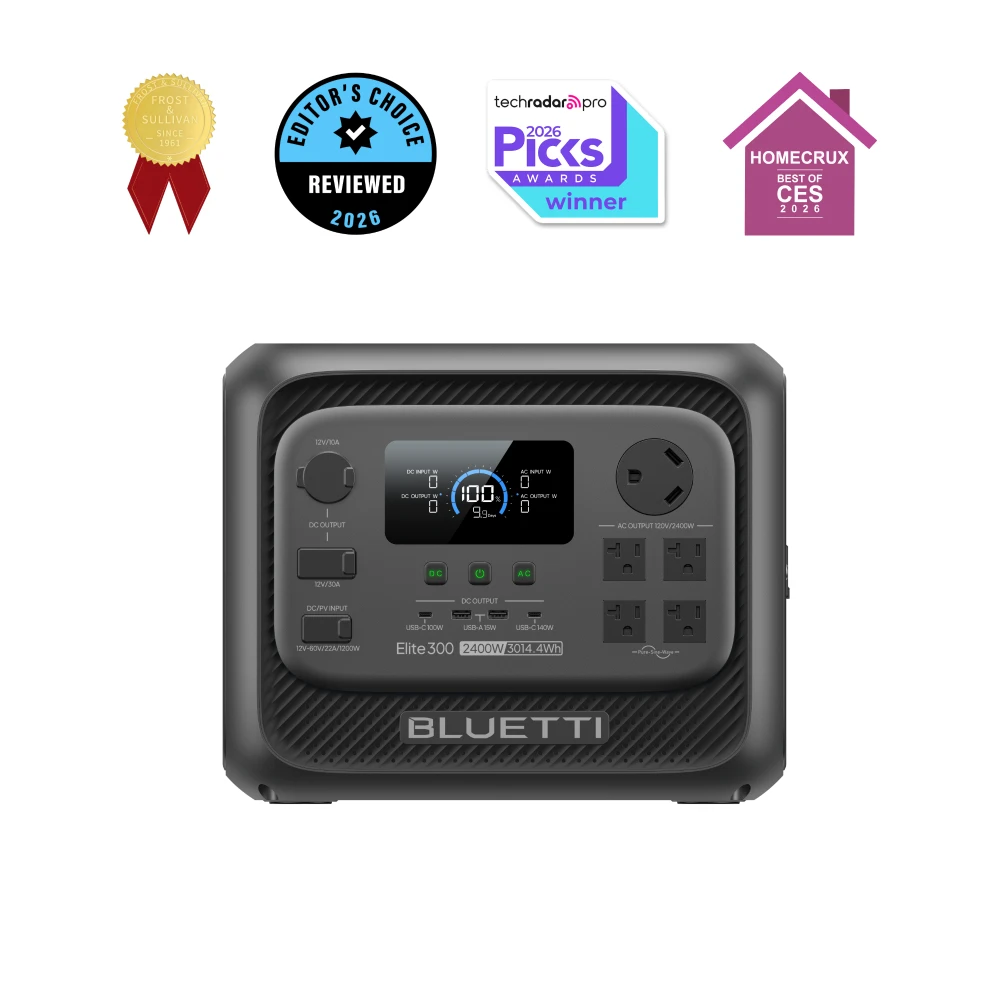

BLUETTI has released a lot of power stations over the years, but the Elite 300 is the one I keep coming back to when someone asks me for a single mid-size recommendation. It’s marketed as the “world’s smallest 3kWh” unit in BLUETTI’s lineup, and after going through its spec sheet against the rest of the Elite and AC series, I think that pitch mostly holds up. Here’s where it actually earns that reputation, and where I’d tell you to pump the brakes.
This article may include affiliate links — if you buy through them we may earn a small commission at no extra cost to you, but our recommendations are based on our own independent research.
Elite 300 Specs at a Glance
- Capacity: 3,014Wh (LiFePO4)
- Continuous output: 2,400W
- Battery chemistry: LiFePO4, rated for thousands of cycles before falling to 80% capacity
- List price: around $1,199, though BLUETTI runs frequent bundle discounts with solar panels or its Charger 2 accessory
For context, that puts it well ahead of the BLUETTI Elite 200 V2 (2,073.6Wh / 2,600W / roughly $899) and the AC200L (2,048Wh / 2,400W / roughly $899) on raw capacity, while staying in a similar physical footprint to both.
Does 3,014Wh Actually Mean 3kWh of Usable Power?
This is the question I always want answered before I care about anything else on a spec sheet. Rated capacity and usable capacity are not the same thing once you factor in inverter conversion losses, and most brands quietly leave that detail out of the marketing copy. In BLUETTI’s case, the Elite 300’s LiFePO4 pack and its stated round-trip efficiency put it in a reasonable range for the category — you should plan on losing a meaningful slice of that 3,014Wh to conversion loss during a full charge-and-discharge cycle, not the full nameplate figure. That’s true of every power station on the market, not a knock specific to BLUETTI, but it’s worth internalizing before you size your setup around the number on the box.
Charging Speed and Noise: The Part the Marketing Slides Skip
A 3kWh-class battery is only as useful as how fast you can top it back up. The Elite 300 supports both AC wall charging and solar input, and it’s compatible with BLUETTI’s Charger 2 accessory for faster car-and-solar dual charging. On paper, that flexibility is genuinely useful if you’re bouncing between home backup duty and weekend trips. What I’d flag: units in this capacity and price class from every major brand tend to run their fans harder than the spec sheet implies once you’re pulling several hundred watts continuously, and BLUETTI is no exception. If a quiet office or bedroom is where this thing will live, don’t assume silence just because the listing doesn’t mention decibels — read owner feedback on fan noise before you commit.
Ports and Real-World Usability
The Elite 300 covers the bases you’d expect at this tier: multiple AC outlets, USB-A and USB-C ports, and a 12V output, all routed through a display that’s legible enough to check status at a glance. It’s built to run a mix of small appliances at once rather than one big single load, which lines up with how most people actually use a power station — a mini-fridge and a laptop and some lighting, not a single 2,400W appliance running solo.
Who the Elite 300 Is Actually For
- Buyers who want meaningfully more runtime than a 2kWh-class unit without stepping up to a 4kWh+ home-backup box
- RV and van-life setups where you need enough capacity to run a compressor fridge overnight plus charge devices
- Anyone consolidating from a smaller BLUETTI unit and wants headroom for future appliances
Who Should Skip It
- If you only ever charge phones, tablets, and a laptop, you’re paying for capacity you won’t use — look at the Elite 100 V2 or AC180 instead
- If whole-home backup for a fridge, well pump, and lighting during multi-day outages is the goal, the Elite 300 alone probably isn’t enough; you’ll want an expandable platform
Running a Fridge and Sizing for Whole-Home Backup
The Elite 300 can comfortably run a compressor fridge for an extended stretch, which is the single most common reason people in this capacity class buy a power station in the first place. But there’s a real gap between “keeps the fridge cold overnight” and “covers a fridge, well pump, and lighting through a multi-day outage,” and it’s worth being honest about which one you’re actually planning for before you buy. If dedicated fridge backup with monitoring and longer runtime is your main use case, it’s worth comparing the Elite 300 against BLUETTI’s FridgePower, which is purpose-built around that exact job rather than being a general-purpose unit that happens to handle it well. For true whole-home coverage across several Tier 1 circuits, see our breakdown of whether one big unit or two smaller ones makes more sense for your layout, since the Elite 300 alone is a strong single-unit choice but not automatically the right foundation for an expandable system.
How the Elite 300 Holds Up Over Years of Use
LiFePO4 packs like the one in the Elite 300 are rated for thousands of charge cycles before dropping to 80% of their original capacity, but that number on a spec sheet doesn’t tell you much about what changes year to year in practice. Charge cycle counting, storage habits, and temperature exposure all affect how quickly a battery actually degrades relative to its rated figure — we cover the mechanics of this in detail in our guide to what 3,000 charge cycles really means for a unit like this one. Cold storage is another variable that catches Elite 300 owners off guard, particularly anyone keeping the unit in an unheated garage or a vehicle over winter; our piece on how cold weather affects your power station’s battery walks through what actually happens to LiFePO4 performance below freezing and how to store the unit to avoid unnecessary wear.
My Take
I like the Elite 300 for what it’s honestly trying to be: a mid-size unit that doesn’t force you to choose between “too small to matter” and “too big to carry.” It’s not the cheapest way to get 3kWh of storage, and I wouldn’t buy it expecting library-quiet operation under heavy load. But for the RV owner or the family that wants one power station to cover both weekend camping and a multi-day outage, it lands in a genuinely useful spot in BLUETTI’s lineup. If your budget stretches further and you want more headroom, it’s worth cross-shopping against BLUETTI’s own AC180 for lighter, cheaper needs, since paying for capacity you’ll never draw down is the most common mistake I see people make in this category.
Frequently Asked Questions
Is the BLUETTI Elite 300 worth it over the AC200L?
The Elite 300 offers more capacity (3,014Wh vs 2,048Wh) at a similar continuous output, making it the better pick if runtime matters more to you than saving a few hundred dollars. If your loads are modest, the AC200L still covers a lot of ground for less.
Can the Elite 300 run a full-size refrigerator?
It can run a compressor fridge for an extended stretch, but “full-size for days” is a home-backup job better suited to BLUETTI’s larger, expandable Apex or Elite 400+ platforms.
How long does the LiFePO4 battery in the Elite 300 last?
LiFePO4 cells are generally rated for thousands of charge cycles before dropping to 80% of original capacity, which in practical terms means years of regular use before you’d notice meaningful degradation.
Is the Elite 300 loud enough to be a problem indoors?
Under light loads it’s quiet enough for most indoor use, but the internal fans ramp up noticeably once you’re pulling close to the 2,400W continuous limit or running a fast charge. If you’re planning to keep it in a bedroom or a small apartment during an outage, treat the fan noise as a real factor rather than an afterthought, and check current owner reviews for the latest word on how loud it gets under sustained load.
Can I add solar panels to the Elite 300?
Yes, it accepts solar input alongside AC wall charging, and pairing it with BLUETTI’s Charger 2 accessory speeds up combined car-and-solar charging. For extended off-grid stretches or multi-day outages where wall power isn’t an option, solar is what keeps the Elite 300’s 3,014Wh capacity from being a one-time buffer instead of a renewable source you can lean on repeatedly.
How does the Elite 300 compare to competitors outside the BLUETTI lineup?
Against similarly sized units from other brands, like the Anker SOLIX F2000, the comparison usually comes down to expandability, app ecosystem, and price per watt-hour rather than any single unit being dramatically better. The Elite 300’s main edge is BLUETTI’s own expandable Elite and Apex platforms if you think you’ll want to grow capacity later; if you’re set on a single fixed-capacity unit with no plans to expand, it’s worth cross-shopping a few brands at this exact capacity tier before deciding.
Related Reading
- Bluetti Premium 100 V2 Review: Compact Power for Everyday Use
- Best Portable Power Stations of 2026: Our Top 5 Picks Ranked
- Lithium-ion vs LiFePO4 Batteries in Portable Power Stations: What’s the Difference?
Khalid Zirari is the founder of Marjajo, where he researches and compares portable power stations, solar generators, and related backup power gear to help readers cut through spec-sheet marketing and find the right fit for their needs.