
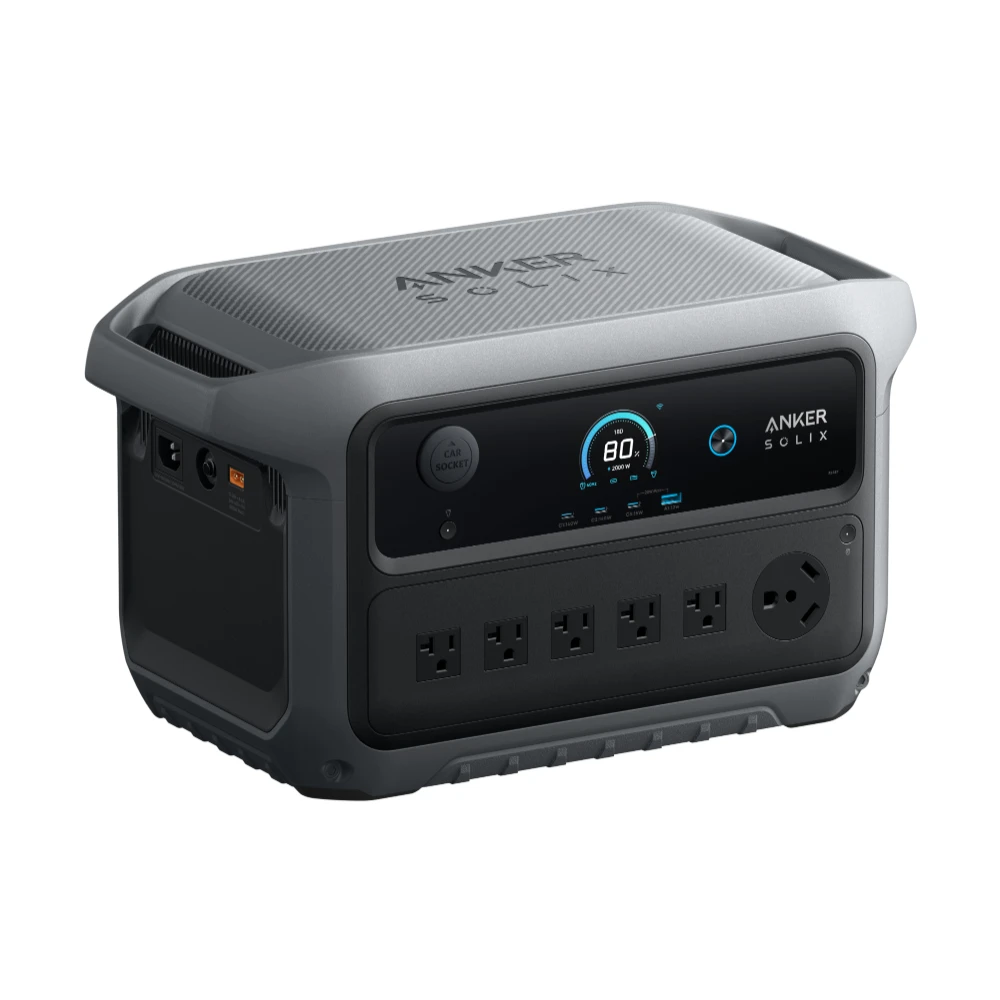

The Anker SOLIX F2000 has been out long enough now that the question isn’t “is it fast” or “does it have enough ports” — reviewers answered that in the first month. The real question is whether it holds up. I pulled together what independent testers have measured, what three-month ownership reviews report, and what shows up in owner forums when something actually goes wrong, instead of just restating the spec sheet.
Short version: the core hardware checks out. StorageReview’s hands-on testing measured roughly 1,870Wh of usable output from the 2,048Wh rated capacity — about 91% efficiency, which is normal and healthy for a LiFePO4 inverter system, not a red flag. BackupPowerHub’s three-month ownership test across van life, home backup, and medical-device use came back positive on real-world performance. The two consistent complaints across sources are the companion app (described as “unpolished”) and the unit’s weight. And in at least one documented case on a DIY solar forum, an owner reported a failed inverter component — worth knowing about, even though a single report isn’t a pattern.
What it actually is
| Spec | Value |
|---|---|
| Capacity | 2,048Wh LiFePO4 (expandable to 4,096Wh with the BP2000 add-on battery) |
| Output | 2,400W continuous, 3,600W surge |
| AC charging speed | 0–80% in about 1.4 hours |
| Weight | ~62–67 lbs depending on configuration and source measured |
| Warranty | 5 years (per StorageReview’s testing notes) |
What independent testing found
StorageReview’s hands-on review put real numbers behind the marketing: the unit needed about 2,300Wh of input energy to reach a full charge and delivered roughly 1,870Wh of usable output afterward. That gap is normal charge/discharge loss for LiFePO4 systems, not a defect — but it’s useful to know your real-world usable capacity is closer to 1,870Wh than the 2,048Wh printed on the box. Their overall take was positive: a comprehensive off-grid solution with a clear display, solid case build, and an LED light bar they called genuinely well designed.
What a longer ownership test found
BackupPowerHub’s review is useful specifically because they tested across three months rather than an initial unboxing, covering van life, stationary home backup, and medical device use. Their conclusion: the LiFePO4 longevity claims held up under real use rather than being pure marketing, and for anything stationary, the unit’s weight (a common complaint) simply doesn’t matter. Their two flagged weaknesses were the mobile app — called unpolished, with connectivity issues — and build details like port cover durability. Neither is a dealbreaker, but they’re worth factoring in if app-based monitoring matters to how you plan to use it.
What shows up when something actually fails
No power station in this category has a perfect record, and the F2000 is no exception. A thread on DIY Solar Forum documents one owner’s report of a failed inverter component. We can’t verify the exact cause from the outside, and a single reported failure doesn’t establish a reliability pattern across a product line that’s sold in meaningful volume — but it’s a real, citable data point, and it’s exactly the kind of thing worth searching for yourself before you buy any power station, not just this one. If you go this route, register the unit and keep your proof of purchase; see our warranty comparison for what Anker’s coverage actually includes.
Who it makes sense for
- Stationary home backup — the weight complaint that shows up in every review stops mattering once the unit lives in one spot.
- Van life and overlanding where 2,400W continuous output covers most onboard appliances, and the BP2000 expansion option gives a path to more capacity later instead of buying a second unit outright.
- Anyone monitoring life-support or medical equipment should treat the app’s reported connectivity issues seriously and test the physical display and alerts rather than relying on phone notifications alone.
What We’d Want to See Before Fully Recommending It Long-Term
Being direct about the gaps: our confidence in this unit’s long-term reliability is based on independent testing plus a three-month ownership window, not a multi-year track record. That’s meaningfully more evidence than a spec sheet alone, but it’s still short of the kind of five-year field data that would let us make a stronger long-term durability claim. If you’re the type of buyer who wants maximum certainty before committing to a higher-capacity purchase like this one, waiting for more accumulated ownership data (ours or from other independent sources) is a reasonable, conservative choice — the unit isn’t going anywhere, and neither is the broader SOLIX F-series.
How It Sits Alongside Anker’s Current Lineup
Anker has expanded its SOLIX line considerably since the F2000 launched, and it’s worth knowing where this unit sits relative to newer options rather than assuming it’s been fully superseded. The SOLIX C1000 Gen 2, for instance, targets a different niche — faster charging and a more compact footprint at somewhat lower capacity — rather than directly replacing the F2000’s higher-capacity, expansion-battery-compatible design. Our Anker SOLIX C1000 Gen 2 review covers that model in detail if you’re cross-shopping within Anker’s own current lineup rather than deciding between brands. The practical takeaway after this long-term look at the F2000: it remains a reasonable choice specifically for buyers who value capacity and expansion-battery compatibility over the fastest possible charge speed, which newer models in the lineup have increasingly prioritized.
Sizing a Whole-Home Setup Around This Unit
If you’re considering the F2000 (with or without the BP2000 expansion) as the core of a whole-home backup strategy, it’s worth thinking through whether one larger unit or a distributed setup with multiple smaller units better fits how your home actually uses power during an outage. A single F2000-plus-expansion setup centralizes your backup capacity in one place, which simplifies management but means the whole household depends on one unit staying healthy. Our comparison of one big power station vs. two smaller ones walks through that tradeoff in more detail, which is directly relevant background before committing to an expansion-battery strategy built around a single high-capacity unit like this one.
FAQ
Is 2,048Wh enough for a few days of home backup?
For essentials — a fridge, some lighting, phone charging, and a router — yes, for roughly a day per full charge depending on your loads. For whole-home backup over multiple days, you’re looking at the BP2000 expansion or a different capacity class entirely.
Does the reported inverter failure mean I should avoid the F2000?
Not on its own. One documented forum report across a widely sold product isn’t statistically meaningful. It’s a reason to register your unit and understand the warranty process before you need it, not a reason to rule the product out.
How does it compare to Anker’s own newer SOLIX models?
Anker’s newer lines (like the C-series with InfiniPower™) push warranty length further on paper. The F2000 remains a capacity-and-output-focused unit rather than the brand’s longest-warranty option — check current model pages before assuming terms carry over.
Is the BP2000 expansion battery worth adding later, or should I buy it upfront?
If you’re confident you’ll want the extra capacity eventually, buying the expansion bundle upfront is usually better value than buying it separately later, since bundles are commonly discounted versus the sum of the individual components. If you’re unsure you’ll need it, starting with the base unit and adding the expansion only if you find yourself capacity-constrained is the lower-risk path.
How has this unit held up beyond the initial three-month review period?
We continue to track long-term ownership reports and forum discussion for this model as part of our ongoing coverage, and we’ll update this review if a clearer pattern emerges beyond the single documented failure report referenced above.
Does the F2000 support solar charging, and how fast?
Yes, it accepts solar input at a meaningful rate for its capacity class, though as with any power station, exact recharge time from solar depends on your panel wattage and available sunlight rather than a single fixed number.
Bottom line
The Anker SOLIX F2000’s hardware performs close to its claims in independent testing, and a three-month ownership review found the longevity story holds up in practice. The app is the software weak point worth knowing about going in, and the one documented forum failure report is worth reading, not worth panicking over. For most stationary and van-life use cases, the published data supports it as a solid pick in its capacity class.
This post may include affiliate links — if you buy through them, we may earn a small commission at no extra cost to you. It doesn’t change what we cover or how we rank anything.