
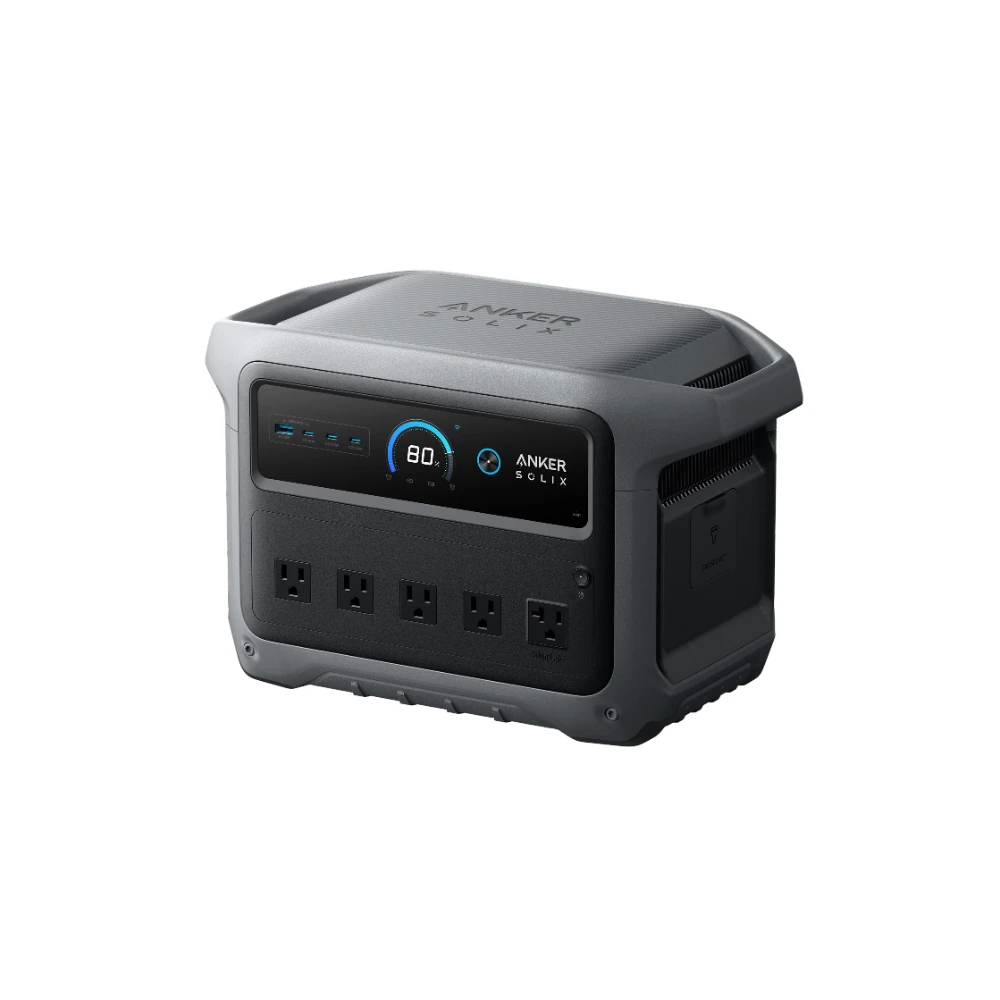

Anker’s SOLIX line has been chasing the “smallest, fastest” crown in the 1kWh class for a couple of generations now, and the C1000 Gen 2 is the version that finally made me stop recommending its predecessor by default. It’s not a bigger battery than before — it’s the same 1,024Wh capacity — but almost everything around that battery got faster, lighter, or better engineered. Here’s what actually changed, and where Anker made a trade-off I think buyers should know about upfront.
Anker SOLIX C1000 Gen 2 Specs at a Glance
- Capacity: 1,024Wh (LiFePO4)
- Continuous output: 2,000W (up from 1,800W on the original C1000), 3,000W peak
- Charging: UltraFast mode claims 0–100% in about 49 minutes from a wall outlet
- Weight: roughly 24.9–25 lbs, about 4 lbs lighter than the original
- Cycle life: rated to retain 80% capacity after roughly 4,000 cycles
- Price: around $449 at list, though it’s frequently discounted
Why the Charging Speed Number Actually Matters
A lot of “fast charging” claims in this category are marginal improvements dressed up as breakthroughs. Anker’s UltraFast mode on the C1000 Gen 2 is a real, noticeable jump — going from empty to full in under an hour could change how you use one of these things day to day. Instead of planning your charging around an overnight window, you can top it off during a lunch break or between errands. That’s the kind of practical improvement that matters more than most spec-sheet bragging rights.
Lighter, But Not Just for the Sake of It
Shaving roughly 4 lbs (about 14%) off the previous generation sounds minor until you’re the one carrying it to a campsite or up a flight of stairs during an outage. Anker achieved this partly through GaN (gallium nitride) power electronics, which run cooler and more efficiently than traditional silicon components. The side benefit of GaN is less heat to dissipate, which generally means less aggressive fan behavior — a detail that matters if you’ve ever been annoyed by a power station’s cooling fan running non-stop.
The Trade-Off: No More Expansion Battery
Here’s the part that doesn’t make it into most marketing pages: to hit this smaller, lighter footprint, Anker removed the expansion port that let the original C1000 double its capacity with an add-on battery. The Gen 2 is a fixed-capacity unit — what you buy is what you get, permanently. If you specifically wanted a 1kWh starter unit with the option to scale up later, that path is closed on this model. It’s a reasonable trade for most buyers who just want a compact, fast-charging unit, but it’s a real limitation if you had expansion plans.
Ports and Everyday Usability
The C1000 Gen 2 spreads its 2,000W across nine total ports, enough to run a genuinely useful mix of devices at once — laptops, a mini-fridge, phones, and small kitchen appliances without constantly unplugging one thing to plug in another. The AC outlets use pure sine wave output, which matters if you’re running sensitive electronics or medical devices like a CPAP machine.
Who Should Buy the C1000 Gen 2
- You want the fastest realistic recharge time in the 1kWh class
- Weight and portability matter as much as capacity
- You don’t need to scale capacity up later with an add-on battery
Who Should Look Elsewhere
- If expandability is a priority, look at Anker’s larger SOLIX units or a competing brand that still supports add-on batteries at this capacity tier
- If your loads regularly exceed 2,000W continuous, you’ll want to size up rather than push this unit to its limit
My Take
I like what Anker did here more than I expected to. Losing the expansion port is a real trade-off, not a marketing footnote, and I want to be upfront about that rather than glossing over it the way some spec-sheet comparisons do. But for the buyer this unit is actually built for — someone who wants a fast-charging, lightweight, grab-and-go 1kWh station and isn’t planning to scale up later — the C1000 Gen 2 is one of the more genuinely improved second-generation products I’ve looked at in this category recently. It’s not trying to be everything to everyone, and that focus shows.
How It Compares to Anker’s Higher-Capacity F2000
Within Anker’s own lineup, the C1000 Gen 2 and the higher-capacity F2000 target genuinely different priorities rather than one simply being a smaller version of the other. The C1000 Gen 2 leads with charging speed and a lighter, more portable build; the F2000 leads with raw capacity and expansion-battery compatibility for buyers who need to scale up over time. If you’re deciding between the two, the honest question is whether fast recharge and portability or maximum capacity and future expandability matters more for how you’ll actually use the unit — our long-term reliability review of the F2000 covers that higher-capacity option in the kind of ownership detail that complements this review.
Against Smaller Options for Trips That Don’t Need 1,024Wh
If you’re specifically comparing the C1000 Gen 2 against smaller, more packable units for camping or trip-specific use — rather than home backup — it’s worth being honest that this unit’s capacity and weight are overkill for some trip types. For tent camping trips where you’re not running a fridge or heavier accessories, a smaller unit like EcoFlow’s RIVER 3 Plus covers the same basic charging needs at a fraction of the weight and cost. Our head-to-head RIVER 3 Plus vs. Anker SOLIX C1000 Gen 2 comparison walks through exactly which trip profiles justify the C1000 Gen 2’s extra capacity and which don’t.
Frequently Asked Questions
Is the Anker SOLIX C1000 Gen 2 worth upgrading from the original C1000?
If fast charging and lower weight matter to you and you never used the expansion port on the original, yes. If you’re relying on add-on battery capacity, stick with the original C1000 or look at a different expandable platform.
Can the C1000 Gen 2 run a CPAP machine all night?
Yes — a CPAP machine draws a small fraction of the C1000 Gen 2’s 1,024Wh capacity and 2,000W output, so it should comfortably last through the night with plenty of headroom for other devices.
How long does the battery actually last?
Anker rates the LiFePO4 pack to retain about 80% of its original capacity after roughly 4,000 charge cycles, which for most households translates to many years of regular use before you’d notice meaningful degradation.
What does a 4,000-cycle rating actually mean in real-world years?
It depends entirely on how often you fully cycle the battery. Someone who does a full charge-discharge cycle weekly is looking at well over a decade before reaching that cycle count; someone charging and discharging daily reaches it faster. Our explainer on LiFePO4 cycle life and what 3,000+ charge cycles really means covers how to translate a cycle rating into a realistic lifespan estimate for your own usage pattern.
Does the faster charging speed mean the battery degrades faster over time?
Fast charging does generate somewhat more heat than slow charging, and heat is the primary driver of long-term battery degradation, but manufacturers accounting for fast-charge support generally engineer the battery management system to manage that heat within safe limits — it’s a factor Anker’s own testing and cycle-life rating already account for, not a hidden downside you need to separately worry about.
Is the C1000 Gen 2 a good choice for someone buying their first power station?
It’s a solid, capable option for a first purchase if your budget supports it, but a first-time buyer with a smaller budget or genuinely lighter power needs might be better served starting with a smaller, less expensive unit and upgrading later once they have a clearer sense of their actual usage patterns, rather than buying at this capacity tier immediately.
Related Reading
- Anker SOLIX C2000 Gen 2 Review
- Best Portable Power Stations of 2026: Our Top 5 Picks Ranked
- Continuous vs Peak Power: What These Numbers Actually Mean
This post may include affiliate links — if you buy through them, we may earn a small commission at no extra cost to you. It doesn’t change what we cover or how we rank anything.
Khalid Zirari is the founder of Marjajo, where he researches and compares portable power stations, solar generators, and related backup power gear to help readers cut through spec-sheet marketing and find the right fit for their needs.