
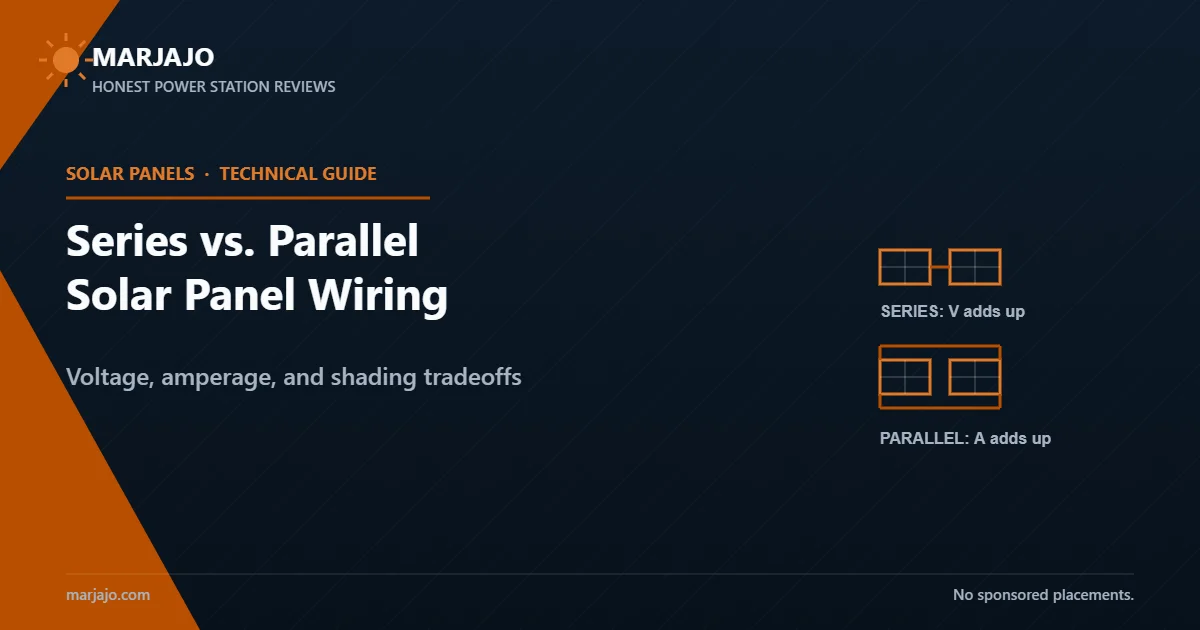

If you own more than one solar panel for your power station, how you wire them together — series or parallel — changes the voltage and current your power station actually receives, and getting it wrong can mean charging slower than you should, or in rare cases, exceeding your unit’s input limits. The concept is simpler than it sounds once you separate what each wiring method actually does to the numbers.
The core rule
| Wiring method | What happens to voltage | What happens to amperage |
|---|---|---|
| Series | Adds up across panels | Stays the same as one panel |
| Parallel | Stays the same as one panel | Adds up across panels |
A concrete example makes this click: connect three 6V panels in series, and you get 18V total output (3 × 6V) with the amperage unchanged. Connect those same three panels in parallel instead, and if each produces 3A, you get 9A total (3 × 3A) while the voltage stays at 6V. Same panels, same total wattage either way — but very different voltage and current numbers reaching your power station’s charging port, which matters because every power station has separate voltage and amperage limits on its solar input, not just a single watt ceiling.
Why shading affects each method so differently
This is where the choice actually matters in real-world use. In a series string, if one panel gets shaded and its output drops, it doesn’t just lose its own contribution — it constrains the entire string, since current is limited by the weakest panel in the chain. A partially shaded panel producing less current forces the whole series string down toward that lower number, even though the other panels could theoretically produce more. In a parallel configuration, panels operate more independently: if one panel is shaded for part of the day, the rest of the array keeps producing at full output, and only the shaded panel’s individual contribution drops. If your setup regularly deals with partial shade — tree cover, changing cloud patterns, panels at different angles — parallel wiring is meaningfully more forgiving.
Trade-offs beyond shading
Series wiring has real advantages where shading isn’t a concern: it needs less cabling since current stays low (thinner, cheaper wire can carry it), and it tends to perform better in low-light conditions like dawn and dusk because higher voltage strings can push past a charge controller’s minimum voltage threshold more easily. Its downside beyond shading vulnerability is that a single failed or disconnected panel can take down the entire string’s output. Parallel wiring avoids that single point of failure and handles mixed lighting better, but requires additional connectors and thicker cabling to handle the higher combined amperage, and your power station’s input hardware needs to be rated for that higher current.
Matching wiring to your controller and power station
MPPT (Maximum Power Point Tracking) charge controllers, which most modern power stations use, handle a range of input voltages efficiently and generally work well with either series or parallel setups, provided you stay within the unit’s rated voltage and amperage window. Simpler PWM controllers are more voltage-sensitive and typically pair better with parallel configurations kept close to the battery’s native voltage. Check your specific power station’s solar input specs before wiring multiple panels — as a real example, EcoFlow’s DELTA Pro supports up to 1,600W of solar input across four 400W panels, and up to 3,200W when paired with a second unit, but exceeding a unit’s rated input voltage (typically by over-wiring panels in series) can trigger a safety cutoff rather than actually charging faster.
A hybrid “series-parallel” approach — wiring pairs of panels in series, then connecting those pairs in parallel — is common precisely because it balances the two approaches: enough voltage for efficient charging, enough current redundancy to reduce shading’s impact on the whole array.
FAQ
Can I mix panels of different wattages in the same array?
You can, but it’s not ideal — in series, the lowest-current panel limits the whole string; in parallel, mismatched voltages between panels can cause inefficient charging. Matching identical panels avoids these issues entirely.
How do I know my power station’s solar input limits?
Check the spec sheet for maximum solar input voltage (Voc) and amperage, usually listed alongside the maximum input wattage — exceeding either the voltage or current limit, not just the wattage total, is what actually risks tripping a safety cutoff or damaging the input circuit.
Does wiring in series or parallel change my panels’ total wattage?
No — total wattage (volts × amps) is the same either way for the same set of panels under identical sun conditions. Wiring method changes how that wattage is delivered (voltage vs. current), not the total amount available.
Is series or parallel better for portable, foldable panel setups?
Most factory-made foldable multi-panel kits are pre-wired by the manufacturer, usually in series for cable simplicity, and are designed to work within a specific power station’s input range out of the box — you generally don’t need to rewire these unless you’re combining separate kits.
Bottom line
Series wiring gives you higher voltage with the same current, which helps in low light but is fragile under partial shade. Parallel wiring keeps voltage steady while adding current, which handles uneven shading far better but needs beefier cabling. Check your power station’s input voltage and amperage limits before wiring multiple panels together, and lean toward parallel or hybrid series-parallel setups if shading is a regular factor at your charging location.
This post may include affiliate links — if you buy through them, we may earn a small commission at no extra cost to you. It doesn’t change what we cover or how we rank anything.