
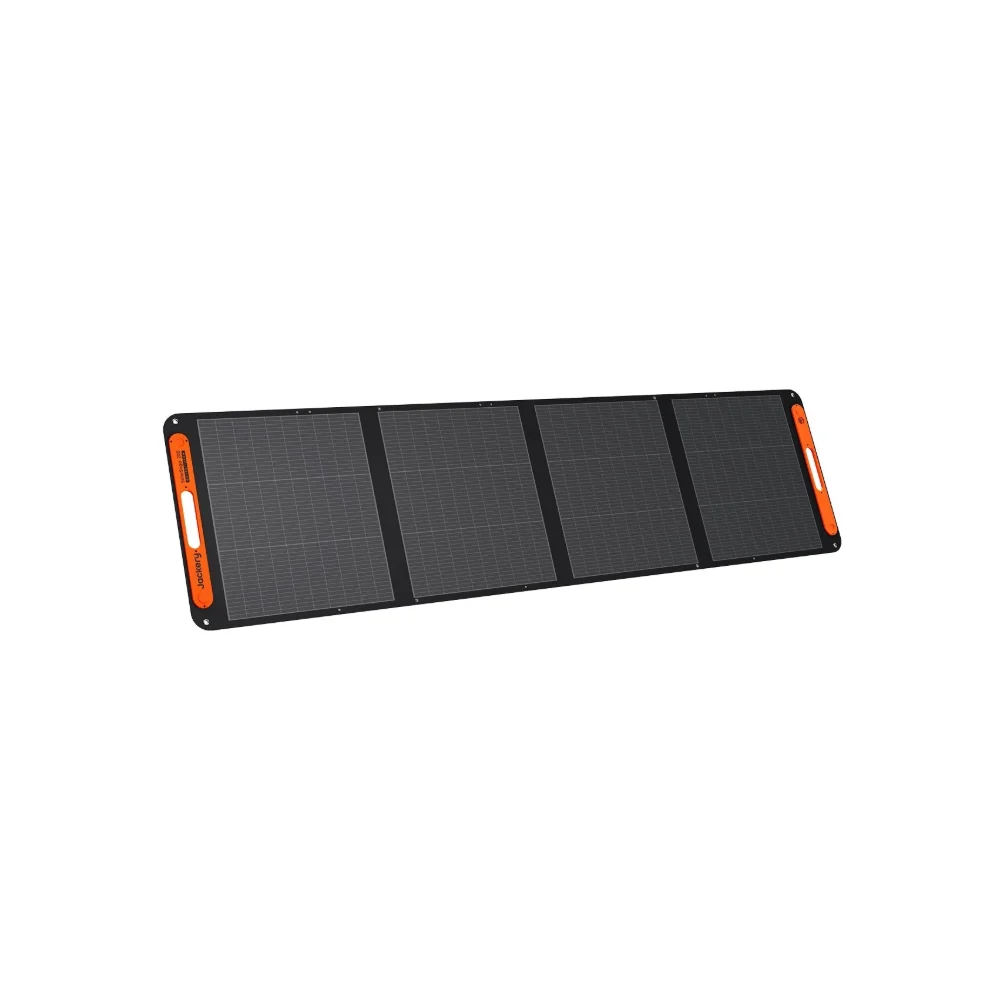

Most people buy solar panels the same way they buy TVs — bigger number, better, done. Then they get to a campsite, plug in a 100W panel to a 2,000Wh power station, and wonder why the battery bar barely moves after a full day of sun. Sizing solar for a power station isn’t complicated, but it does require actual numbers, not vibes. You need to know how much energy you use in a day, how many usable hours of sun you’ll realistically get, and how much of a panel’s rated wattage survives contact with the real world. Skip any one of those three and you’ll either overspend on capacity that sits idle or end up perpetually running a deficit. Here’s the math, worked through with real examples.
Step 1: figure out your daily energy use in watt-hours
Every device has a wattage rating, usually on a label or in the manual. Multiply that wattage by the hours you actually run it per day, and add everything up. A few common examples:
- A CPAP machine drawing 40W for 8 hours overnight uses about 320Wh a day.
- A 12V portable fridge rated at 50W doesn’t run constantly — it cycles on and off to hold temperature, so figure roughly 30-40% duty cycle, meaning a 50W fridge running 24 hours might only draw 350-500Wh, not the 1,200Wh a naive 24-hour multiplication would suggest.
- Charging a laptop once from near-empty is typically 50-90Wh depending on battery size.
- A string of LED camp lights at 10W run for 4 hours is 40Wh — small, but it adds up alongside everything else.
Add every device’s daily watt-hours together to get your total daily load. This number is what your solar setup needs to replace every day to keep you indefinitely off-grid, rather than slowly draining your power station’s reserve over a multi-day trip.
Step 2: know your realistic peak sun hours
“Peak sun hours” is a way of compressing a full day of variable sunlight into an equivalent number of hours at maximum intensity (1,000 W/m²). It is not the same as daylight hours. Most of the continental US averages somewhere between 3 and 6 peak sun hours a day depending on season, latitude, and local cloud cover — the desert Southwest sits at the high end, the Pacific Northwest and New England in winter sit at the low end. If you don’t know your area’s number, a conservative planning figure of 4 peak sun hours works reasonably well for most of the country outside of winter in northern latitudes.
Step 3: account for real-world derating
A panel’s rated wattage is a lab number. In the field, expect to lose output to a few unavoidable factors: imperfect angle to the sun through most of the day, cells running hotter than the 25°C test standard (which reduces output), dust or haze, and small resistive losses in cables and connectors. A reasonable planning assumption is that a panel delivers about 70-80% of its rated wattage across an average day of use, even with decent positioning. This isn’t a flaw in any particular panel — it’s true of foldable panels from every brand.
Putting it together: the formula
Panel wattage needed = Daily watt-hour use ÷ (peak sun hours × 0.75)
Worked example: say your daily load is 800Wh (fridge, lights, phone and laptop charging, a fan) and you’re camping somewhere that gets 4.5 peak sun hours. That’s 800 ÷ (4.5 × 0.75) = roughly 237W of panel needed just to break even each day. Round up to the next practical panel size — a single 300W-class panel, or a 200W panel plus a smaller supplemental one, would keep you ahead rather than exactly at breakeven, which matters on a cloudy day. For that load, something like the BLUETTI PV350 gives you real headroom above breakeven instead of running the math razor-thin.
Sizing for different scenarios
- Weekend camping, phones and lights only: daily loads under 200Wh need very little — even a 100W panel like the Jackery SolarSaga 100W Air can keep up in a few hours of midday sun.
- Extended van life or off-grid living with a fridge and CPAP: daily loads of 1,000-1,500Wh call for 300-400W of panel minimum, and that’s assuming decent sun — a panel like the Anker SOLIX PS400 is sized for exactly this kind of daily-replacement math.
- Emergency home backup, topping off between grid outages: you’re less concerned with daily breakeven and more with recharging a large battery as fast as possible when the sun is out, which argues for maxing out your power station’s solar input ceiling rather than sizing to a daily load.
Frequently asked questions
Should I size solar to my power station’s battery capacity or my daily energy use?
Daily energy use, not battery capacity. The battery is your buffer for cloudy days and nighttime; the panel’s job is to replace what you use each day. Sizing purely to battery capacity often leads to buying either far more or far less panel than you actually need.
What if I can’t find my exact peak sun hour number?
Use 4 peak sun hours as a conservative year-round planning number for most of the continental US outside of deep winter in the north. It will slightly undersize your setup for summer in the Southwest and slightly oversize it for winter in New England, but it’s a safe default in the absence of local data.
Is it better to buy one large panel or two smaller ones?
Two smaller panels give you flexibility — you can angle them independently toward different parts of the sky, or run just one when your needs are lower — but add complexity in cabling and connectors. A single larger panel is simpler to set up and stow. Either works as long as the combined wattage matches your calculated need and stays within your power station’s solar input ceiling.
What happens if my panel is bigger than my power station’s solar input limit?
Nothing breaks — the power station simply caps the input at its own maximum and the excess panel capacity goes unused. It’s not dangerous, just inefficient, since you paid for wattage you can’t actually deliver into that particular battery.