
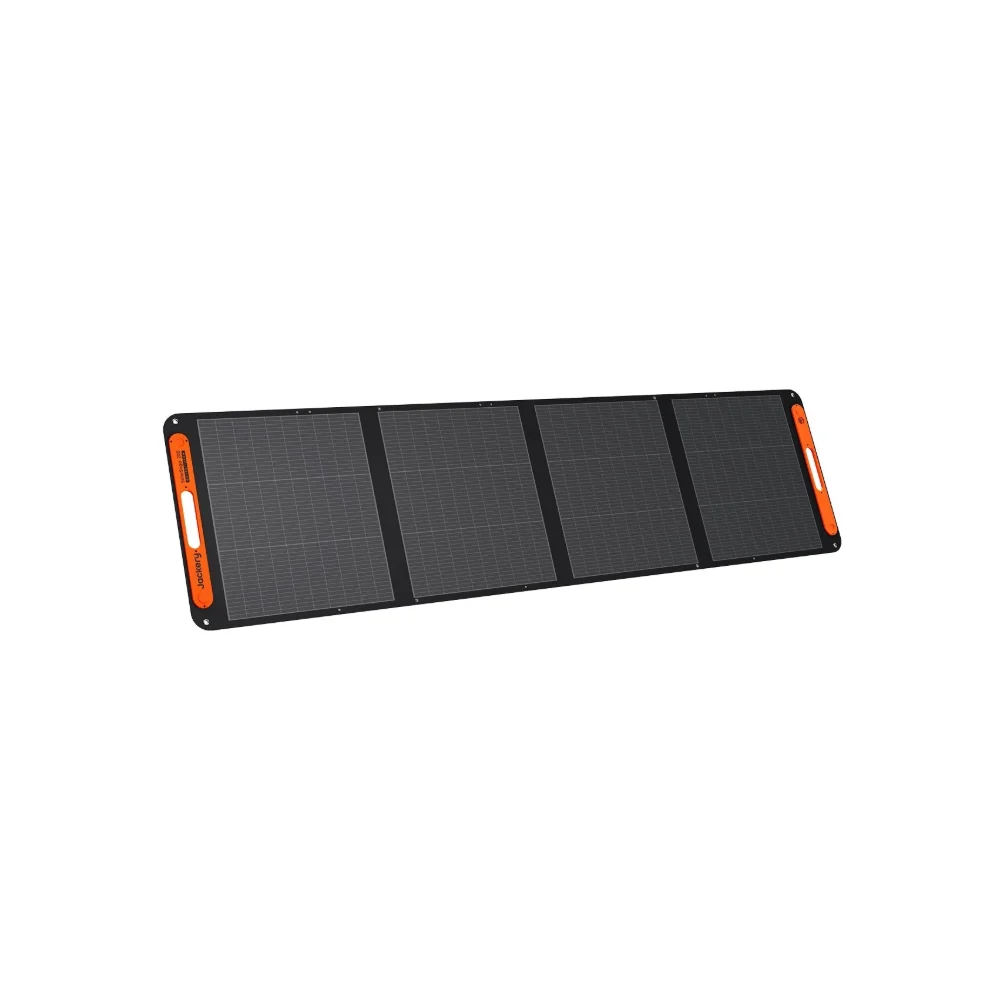

A single tree branch’s shadow falling across the corner of your solar panel shouldn’t matter much — it’s covering maybe 10% of the surface, so you’d expect to lose maybe 10% of your output. Instead, you might watch your charging rate collapse by half or more. That’s not a defective panel. It’s how series-connected solar cells behave under partial shade, and it’s the reason bypass diodes exist inside nearly every panel you’ll buy. Understanding this mechanism changes how you think about panel placement — a small shadow in the wrong spot does far more damage than a large shadow spread evenly, and knowing why helps you avoid the setups that quietly waste your charging time.
Why cells are wired in series in the first place
A single solar cell only produces about half a volt. To get a panel up to a usable voltage — the 18-40V range typical of portable panels — dozens of cells are wired in series, like batteries stacked end to end in a flashlight. In a series circuit, the same current has to flow through every cell in the chain. That works fine when every cell is producing equally. It breaks down the moment one cell can’t keep up.
What happens when one cell is shaded
A shaded cell can’t generate as much current as its unshaded neighbors, but the series circuit is still trying to push the same current through it. The stronger cells around it effectively force current through the weak cell anyway — and because that cell can’t handle it as a normal generator, it gets driven into reverse bias, where it behaves less like a solar cell and more like a resistor burning off the mismatch as heat. This is what’s known as a hot spot, and in a bad enough case it can physically damage the cell or its laminate over time. Critically, this isn’t limited to the shaded cell losing its own small contribution — the entire series string it’s part of gets bottlenecked down toward that one weak cell’s reduced current output, dragging down everything connected in series with it.
What a bypass diode actually does
A bypass diode is wired in parallel across a group of cells — typically covering a substring of somewhere around a dozen or more cells rather than every individual cell, since a diode per cell would be impractical and expensive. During normal, unshaded operation, the diode sits idle, reverse-biased and doing nothing, because the cells it’s guarding are all producing current normally. The moment one cell in that substring gets shaded and starts being pushed into reverse bias, the voltage conditions flip and the bypass diode turns on. It gives the current an alternate path around the entire shaded substring, rather than forcing it through the compromised cells.
- It protects the panel from heat damage. By giving current a way around the weak substring, the diode limits how much reverse voltage the shaded cells actually see, keeping hot-spot heating well below what it would otherwise be.
- It does not restore lost power. The entire substring the diode bypasses stops contributing to the panel’s output while it’s active — you don’t get partial credit for the unshaded cells in that same substring. This is exactly why a small shadow can cause an outsized drop: it’s not losing the shaded cell’s share, it’s losing that whole substring’s share.
- More substrings generally means better shade tolerance. A panel divided into more, smaller bypass-diode substrings loses less total output when a small shadow hits it, since only the affected substring — not a larger one — gets bypassed.
What this means for how you set up a panel
- A small shadow across a line of cells is worse than the same shadow spread as a light haze over the whole panel. Concentrated shade knocks out entire substrings; evenly diffused light loss (like thin cloud) reduces every cell a little without triggering the bypass mechanism at all.
- Scout for moving shadows, not just current ones. A branch, guy-line, or your own tent that will cast a shadow across the panel an hour from now is just as much a problem as one doing it right now — reposition before it happens, not after you notice the charging rate has dropped.
- If part of your setup is unavoidably shaded, isolate it rather than covering the whole panel. If you’re running two panels and one location is partly shaded, it’s often better to move that entire panel elsewhere and consolidate full sun on fewer panels than to spread partial shade across all of them.
Frequently asked questions
Do all portable solar panels have bypass diodes?
Effectively all reputable panels do — they’re a basic protective component, not a premium feature. If a panel doesn’t have them, shading risks real heat damage to the cells over time, not just lost output.
Can I fix a shading problem by adding more bypass diodes myself?
No — bypass diode placement is built into the panel’s internal wiring during manufacturing and isn’t something you can retrofit or add to safely. The practical fix for shading is always positioning, not modifying the panel.
Does a small amount of dirt or dust on the panel act like shading?
Light, even dust reduces output roughly proportionally without triggering the same hot-spot mechanism, since it dims cells fairly evenly rather than blocking some completely. A thick patch of mud or debris concentrated on one area, though, can behave more like a real shadow. Regular wiping keeps this a non-issue either way.
Why does my power station’s charging wattage jump around so much even in steady sun?
Small moving shadows — a swaying branch, a passing cloud edge — trigger and release bypass diodes in real time, which shows up as visible jumps in charging wattage on your power station’s display. This is normal behavior, not a fault, and it’s a useful signal that something nearby is intermittently shading the panel.