
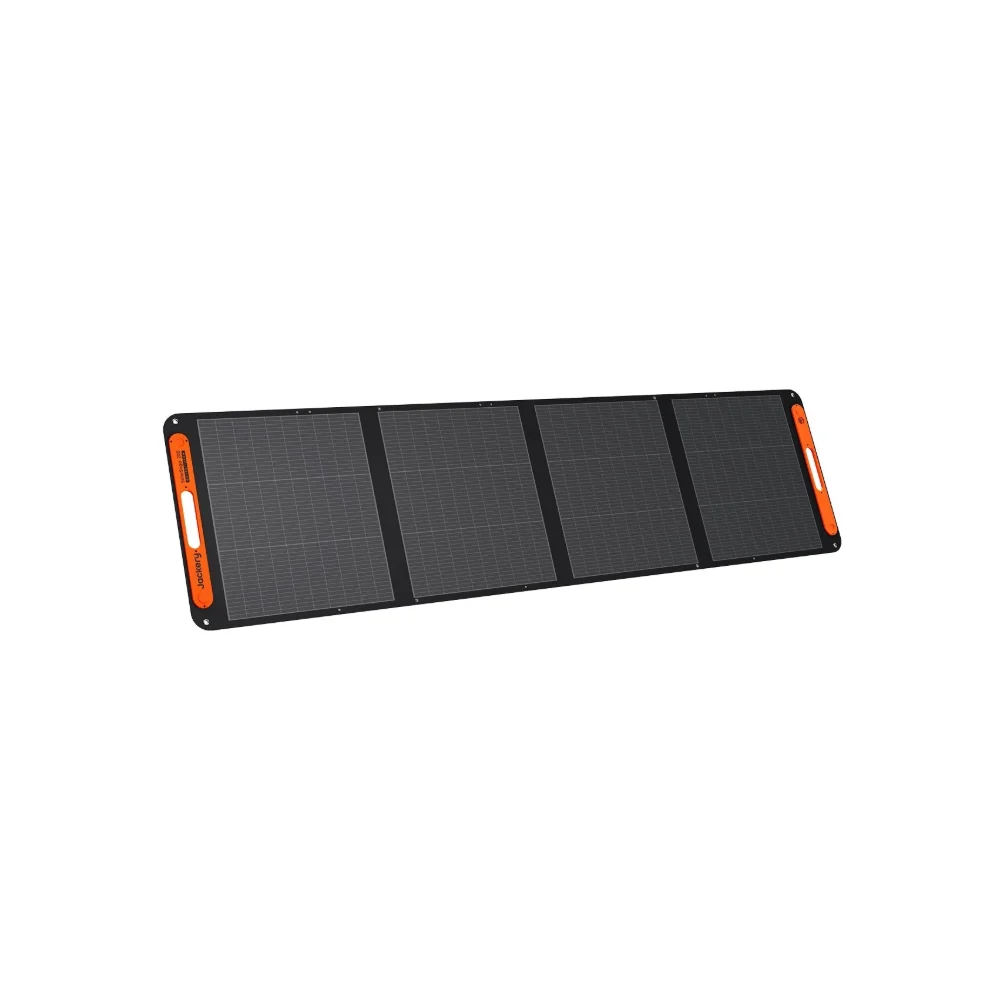

Ask ten RV owners whether to bolt panels to the roof or carry a foldable one, and you’ll get ten different answers — because there isn’t one right answer. Rigid roof-mount panels and foldable portable panels aren’t really competing products; they solve different problems, and a lot of experienced RV owners end up running both. The decision comes down to how you park, how often you move, and whether you’re willing to trade setup convenience for the ability to chase shade and sun independently of where your rig happens to be sitting. Here’s how the two actually compare once you get past the marketing.
Rigid roof-mounted panels: the case for them
- They charge while you drive and while you’re away from the rig. A roof panel is generating power any time the sun’s out, with zero setup — no unfolding, no running cables out a window, no packing up before you leave a spot.
- Nothing to steal, lose, or forget outside. A permanently mounted panel isn’t sitting in a campsite where it could walk off, and you can’t accidentally drive away and leave it behind.
- Higher total wattage over time in typical use. Because it’s always deployed and charging without you having to think about it, a roof array often ends up contributing more cumulative energy over a trip than a foldable panel that only comes out when you remember to set it up.
- The tradeoffs are real, though. A fixed roof angle means you’re stuck with whatever orientation the RV happens to be parked in — you can’t chase the sun or dodge shade from a tree without physically moving the whole vehicle. Installation is also more involved, typically requiring roof penetrations or adhesive mounts, and rated wattage is capped by usable roof space.
For owners committing to a permanent or semi-permanent roof setup, panels like the Anker 440W rigid panel 2-pack or the Rich Solar MEGA 200W monocrystalline panel are built for exactly this kind of fixed installation, with the rigidity and mounting points a roof setup calls for.
Foldable portable panels: the case for them
- You can chase the sun independently of the rig. Park in the shade to keep the RV cool, and set the panel out in a sunny spot 20 feet away — something a roof panel simply can’t do.
- No permanent modification to the vehicle. Nothing to drill, glue, or wire into the RV’s roof — useful for renters, leased rigs, or anyone who wants to keep resale value untouched.
- Easy to scale up or down trip to trip. Bring one panel for a solo weekend, two for an extended family trip — a foldable setup flexes with your actual needs in a way a fixed roof array can’t.
- The tradeoffs: it requires setup and teardown every time, and it’s only generating power when someone remembers to deploy it and aim it — sitting folded in a storage bay does nothing.
For this role, something like the EcoFlow 400W portable panel gives serious wattage without a permanent commitment, while the Jackery SolarSaga 500 X suits owners who want to push charging speed even higher on the days it’s worth setting up.
Why a lot of experienced RV owners run both
A modest rigid roof array covers baseline needs — keeping a fridge and basic electronics topped up without any daily effort — while a foldable panel comes out on high-demand days, or when the rig is parked somewhere the roof panels can’t get good sun. This combination hedges against the biggest weakness of each approach: the roof array’s fixed angle and the foldable panel’s dependence on someone actually setting it up. A budget-friendly way to add roof capacity without overcommitting is a two-panel rigid kit like the EcoFlow 100W rigid panel 2-pack, paired with a foldable panel for the days you need more.
How to decide for your situation
- Full-time or extended-stay RVers who park for weeks at a time generally get more value from rigid roof panels, since the setup effort pays off over long stationary periods.
- Weekend or occasional RVers who move frequently often do better with foldable panels alone, since a roof array’s advantage shrinks when you’re rarely parked in one place long enough for a fixed angle to matter much.
- Anyone who frequently boondocks under trees or in shaded sites benefits disproportionately from a foldable panel’s ability to be moved into open sun away from the vehicle.
Frequently asked questions
Can I run a foldable panel and a roof array into the same power station or battery system at once?
In many setups yes, as long as you stay within your charge controller’s or power station’s combined solar input limit and the wiring is done correctly. Check the total combined wattage against your system’s maximum solar input before running both simultaneously.
Do rigid panels really outlast foldable ones?
Generally yes, in relative terms — rigid panels have no hinges or fold points to wear out and are built for permanent outdoor exposure. Foldable panels are engineered to be more durable than they look, but the folding mechanism and softer lamination are the parts most likely to show wear first.
Is roof installation something I can do myself?
Many RV owners do install rigid roof panels themselves, but it typically involves roof penetrations or adhesive mounting, running wire into the cabin, and connecting to a charge controller — it’s a more involved project than plugging in a foldable panel, and doing it wrong risks leaks. If you’re not confident with the process, professional installation is worth the cost.
Will a rigid roof panel void my RV’s warranty?
It depends on the manufacturer and how the installation is done — roof penetrations in particular can be a warranty concern with some RV makers. Check your specific warranty terms before drilling into the roof, and consider adhesive-mount options if warranty preservation matters to you.