
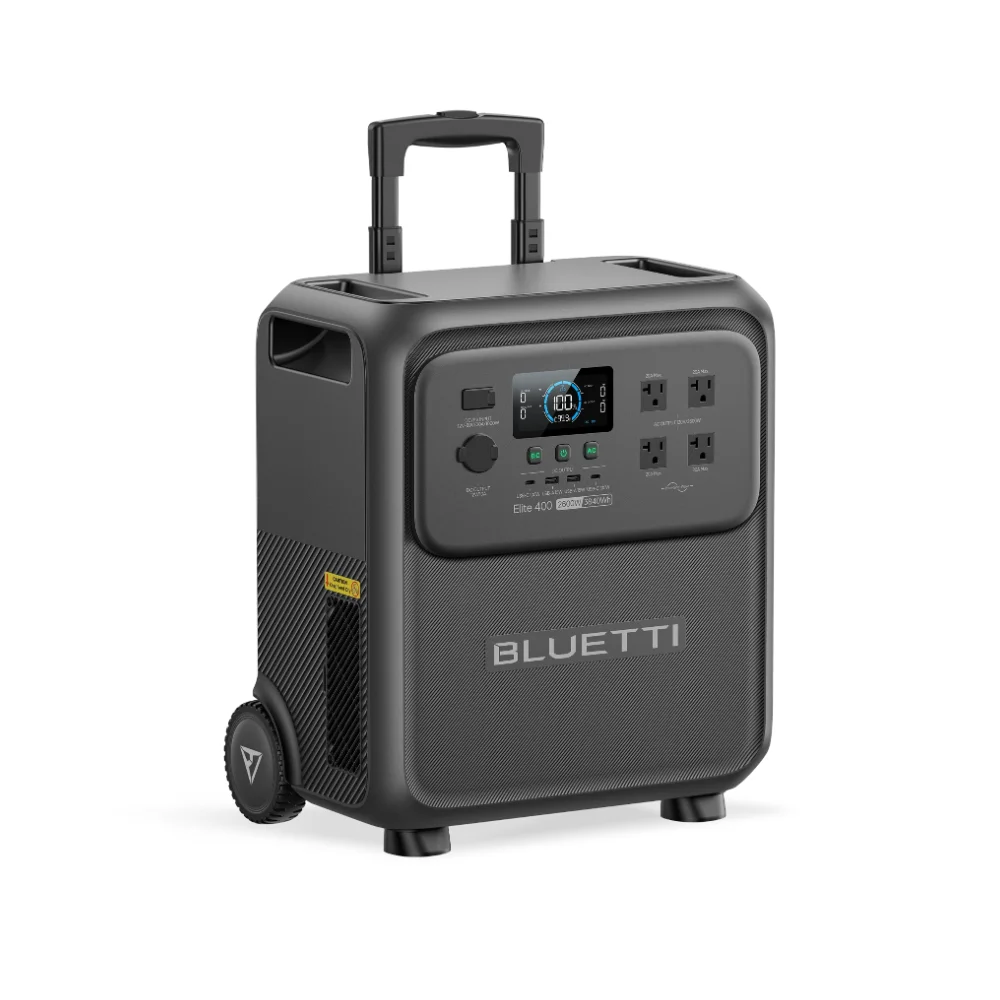

The Bluetti Elite 400 is rated at 3,840Wh — but a battery’s rated capacity and what you actually get to use are never quite the same number, thanks to inverter losses and battery management overhead. Rather than repeat Bluetti’s marketing spec sheet, this rounds up what independent testers actually measured when they ran the Elite 400 under real loads.
Rated vs. measured capacity
BackupPowerHub’s review calculated usable capacity using the standard 90% LiFePO4 efficiency factor, arriving at 3,456Wh effective from the 3,840Wh rated figure — a fairly typical derate for this battery chemistry. Notebookcheck’s independent lab testing measured something closer to real-world variability: under a continuous 250W AC draw, the unit delivered approximately 3,130Wh, or just under 82% of rated capacity — but at a much higher 1,800W load, efficiency actually improved to roughly 93%. That’s a genuinely useful finding for buyers: efficiency on this unit isn’t a flat number, and lighter, longer-duration loads can measure lower than heavier, shorter ones, which runs against the intuition that using less power should always be more “efficient” in the capacity-recovery sense.
Real appliance runtime estimates
| Appliance | Estimated runtime | Power draw |
|---|---|---|
| Mini-fridge | ~32 hours | 120W avg |
| 10x LED lights | ~640 hours | 6W avg |
| 65″ TV + router | ~27 hours | 140W avg |
| Laptop | ~85 charges | 45W avg |
These BackupPowerHub estimates are based on the 3,456Wh effective capacity figure, so treat them as a reasonable planning baseline rather than a guarantee — your specific appliances’ actual draw will vary from these averages.
Output and charging performance
Both reviews agree on the core output specs: 2,600W continuous AC output, with Notebookcheck measuring 3,900W peak and 5,200W surge protection in testing. Charging is genuinely fast for a unit this size — Notebookcheck measured a full charge in just over 2 hours via AC input up to 2,300W, with combined AC+DC input reaching up to 3,300W. BackupPowerHub’s testing found 0-80% in 70 minutes using the dual charger setup, and roughly 6 hours to full charge via two 350W solar panels in optimal sun. Notebookcheck also measured overall charging efficiency at 87% when drawing 4,400Wh from the wall to reach a full charge — a useful number if you’re calculating your actual electricity cost to recharge the unit, not just its rated capacity.
Weight and portability
At roughly 39kg (about 86 lbs), the Elite 400 is heavy in absolute terms, but Notebookcheck’s comparison found it notably lighter than some similarly sized competitors — about 10kg lighter than the EcoFlow DELTA Pro 3, and slightly lighter than the Anker SOLIX F3000 despite the F3000 holding just under 1kWh less capacity. Bluetti offsets the weight with a rolling design and telescopic handle, which both reviews describe as functional, though BackupPowerHub notes the rolling design itself adds weight compared to more compact, non-wheeled alternatives in the same capacity class.
Where it falls short
BackupPowerHub’s review flags a few real limitations worth knowing before buying: no expansion battery support, unlike some modular competitors that let you add capacity over time; it can’t run central HVAC systems given its output ceiling; and UPS (uninterruptible power supply) protection requires the unit to already be connected and pre-positioned before an outage starts, rather than being able to instantly jump in from a cold start.
FAQ
Is an 82-93% efficiency range normal for a LiFePO4 power station?
Yes — a 10-20% efficiency loss between rated and usable capacity is typical for lithium power stations due to inverter conversion losses and battery management overhead. The Elite 400’s range falls within normal expectations for the category.
Why did efficiency improve at higher loads in Notebookcheck’s test?
Inverters often have a “sweet spot” load range where they operate closer to peak efficiency; very light loads can spend proportionally more energy on baseline conversion overhead relative to the actual output delivered.
Is the Elite 400 a good fit for whole-home backup?
It handles a strong subset of home essentials (fridge, lights, TV, devices) for a day or more based on the runtime tests, but its output ceiling rules out central HVAC — a good match for selective-circuit backup, not whole-home coverage.
Can I add more capacity to the Elite 400 later?
Based on BackupPowerHub’s review, no — this specific model doesn’t support expansion batteries, so buy for the capacity you’ll actually need rather than planning to scale up later.
Bottom line
Independent testing broadly confirms Bluetti’s core specs on the Elite 400, with usable capacity landing in the 82-93% range of the 3,840Wh rating depending on load, and genuinely fast charging for the size class. The tradeoffs are real too: no expansion capability and a rolling design that adds weight compared to leaner alternatives. For selective home backup rather than whole-home coverage, the numbers hold up.
This post may include affiliate links — if you buy through them, we may earn a small commission at no extra cost to you. It doesn’t change what we cover or how we rank anything. This review is based on independent published testing, not first-hand long-term use of the Elite 400.
Sources externes citées
- BackupPowerHub — BLUETTI Elite 400 Review: 3,840Wh Rolling Home Backup
- Notebookcheck — Bluetti Elite 400 XXL Powerstation Review