
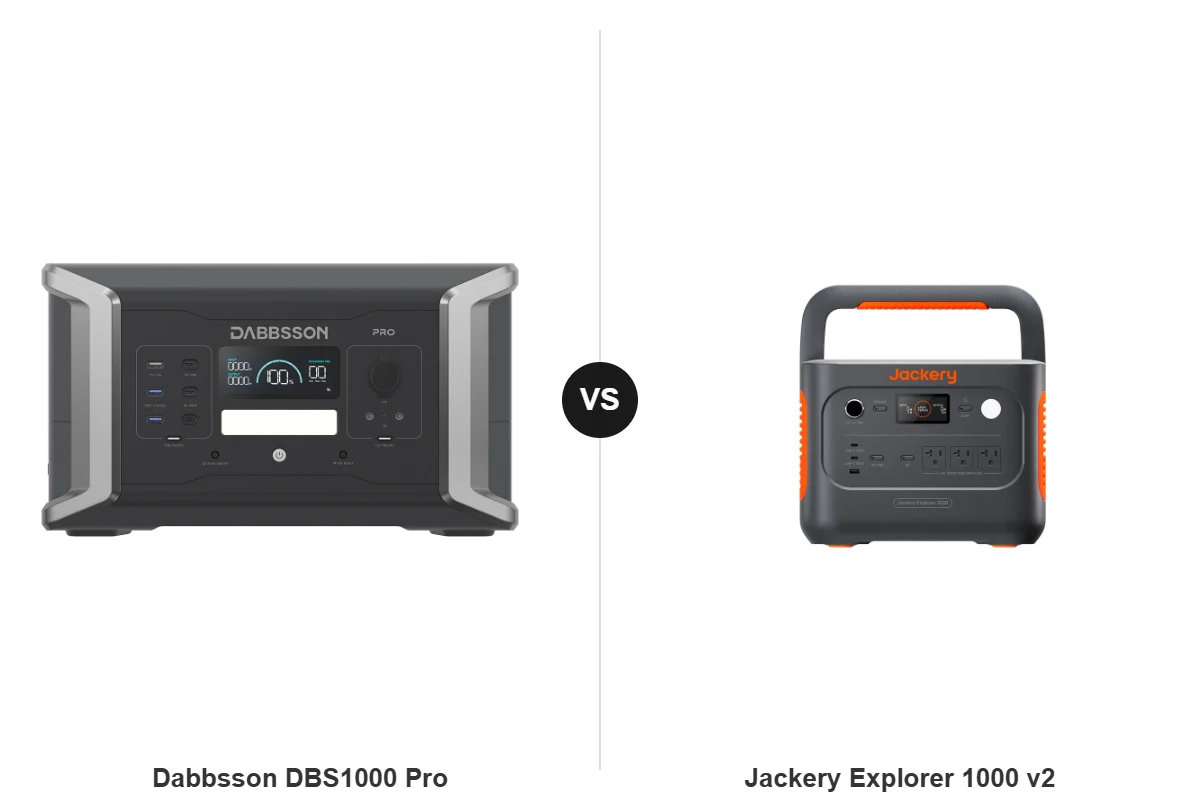

A note on “long-term” here: Dabbsson is a newer entrant compared to Jackery, EcoFlow, Anker, and Bluetti, and the DBS1000 Pro hasn’t been on the market long enough to generate the multi-year ownership data those established brands have. What follows is an honest aggregation of published hands-on testing and manufacturer specs — not a claim of years of personal ownership, since no independent source has that data yet either.
The core specs
| Spec | Value |
|---|---|
| Base capacity | 1,024Wh (expandable to 5kWh with add-on packs; up to 10,240Wh with two units + max expansion) |
| AC output | 2,000W continuous, 4,000W surge |
| Weight | 16kg (~35 lbs) |
| Inverter efficiency | 90% |
| AC recharge | Under 1 hour (80% in ~50 minutes at 1,200W input, per hands-on testing) |
| Price | $899 MSRP (frequently discounted to $541-$759) |
What testers actually found
TechRadar’s review highlighted the unit’s inverter power and battery capacity relative to its compact footprint (43×25×25cm, under 28 liters) as standout traits for the price, calling it a strong option for “a low-cost compact power station with an option to expand the battery capacity.” Geeky Gadgets’ hands-on weekend camping test reported the DBS1000 Pro “outperformed expectations,” running a portable fridge, laptop, and small electric grill simultaneously without issue, with 80% AC recharge in about 50 minutes and a full solar charge via MPPT in roughly 1.5 hours under good sun — both quick numbers for this capacity class.
Build quality and battery technology claims
The unit uses reinforced aluminum alloy construction with fire-retardant materials, which Geeky Gadgets’ tester noted gave confidence for rugged outdoor handling. Dabbsson markets the DBS1000 Pro’s battery as “semi-solid-state” LiFePO4 technology, with manufacturer claims of 4,500+ charge cycles and a 15-year projected lifespan — notably higher than the roughly 3,000-cycle figures common on standard LiFePO4 units from other brands. It’s worth being direct about this: that’s a manufacturer projection based on lab cycling tests, not something any independent reviewer has verified through 15 years of real ownership, since the product simply hasn’t existed that long. Treat it as a promising spec to watch play out, not a guarantee.
App, UPS mode, and everyday usability
The Dabbsson companion app supports both Wi-Fi and Bluetooth monitoring and was described as accessible and intuitive in hands-on testing, with a UPS (uninterruptible power supply) mode achieving under 15ms battery switchover — fast enough to keep sensitive electronics running through a brief outage without a noticeable interruption. Built-in AI-assisted battery management is marketed as protecting against overload, overheating, and over-discharge, with no reported failures across the testing referenced here — though again, that’s testing measured in weeks, not years.
What we’d want to see before calling this “proven” long-term
The honest gap in the record right now: no independent multi-year ownership reports, no data on how the expansion battery connections hold up after repeated add/remove cycles over time, and no real-world confirmation of the 4,500-cycle/15-year battery claim outside Dabbsson’s own lab testing. None of that means the unit is unreliable — it means the track record is still being written, which is a fair thing to know before betting a long-term home backup plan entirely on a newer brand versus an established one with a longer public history.
FAQ
Is Dabbsson a reputable brand, or a newer/riskier one?
Newer relative to Jackery, EcoFlow, Anker, and Bluetti — it doesn’t have those brands’ years of accumulated owner reports, but early hands-on testing and specs have been consistently positive so far.
Can I trust the 4,500-cycle battery life claim?
It’s a specific, checkable number rather than vague marketing, which is a good sign, but it’s currently based on manufacturer lab testing rather than independently verified long-term use.
Is the expansion battery system worth it over buying one larger unit upfront?
If your power needs might grow over time, expandability lets you scale gradually rather than committing to a large single purchase — a genuine advantage for buyers who aren’t sure yet how much capacity they’ll ultimately want.
How does the DBS1000 Pro compare to similarly priced Jackery or Anker units?
On paper, its output-to-capacity ratio and expansion options are competitive with established brands at a similar price point — the meaningful difference right now is track record length, not raw specs.
Bottom line
Early testing on the Dabbsson DBS1000 Pro is genuinely positive — strong output for its size, fast charging, and a thoughtful expansion system — but “long-term reliability” claims for this specific unit are still resting on manufacturer projections rather than years of independent ownership data. It’s a reasonable buy on current merits; just go in knowing the multi-year track record other brands have isn’t there yet for this one.
This post may include affiliate links — if you buy through them, we may earn a small commission at no extra cost to you. It doesn’t change what we cover or how we rank anything. This review is based on independent published testing and manufacturer specifications, not first-hand long-term ownership of this unit.
Sources externes citées
- TechRadar — Dabbsson DBS1000 Pro Compact Power Station Review
- Geeky Gadgets — Dabbsson DBS1000 Pro and DBS2000B Hands-On Review