
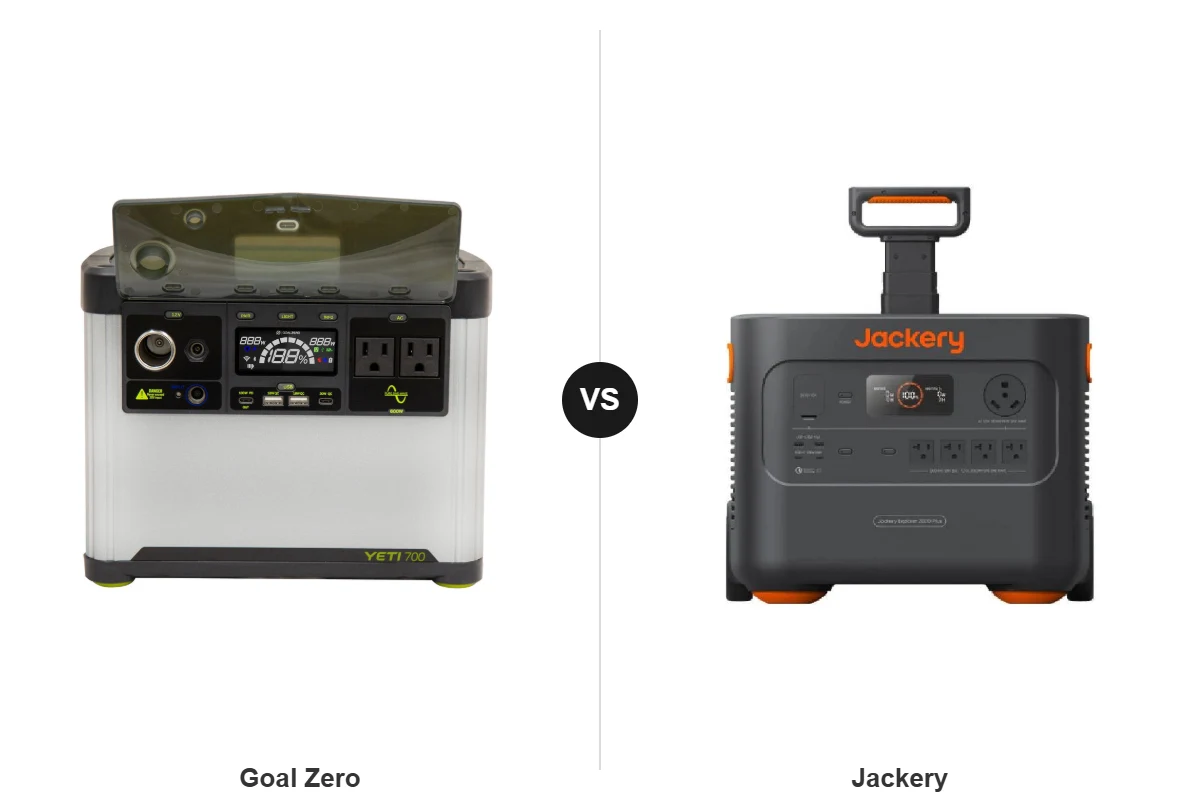

Goal Zero vs Jackery: Which Brand Makes the Better Power Station?
Goal Zero and Jackery are two of the names that come up constantly when people start researching power stations, and they get compared against each other more than almost any other pair in this category. I dug into how the two brands actually stack up, spec for spec, rather than just going on reputation.
This article may include affiliate links — if you buy through them we may earn a small commission at no extra cost to you, but our recommendations are based on our own independent research.
Capacity and Output, Head to Head
At the comparable tier, the Goal Zero Yeti 1000X carries 983Wh against the Jackery Explorer 1000’s 1,002Wh — close enough that it’s a non-factor in most buying decisions. Where it gets more interesting is weight: the Yeti is roughly 15lbs heavier than the equivalent Jackery, despite the near-identical capacity. If portability matters to you at all, that’s not a small gap.
Inverter Technology: An Important Asterisk
Here’s a detail that doesn’t get enough attention in most comparisons: Jackery uses pure sine wave inverters across its entire lineup. Goal Zero only does the same on its larger units — the Yeti 6000X, 3000X, 1500X, 1000X, and 500X — but not on the smaller Yeti 200X. If you’re looking at Goal Zero’s entry-level units, that’s worth knowing, since pure sine wave output matters for sensitive electronics like CPAP machines and some laptop chargers.
Price and Weight, Overall
Across the board, Jackery’s lineup tends to run noticeably cheaper and a bit lighter than Goal Zero’s comparable units — it’s a consistent gap across the lineup, not a one-off on a single model, though exact figures shift as both brands update pricing.
Where Goal Zero Pulls Ahead
It’s not a clean sweep for Jackery, though. Goal Zero tends to offer better port variety, and — this is the detail that surprised me most going through the data — Goal Zero units tend to charge from solar panels noticeably faster on average than comparable Jackery units, based on the published charging specs I found in my research. If you’re building a solar-dependent setup and fast recharge from panels is your priority, that’s a real point in Goal Zero’s favor, even with the weight and price disadvantages.
The Entry-Level Reality Check
Worth flagging: the Goal Zero Yeti 500 (499Wh, 16lbs, just 2 AC outlets and two USB-C ports (one up to 60W, one up to 18W)) is underpowered for anything beyond basics like a CPAP machine or charging devices — it’s not going to handle a coffee maker or an induction cooktop. If you’re eyeing Goal Zero’s smaller tier, go in with realistic expectations about what it can actually run.
Who Should Pick Which
- Pick Jackery if price, weight, and consistent pure sine wave output across the whole lineup matter most to you
- Pick Goal Zero if you’re building a solar-first setup and faster panel recharging is a priority worth paying a premium for
My Take
For most buyers, I lean Jackery — the combination of lower price, lighter weight, and pure sine wave output across every model in the lineup is hard to argue with for general use. But if you’re specifically building around solar charging as your primary power source rather than wall outlets, Goal Zero’s faster panel charging is a legitimate reason to pay the premium. This isn’t a case where one brand is simply better across the board — it depends on how you’re actually going to charge and use the thing.
Side-by-Side Spec Comparison
- Capacity (1kWh tier): Goal Zero Yeti 1000X (983Wh) vs Jackery Explorer 1000 (1,002Wh) — essentially a tie
- Weight: Jackery lighter by roughly 15 lbs at this tier
- Inverter type: Jackery pure sine wave across the full lineup; Goal Zero pure sine wave on larger units only (1000X and up)
- Solar charging speed: Goal Zero tends to charge faster from solar on average, per the published specs I researched for this comparison
- Typical price gap: Jackery tends to run cheaper on comparable units — check current pricing directly, since this shifts often
Brand Reputation and Support
Both brands have been in this space long enough to have established track records. Goal Zero, with roots in outdoor and camping gear, tends to have a slight edge in rugged, outdoor-focused design details. Jackery has built its reputation more around value and consistency across a wide product range. Neither brand shows systemic reliability red flags in aggregated owner feedback — this is much more a “which priorities matter to you” decision than a “one brand is objectively better” one.
A Middle-Ground Consideration
If you’re torn, it’s worth asking yourself honestly how often you’ll actually be charging via solar versus a wall outlet. Most owners, even those who bought specifically for off-grid use, end up charging from AC power more often than they initially expected — camping trips near a car, home outages where the grid comes back within a day or two. If that’s likely to be you too, Jackery’s price and weight advantages probably matter more day to day than Goal Zero’s faster solar charging, which only pays off if you’re genuinely solar-dependent on a regular basis.
Warranty and Support: A Real Difference Over Time
Warranty length and how each company actually handles claims matters more than either brand’s marketing suggests, since a power station is exactly the kind of purchase you expect to rely on for years, not months. Both brands offer multi-year warranties on current units, but user reports on response times and replacement-part availability diverge more than the paperwork implies — it’s worth searching recent owner reviews specifically for warranty claim experiences rather than assuming coverage length alone tells the full story.
My take: I’d weight this factor higher than most buyers do. A slightly cheaper unit that’s a hassle to get serviced isn’t actually cheaper once you’ve spent hours on hold trying to get a faulty unit replaced. If you’re on the fence between these two brands and can find recent, specific feedback on warranty handling for the exact models you’re considering, let that break the tie rather than defaulting to whichever spec sheet looks marginally better.
Frequently Asked Questions
Which brand has better customer service?
Both maintain standard manufacturer support channels and warranties; aggregated feedback doesn’t show a decisive, consistent gap between the two on this front specifically.
Can I mix and match — Jackery station with Goal Zero panels, or vice versa?
Usually not directly without an adapter, since both brands generally use their own proprietary solar connectors. Check compatibility or budget for an adapter cable if you’re planning to mix brands.
Is one brand better specifically for RV use?
Jackery’s lighter weight and consistent pure sine wave output across its whole lineup make it a slightly easier default recommendation for RV use, though Goal Zero’s higher-tier units are equally capable if faster solar recharge is your priority on the road.
Related Reading
- Best Portable Power Stations of 2026: Our Top 5 Picks Ranked
- Bluetti Premium 100 V2 Review: Compact Power for Everyday Use