

Apartment dwellers get a strange mix of advice when it comes to backup power: either “just buy a generator” — which is often against the lease, impossible on a balcony, or both — or “one power station will cover you,” which is only true if you’re backing up a phone charger and a lamp. The honest answer is that backing up a whole apartment is a real math problem, not a single-product purchase, and the right number of power stations depends on how much of your apartment you actually want to keep running versus how much you’re willing to let go dark. Here’s how to work through it properly, using real numbers instead of guesswork.
Start with what “whole apartment” really means
According to the U.S. Energy Information Administration, the average U.S. residential customer uses roughly 10,800 kWh per year — about 900 kWh a month, or somewhere near 30 kWh per day. That figure is a whole-house average across all home types and includes central air conditioning, electric heat, and other big continuous loads that most apartments either don’t have or don’t run constantly. Apartments, especially smaller ones without electric HVAC, typically land well below that national average — often in the range of a third to half of it, though your actual usage depends heavily on your appliances, climate, and unit size. The point is: true whole-apartment backup, replicating every single watt you’d otherwise draw from the grid, is a bigger and more expensive undertaking than most people need or expect. What almost everyone actually wants during an outage is critical-load backup — the handful of circuits that matter — not a literal one-to-one replica of normal usage.
Build your load list first
Before buying anything, walk through your apartment and list what you’d actually want powered during a multi-day outage, with real wattage numbers next to each item — either from the appliance’s label or a plug-in watt meter.
- Refrigerator. Typically 100–200 watts running, but it cycles on and off rather than drawing continuously, and the compressor’s startup surge can briefly spike two to three times higher — a detail that matters for choosing an inverter, not just a battery size.
- Lighting. A handful of LED lamps draws almost nothing — often under 50 watts combined for a whole apartment’s worth of lighting.
- Router and devices. 20–40 watts combined for networking gear and charging phones or laptops.
- Fans. 30–100 watts each depending on size and speed — cheap to run, and often the single most impactful comfort item during a summer outage.
- Window AC unit, if you have one. This is the load that changes everything — a small window unit can draw 500–1,200 watts, and running one for hours at a time consumes battery capacity fast.
- Cooking appliances. Microwaves and electric kettles draw 800–1,500 watts but only briefly — fine for a power station’s inverter to handle, as long as you’re not running them alongside every other high-draw item at once.
Add up the “always-on” items (fridge, router, some lighting) as your baseline continuous load, and treat AC, cooking, and other big draws as separate, occasional add-ons you size for individually rather than expecting the same battery to do everything at once.
A realistic critical-load scenario
A fridge, router, some lighting, and device charging typically averages out to somewhere around 3,000–5,000 watt-hours over a 24-hour day, once you account for the fridge cycling rather than running continuously. That’s a single power station’s territory. A 2,000Wh-class unit like the EcoFlow DELTA 3 Max Plus can cover roughly a day of that critical load on its own, and stretches further with solar panels recharging it during daylight — a realistic setup for a one- or two-bedroom apartment that just wants the essentials covered.
Add a window AC unit running several hours a day, and you’re looking at another 2,000–4,000Wh on top of that baseline — which is where a second, dedicated power station (or a genuinely large single unit) starts to make more sense than trying to stretch one battery across everything. This is also where the math genuinely shifts to “more than one power station,” and it’s a fair, common outcome rather than a failure of planning — splitting loads across two smaller units gives you redundancy too, since one unit failing doesn’t take down your whole setup.
When one big unit beats two smaller ones
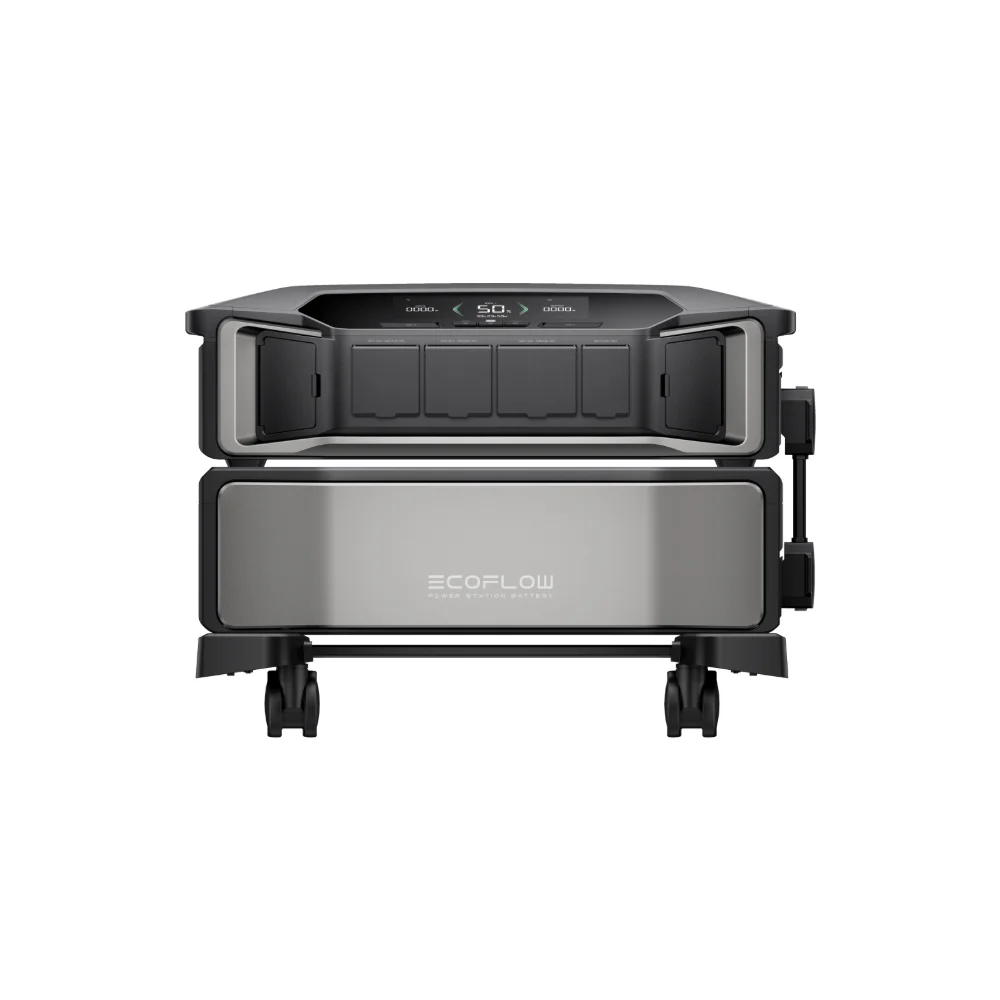
For apartments wanting to genuinely cover most of their normal load — AC, full kitchen use, multiple rooms — rather than a stripped-down critical list, a single large-capacity system can be simpler to manage than juggling several smaller units and their extension cords. The Anker SOLIX E10 scales from 6kWh up to 30kWh with up to 30kW of turbo output, which is genuinely whole-home-scale capacity — likely more than a typical apartment needs, but it illustrates how far the category has stretched beyond “portable power station” into real home-backup territory. On the same end of the spectrum, the EcoFlow DELTA Pro Ultra offers 6,144Wh with 7,200W output, enough to genuinely run AC, a fridge, and general apartment loads simultaneously without careful rationing. Systems at this scale often require a licensed electrician for any hardwired integration, so factor that into your budget and timeline if you go this route rather than a plug-in-only setup.
Frequently asked questions
Is it cheaper to buy one large power station or several small ones?
It depends on your load list, but per-watt-hour, larger units are often more cost-efficient than buying several small ones. The tradeoff is redundancy and flexibility — two smaller units let you run one in the kitchen and one near your workspace, and if one fails or needs charging, the other keeps working. Most apartment households land on a hybrid: one solid mid-to-large unit for critical loads, sized to their actual measured usage rather than a guess.
Can I charge a power station from a regular apartment outlet?
Yes — nearly all portable power stations recharge from a standard 120V wall outlet, which is exactly how you’d top it off before an anticipated outage or after power returns. Charging speed varies by model, with some units able to reach a full charge from AC power in under two hours.
Does my lease allow using a power station at all?
Most leases that restrict backup power are written around generators, specifically because of fuel storage and exhaust — battery power stations rarely raise the same concerns and are usually not addressed at all. Still, it’s worth a quick check of your lease or a message to your property manager, especially if you’re considering solar panels on a balcony, which some buildings restrict for appearance or safety reasons unrelated to the power station itself.