
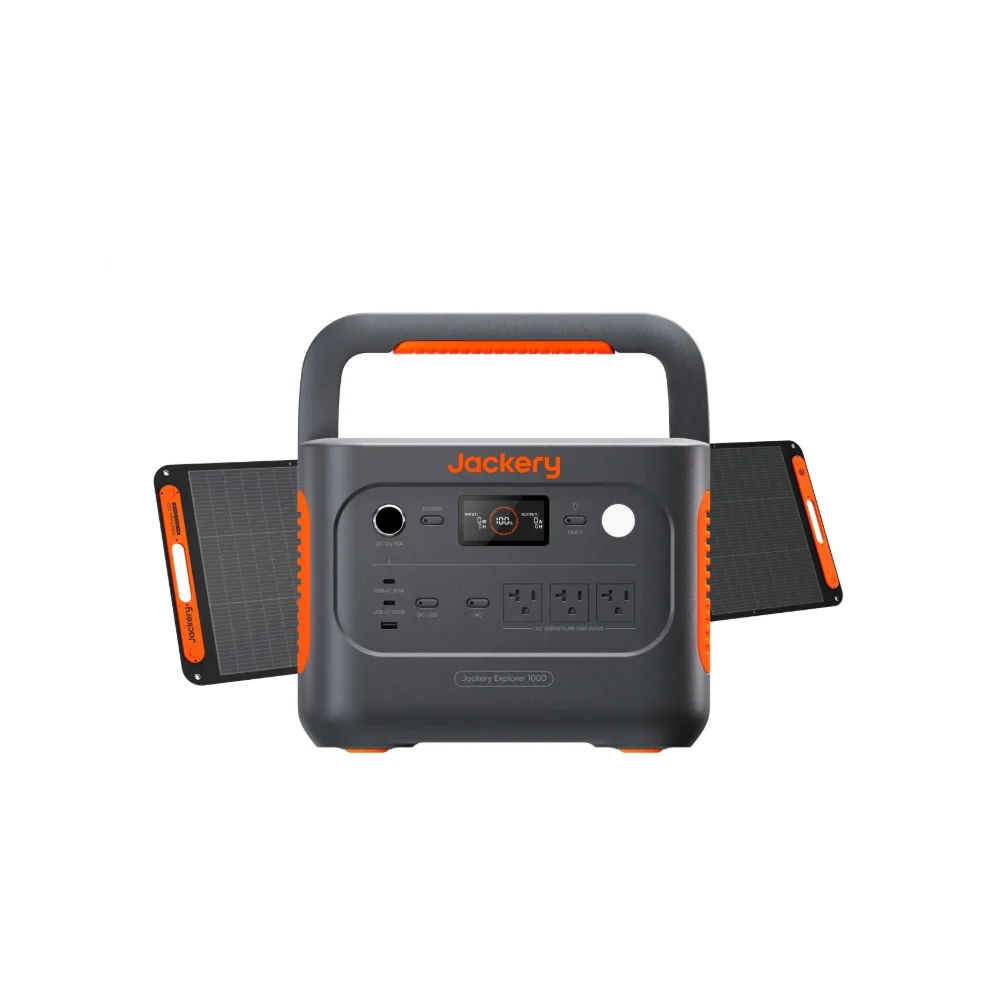

“How many solar panels do I need for my power station?” is one of those questions where every answer online says “it depends” and then doesn’t actually do the math for you. So let’s do the math. This isn’t complicated once you have three numbers: your battery capacity in watt-hours, your panel’s rated wattage, and roughly how many hours of usable direct sun you’re getting.
This article may include affiliate links — if you buy through them we may earn a small commission at no extra cost to you, but our recommendations are based on our own independent research.
If you’re shopping for a panel to pair with your setup, the Jackery SolarSaga 200W Solar Panel is worth a look. Check current price on Jackery →
The Actual Formula
Take your power station’s capacity (Wh), divide by your panel’s rated wattage, and that gives you a rough hours-to-full number under ideal sun. A 200W panel charging a 1,000Wh power station takes roughly 5-6 hours of direct, unobstructed sunlight to fill it — and I say “roughly” on purpose, because real-world efficiency losses (angle, heat, partial cloud cover, panel age) typically knock 15-25% off the theoretical number.
In my experience, the gap between the spec sheet number and the real number is the single biggest source of buyer disappointment in this category. People see “200W panel” and assume a fixed, guaranteed charge rate, when it’s really a best-case ceiling.
Worked Examples
- 500Wh station + 100W panel: roughly 5-6 hours in strong sun, closer to a full day in mixed conditions.
- 1,000Wh station + 200W panel: roughly 5-6 hours in strong sun — a solid one-day recharge for most camping setups.
- 2,000Wh station + 400W (two 200W panels): roughly 5-6 hours as well, since you’ve doubled both sides of the equation — this is why serious off-grid setups scale panels alongside capacity rather than relying on one panel to do more work.
Why More Panels Beats One Bigger Panel (Usually)
If you need more solar input, two smaller panels wired in the station’s supported configuration are often more practical than one giant panel — smaller panels are easier to angle toward the sun individually, easier to move as shade shifts through the day, and easier to pack. My take: unless you’re running a fixed installation, chase flexibility over raw single-panel wattage.
Don’t Forget the Charge Controller Ceiling
Every power station has a maximum solar input rating, and panels beyond that ceiling don’t add extra charging speed — the controller just caps it. Check this number before you buy a second or third panel expecting a proportional speed increase. This is a detail that’s easy to miss and it’s exactly where I’ve seen people spend money on capacity they can’t actually use.
Our Recommendation
Start with your daily watt-hour usage, not your battery’s total capacity, to size your panels — you’re trying to keep pace with what you use each day, not necessarily refill an empty tank from zero every time. For most one-to-two-person camping setups, a 200-400W solar array covers daily use in decent sun. Check your station’s max solar input before adding more panels than the controller can actually use.
Rigid vs Folding Panels: Which Fits Your Setup
Folding panels are the default for most portable setups — lightweight, foldable to a manageable size, and designed to be moved and re-angled through the day. Rigid panels, more common for permanent rooftop or overlanding rack mounts, tend to be more durable long-term and slightly more efficient per square foot, but they’re not something you’re packing away each morning. My take: unless you’re building a permanent installation on a vehicle or cabin roof, folding panels are the right call for the flexibility of repositioning them as the sun moves, which matters more for real-world output than the small efficiency edge rigid panels offer.
If you do go with a permanent rigid setup, oversize it slightly compared to a folding panel calculation, since you’ll lose the ability to actively re-angle it through the day to chase the sun.
FAQ
Can I mix different panel brands on one power station?
Only if voltage and connector type match the station’s input spec — mismatched panels can undercharge or, in rare cases, damage the charge controller.
Does cloudy weather really cut charging that much?
Yes — expect 50% or more reduction in charging speed under heavy cloud cover compared to direct sun, which is worth planning around on multi-day trips.
Season and Latitude Change the Math a Lot
The examples above assume something close to peak summer sun. In practice, “usable direct sun hours” swings wildly by season and location. A location that gets 6-7 peak sun hours in July might only see 2-3 in December, and that’s before accounting for a lower sun angle hitting a flat-mounted panel at a worse incidence angle all day. If you’re planning winter camping or live somewhere north of about 45 degrees latitude, I’d budget for roughly double the panel wattage you’d calculate from a summer-based formula, or accept that solar becomes a supplemental charging method rather than your primary one during the darker months.
This is the detail that catches people who buy their setup in June and only really stress-test it in November. Test your actual setup during the season you’ll rely on it most, not just when you bought it.
What This Looks Like Over a Multi-Day Trip
Picture a five-day trip running a 1,000Wh station with a 200W panel for a fridge, lighting, and daily laptop and phone charging — a common enough setup that it’s worth walking through. On clear days, that combination typically gets you close to a full recharge by early afternoon. On overcast days, you might only recover somewhere around 40% of what you used, which means by day three or four you’re likely being more careful — running the fridge on eco mode, holding off the laptop charge until you actually need it. That’s the honest, unglamorous reality of solar charging: it tends to even out over a week, but it doesn’t guarantee a full battery every single day, and planning around that variability matters more than chasing a bigger panel number.
What angle should I set my solar panel at?
As a rough rule, angle the panel to roughly match your latitude for the best average performance across a day, or simply track the sun by adjusting the angle every hour or two if you’re staying put and want to maximize output.
Do I need an MPPT charge controller, or does it come built in?
Virtually every current power station has an MPPT (Maximum Power Point Tracking) controller built into the unit itself, so you don’t need a separate one unless you’re building a custom off-grid solar system from scratch rather than using a packaged power station.
Should I buy a bifacial solar panel for better efficiency?
Bifacial panels, which capture reflected light on their back side as well as direct sun on the front, can add a modest 5-10 percent output boost in the right setup (elevated, over a reflective surface like light-colored ground or snow), but for typical portable camping use where the panel sits flat on the ground, the benefit is minimal. They are more worth considering for a fixed rooftop or ground-mount installation than a folding travel panel you move around daily.
Bottom line: run the numbers before you buy, oversize slightly rather than exactly, and expect to lean on your battery reserve during the darker months no matter how good your panel setup is. Solar charging is a genuinely reliable supplement to off-grid power, but treating it as a guaranteed daily top-up rather than a variable bonus is where most first-time buyers end up frustrated.
Related Reading
- Best Solar Generators for RV and Van Life in 2026
- Solar Generator Kits Explained: What’s Included vs What to Add
Looking to add solar charging to your setup? The Jackery SolarSaga 200W Solar Panel is worth considering. Check current price on Jackery →