
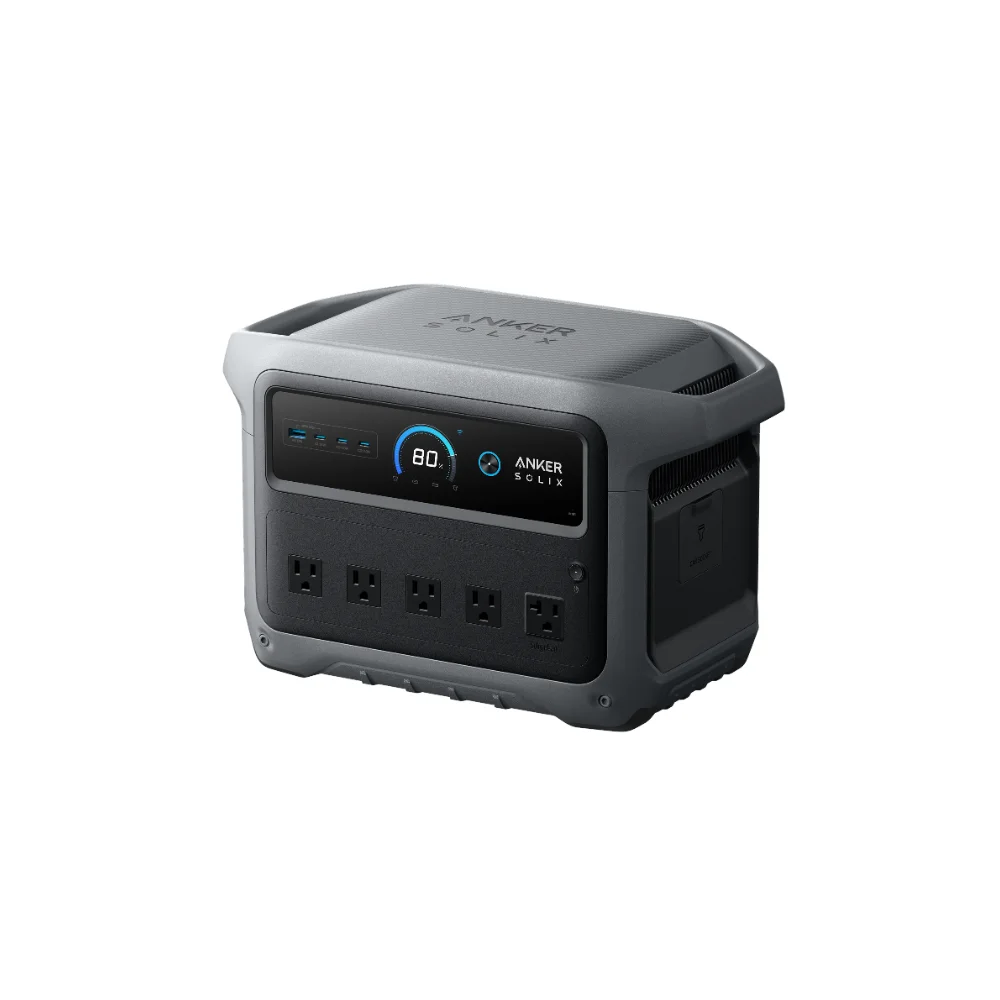

Here’s how to choose power station capacity the right way: every power station listing leads with its watt-hour number, and almost nobody explains what that number should actually mean to you as a buyer. Work backward from what you actually plan to run, not forward from whatever capacity looks impressive on a product page.
This article may include affiliate links — if you buy through them we may earn a small commission at no extra cost to you, but our recommendations are based on our own independent research.
How to Choose Power Station Capacity: What a Watt-Hour Actually Is
A watt-hour (Wh) is a unit of stored energy — a device drawing 100 watts will run for roughly one hour on 100Wh, or two hours on 200Wh, assuming no efficiency losses (there always are some, typically in the 10-15% range). Once you have that mental model, sizing a power station becomes a straightforward addition problem instead of a guessing game.
Add Up Your Real Daily Draw
Rough per-use estimates, since exact draw varies by device and model:
- Phone charging: roughly 15-20Wh per full charge
- Laptop: roughly 50-70Wh for a full charge
- LED camp lantern (a few hours): roughly 10-30Wh
- Mini fridge or cooler (12V, several hours): often 200-400Wh over a day, depending on ambient temperature and how often the door opens
- CPAP machine (overnight): commonly 40-100Wh depending on model and settings
Add up what you’ll realistically run in a day, then add 20-30% headroom for inefficiency and the days that don’t go as planned. That total is your target capacity — not the biggest number you can afford.
My Take on Capacity Tiers
From researching this category closely, a 300-500Wh unit comfortably covers phones, a laptop, and lighting for a weekend. A 1,000Wh-class unit is the sweet spot for most campers running a small fridge plus electronics. Anything above 2,000Wh is really for sustained loads — full-time van life, home backup, or genuinely extended off-grid stretches. I’d rather see someone slightly undersized and add a second unit later than overspend on capacity they’ll rarely touch.
Don’t Forget Recharge Time
Bigger capacity also means longer recharge time on the same solar input, so if you’re relying on solar day to day rather than AC top-ups, factor that into your sizing too — a battery you can’t reliably refill isn’t actually the capacity you paid for.
Our Recommendation
List your actual devices and realistic daily hours of use, add them up in watt-hours, add 20-30% headroom, and buy to that number. Resist the pull toward the biggest capacity on the shelf unless your real usage genuinely justifies it — that extra capacity is extra weight, extra cost, and extra recharge time you may never need.
FAQ
What size power station do I need for a weekend camping trip?
For phones, a laptop, and lighting, 300-500Wh is usually plenty for two to three days.
Is it better to oversize than undersize?
A little headroom is smart, but significant oversizing mostly adds cost, weight, and recharge time without real benefit — match capacity to your actual use, not a worst-case fantasy scenario.
A Full Worked Example
Let’s put together a real weekend scenario rather than talking in abstractions. Say you’re car camping for three days with a partner, running a small 12V cooler, charging two phones, running a laptop once a day, and using a lantern for a few hours each evening. Here’s how that adds up per day (illustrative numbers, your actual devices will vary):
| Device | Daily Usage | Estimated Wh/day |
|---|---|---|
| 12V cooler/mini fridge | All day, cycling | ~250Wh |
| 2x phone charging | Once each | ~35Wh |
| Laptop | One full charge | ~60Wh |
| LED lantern | 4 hours | ~25Wh |
| Daily total | ~370Wh |
For a three-day trip with no recharging at all, that’s roughly 1,100Wh total — right in range for a station in the 1,000-1,200Wh class with a little care, or comfortably covered by a larger unit with headroom to spare. Add a small-to-mid-size solar panel into the mix and you’re likely fine indefinitely, since you’d be replacing a meaningful chunk of that daily draw during a few hours of midday sun.
The Mistake That Trips Up First-Time Buyers: Wh vs W
This is genuinely the most common confusion I see in comments and emails: watt-hours (Wh) measure stored energy — how much you have. Watts (W) measure the rate of power draw or output — how fast you’re using or delivering it. A power station can have huge capacity (Wh) but a weak inverter (low W output) that can’t actually run a higher-draw appliance like a microwave or space heater, even though it technically has “plenty of battery.” Always check both numbers separately: capacity tells you how long things run, output wattage tells you what you can actually plug in and run at all. A high-capacity station with an undersized inverter can’t run an appliance that draws more than its rated continuous output, no matter how full the battery is — it’ll simply refuse to power it, or trip an overload protection.
I’d genuinely recommend checking the continuous output wattage against your single highest-draw device before you even look at the watt-hour number, since that’s the number that determines whether the unit works for you at all, regardless of how much energy it stores.
Real-World Efficiency: Why You Never Get the Full Rated Capacity
Manufacturers rate capacity based on the battery cells themselves, but the inverter, charge controller, and general system overhead all consume some power just running the unit. In practice, expect to actually use somewhere in the 85-90% range of the rated Wh number before the unit shuts off, not the full number on the box. This isn’t false advertising — it’s industry-standard rating methodology — but it’s exactly why I tell people to add headroom to their calculated needs rather than buying to the exact number.
Does temperature affect how much capacity I actually get?
Yes — both very cold and very hot temperatures reduce a battery’s effective usable capacity and can slow charging, which is another reason to add headroom rather than cut it close, especially for shoulder-season or winter use.
Should I size my power station around my biggest single appliance or my total daily usage?
Both, separately — output wattage (W) needs to exceed your single biggest device’s draw, while capacity (Wh) needs to cover your total daily usage across everything combined. Undersizing on either one causes a different kind of failure, so check both independently rather than assuming one covers the other.
One last practical tip: write your device list down before you shop, not while standing in front of a wall of options at a store or scrolling a listing page. It takes five minutes and it is the single best defense against buyer remorse from undersizing, or overspending on capacity dressed up as future-proofing.
Related Reading
- What Size Power Station Do You Need to Run a Fridge?
- Power Station Connector Types Explained: Avoid Compatibility Headaches