
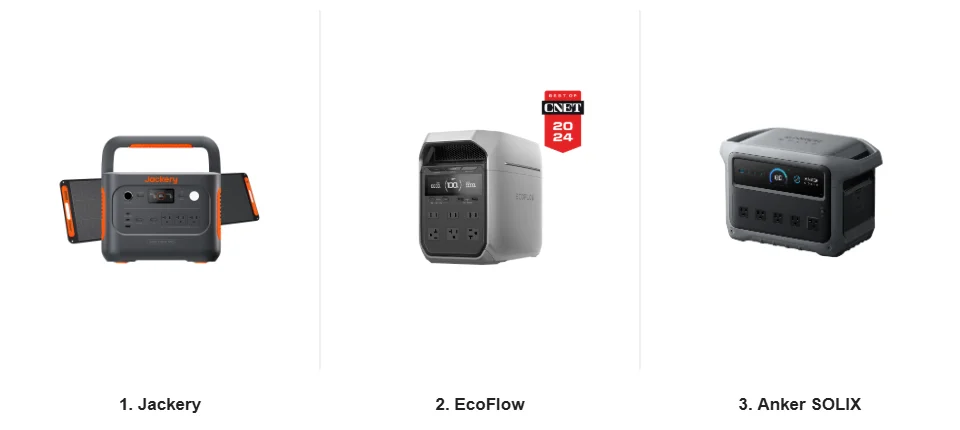

Jackery vs EcoFlow vs Anker SOLIX — ask five different solar generator buyers which brand they trust and you’ll get five confident, contradictory answers. I’ve spent enough time reading spec sheets and user reports across all three of these brands to have a real opinion now, and it’s not the one I expected to land on when I started looking at this category. Here’s how these three brands actually stack up against each other in 2026 — not marketing claims, the real trade-offs. One note before diving in: I’m working from in-depth research into published specs, owner reports, and manufacturer data rather than a side-by-side unit test I ran myself, and pricing across all three brands moves constantly, so treat every dollar figure below as a rough snapshot, not a quote.
This article may include affiliate links — if you buy through them we may earn a small commission at no extra cost to you, but our recommendations are based on our own independent research.
Jackery vs EcoFlow vs Anker SOLIX: The Short Version
Jackery is best for buyers who want a simple, well-supported unit and are fine paying a bit more for brand recognition and easy modular expansion. EcoFlow tends to offer the best value-to-capacity ratio right now, especially at the mid-range, with fast recharge times across the lineup. Anker SOLIX is best for people who want to eventually run whole-home or RV split-phase power and don’t mind paying for that ceiling upfront.
Capacity and Pricing, Side by Side
The Jackery Solar Generator 2000 Plus delivers roughly 2,000Wh with a 3,000W-class inverter, and it expands modularly into a much larger capacity range — a real advantage if you’re not sure how much capacity you’ll want in two years. EcoFlow’s DELTA 3 Plus comes in noticeably cheaper for a similar capacity class, expandable further still, which makes it one of the stronger dollar-per-watt-hour deals in the category right now (check EcoFlow’s site for the current number, since this is one of their more frequently discounted units). Anker SOLIX’s C1000 sits in the middle of the pricing pack with similar capacity to the EcoFlow unit at a somewhat higher price, but with LFP battery chemistry baked in from the start.
At the high end, Anker SOLIX’s F3800 is really in its own category: a high-output unit with 120V/240V split-phase support for whole-home backup, priced well above everything else in this comparison. Jackery and EcoFlow both have big units too, but the F3800’s split-phase compatibility is the detail that pulls it ahead if a breaker-panel-level backup is actually your goal. Check each brand’s current site for exact pricing before you shop — these numbers move with sales often enough that anything printed here will be stale within weeks.
Battery Chemistry: The Quiet Deciding Factor
This is where I’d actually weight my decision if I were buying today. EcoFlow and Anker SOLIX have both standardized on LiFePO4 (LFP) chemistry across most of their current lineup, generally rated for several thousand charge cycles and relatively fast AC recharging. Jackery still ships some models, including the Explorer 3000 Pro, with NMC lithium, which is rated for meaningfully fewer cycles — check each brand’s spec sheet for the exact current numbers, since these get revised. That’s not a dealbreaker if you’re only cycling the unit a few times a year for camping trips, but if you plan to use it regularly, running it down and recharging often, the LFP units from EcoFlow and Anker will simply last longer before capacity starts to fade.
Recharge Speed
EcoFlow’s LFP lineup edges out older-generation Bluetti units on recharge speed by a noticeable margin, and that pattern holds against a lot of the competition — EcoFlow has consistently prioritized fast AC recharge as a core selling point. If you’re the kind of person who forgets to charge things until the last minute, that’s worth factoring in.
What I’d Actually Buy
If I were starting from zero with no brand loyalty, I’d go EcoFlow for anything under 2kWh purely on value, and I’d go Anker SOLIX if I had my eye on eventually running real house circuits. Jackery still earns its spot for people who want the most established name and the easiest modular upgrade path — there’s real value in a company that’s been doing this the longest, especially if support and warranty service matter to you as much as the spec sheet. None of these three are a bad choice at this point in 2026; they’re just optimized for slightly different buyers.
What surprised me most doing this comparison wasn’t which brand “won.” It’s how close the specs have converged. Two years ago these companies felt meaningfully different. Now the real differentiator is chemistry and expandability, not raw wattage.
Full Spec Comparison Table
Capacity, output, and especially price below are approximate snapshots at the time of writing — confirm current numbers directly on each brand’s site before buying, since all three brands run frequent sales.
| Brand / Model | Capacity (approx.) | Output (approx.) | Chemistry | Relative Price Tier |
|---|---|---|---|---|
| Jackery 2000 Plus | ~2kWh, expandable | ~3,000W | LiFePO4 | High |
| EcoFlow DELTA 3 Plus | ~1kWh, expandable | ~1,800W | LiFePO4 | Lowest |
| Anker SOLIX C1000 | ~1kWh | ~1,800W | LiFePO4 | Mid |
| Anker SOLIX F3800 | ~3.8kWh, expandable | ~6,000W | LiFePO4 | Highest |
Warranty and Support: The Part Nobody Compares
Spec sheets get all the attention, but warranty length and how a company handles a defective unit matters just as much over a five-year ownership window. Jackery and EcoFlow both typically offer a standard multi-year warranty depending on the model and region, with paid extensions available on many units. Anker SOLIX has been aggressive about warranty length on its SOLIX line specifically, often matching or beating the older Anker consumer-electronics reputation for straightforward RMA handling. In my experience reading through user forums rather than marketing pages, EcoFlow’s community support and firmware update cadence get mentioned more often — for better and worse, since frequent firmware updates mean more features but also more potential for a bad update to cause a hiccup.
None of the three has a bad reputation here. But if you’re buying a unit in the thousands of dollars, it’s worth spending ten minutes reading recent owner reviews specifically about the RMA process before you commit — that’s more predictive of your actual ownership experience than another spec-sheet number.
Frequently Asked Questions
Which brand has the best app and monitoring experience?
All three now offer Bluetooth and Wi-Fi app control with real-time power monitoring. EcoFlow’s app tends to get the most frequent updates and the widest feature set, while Jackery’s is the simplest to use if you just want basic on/off and battery-level monitoring without much fuss.
Can I mix and match panels between these brands?
Technically often yes if the voltage and connector type match, but each brand optimizes its MPPT charge controller for its own panels, so you’ll get faster, more efficient charging sticking with the same brand’s solar panels rather than mixing them.
Is Anker SOLIX really the same company as Anker chargers and cables?
Yes — SOLIX is Anker’s dedicated power-station and solar sub-brand, launched to compete directly in this category, backed by the same manufacturing and support infrastructure as their better-known consumer electronics.
Which of these three is easiest to travel with?
For anything under roughly 1kWh, the EcoFlow DELTA 3 Plus and Anker SOLIX C1000 are both compact and light enough for regular car camping trips. Once you’re in Jackery 2000 Plus or F3800 territory, you’re planning around a dedicated space in the trunk, not tossing it in as an afterthought.
These are currently available through Outbound Power: Check current price on the EcoFlow DELTA 3 Plus →, Check current price on the Anker SOLIX C1000 Gen 2 →, or Check current price on the Anker SOLIX F3800 → The Jackery 2000 Plus is also available: Check current price on Jackery →
One more practical note: pricing on all three brands fluctuates a lot around sales events like Black Friday, Prime Day, and Earth Day promotions. I don’t have verified data on typical discount depth, so I won’t quote a percentage — but if you’re not in an emergency-purchase situation, it’s generally worth waiting for one of those windows rather than buying at list price, since the underlying hardware rarely changes mid-cycle.
Related Reading
- Best Solar Generators for Home Backup in 2026
- Best Large-Capacity Solar Generators for Extended Off-Grid Living