
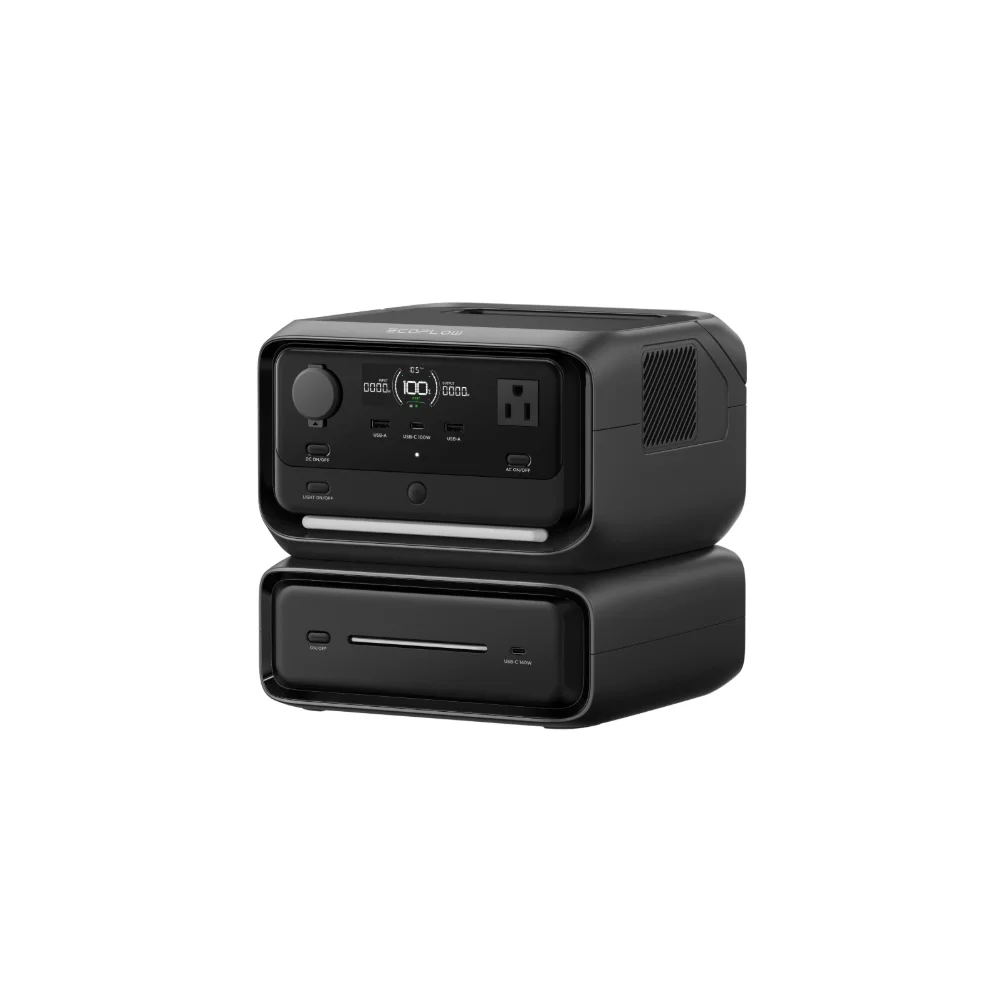

Fan noise is one of the least-documented specs on any power station’s product page — manufacturers rarely publish decibel ratings, yet how loud a unit’s cooling fan gets under real load dramatically shapes what it’s actually like to own one, especially for anyone using it inside a tent, a bedroom, or a quiet campsite.
The baseline to expect
Hands-on testing across multiple brands (Anker, Bluetti, EcoFlow, Jackery) found a reasonable baseline expectation of 50-55dB of blower noise at about arm’s length under real load — comparable to a running dishwasher or a quiet conversation. That’s the range to expect from most mainstream units when their cooling fans are actively working, not a defect specific to any one brand.
What the numbers actually mean
| Reference point | Approximate dB |
|---|---|
| Whisper | ~20dB |
| Quiet office | ~40dB |
| Comfortable indoor threshold | under 50dB |
| Typical power station under load | 50-55dB |
| Gas generator | 70-90dB (comparable to a lawnmower) |
That last comparison is worth sitting with: even a power station running its fan at a fairly audible level is still dramatically quieter than any gas generator, which is a meaningful part of why battery power stations have become the default for noise-sensitive settings like festival camping and shared campsites.
Specific models that stood out, quiet or otherwise
Hands-on testing found the Bluetti Apex 300 and Jackery HomePower 3600 Plus were “barely noticeable” for fan noise — a genuine standout given both units’ substantial output capability. On the quieter end of published measurements, the EcoFlow DELTA 2 runs under 45dB during most use, and the smaller EcoFlow RIVER 2 often stays under 30dB during light operation — both use smart fans that scale up gradually with load rather than jumping straight to full speed. The Bluetti AC60, a compact IP65-rated unit, is separately rated at just 30dB under light loads by its manufacturer — genuinely close to whisper-level for that use case.
When fans actually kick in
Fan behavior isn’t constant — it scales with what the unit is actually doing. Maximum-rate AC charging generally produces the loudest fan noise of any operation, since the inverter and charging circuitry generate the most heat during a fast recharge. Some units stay impressively quiet right up until they’re heavily loaded, then ramp up more aggressively than others by design — meaning two units with similar published noise specs can feel very different in practice depending on how gradually or abruptly their fan curve responds to load.
Why this matters more for some use cases than others
For home backup sitting in a garage or basement, fan noise is close to irrelevant. For anyone using a power station inside a tent, a van, a bedroom during a power outage, or at a quiet campsite, it’s a genuinely significant quality-of-life factor that most spec sheets simply don’t disclose. If noise matters for your specific use case, it’s worth checking independent hands-on reviews specifically for fan behavior under the load level you’ll actually be using, rather than assuming a unit is quiet just because its overall reviews are positive on other dimensions.
FAQ
Does a quieter power station mean weaker cooling and more risk of overheating?
Not necessarily — quieter designs often use larger, slower-spinning fans or smarter thermal management rather than sacrificing cooling capacity, though it’s worth checking if a specific quiet model has any documented thermal throttling issues under sustained heavy load.
Can I do anything to reduce fan noise on a unit I already own?
Charging at a slower rate rather than maximum speed, when your situation allows the extra time, generally reduces fan activity meaningfully since fast charging is one of the biggest noise triggers.
Is fan noise consistent, or does it cycle on and off?
It varies by unit and load — many power stations cycle their fans on and off based on internal temperature rather than running continuously, so noise levels can fluctuate even during a single charging or discharging session.
Are smaller-capacity power stations always quieter than larger ones?
Generally yes, since smaller units handle less power and generate less heat, but it’s not a strict rule — a well-designed larger unit with smart fan scaling (like the DELTA 2 example above) can be quieter under moderate load than a poorly designed smaller one.
Bottom line
Expect roughly 50-55dB under real load as a reasonable baseline across mainstream brands, with some standout units (Bluetti Apex 300, Jackery HomePower 3600 Plus, EcoFlow’s smart-fan DELTA and RIVER lines) running noticeably quieter. If noise matters for your use case, check hands-on reviews for fan behavior specifically — it’s rarely on the official spec sheet.
This post may include affiliate links — if you buy through them, we may earn a small commission at no extra cost to you. It doesn’t change what we cover or how we rank anything.