
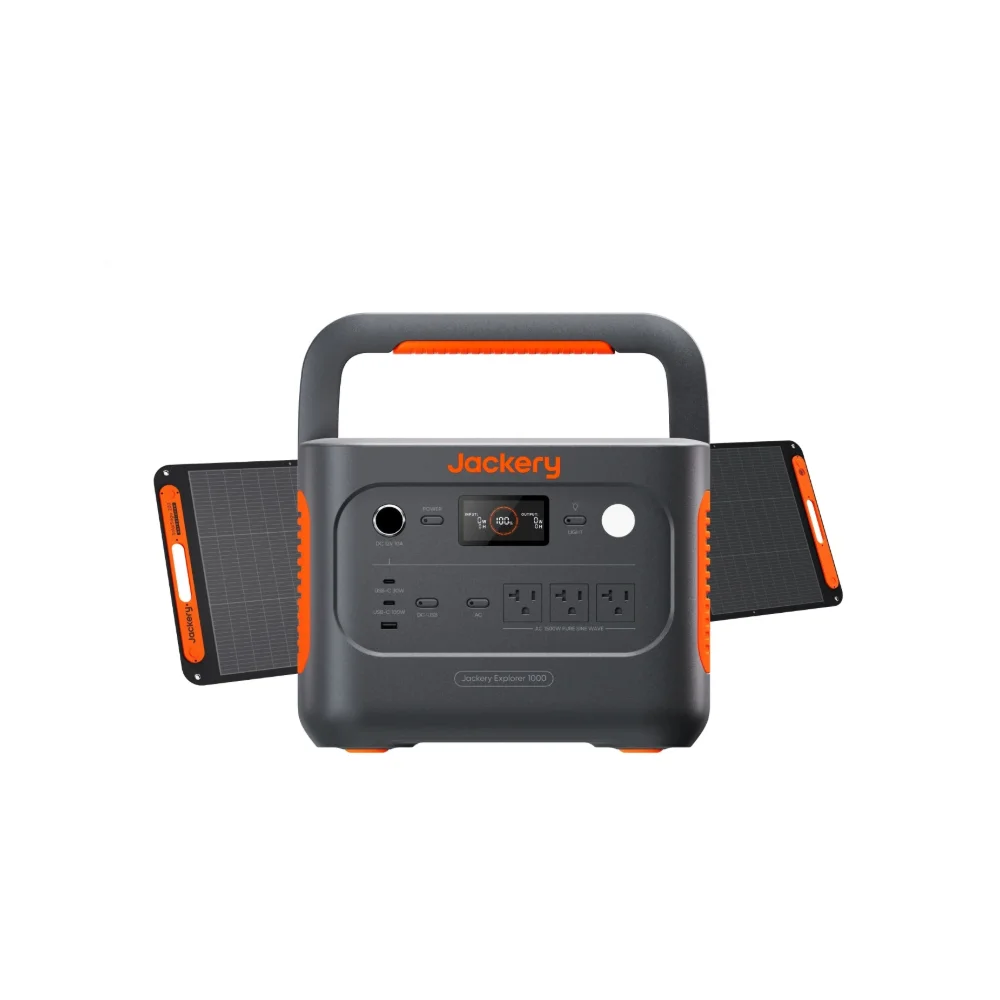

Tiny house living tends to attract either wildly optimistic or wildly pessimistic assumptions about solar power — either “a couple of panels will handle everything” or “you’ll need a system as complex as a full house.” The real numbers land in a much more specific, plannable range, once you know your actual daily energy consumption instead of guessing.
What a tiny house actually uses per day
| Lifestyle | Typical daily consumption |
|---|---|
| Baseline minimal (lighting, fridge, laptop, water pump) | ~1.1 kWh/day |
| Full-time living with AC | 4-6 kWh/day |
| Four-season, heavy load | 6-10 kWh/day |
Most tiny houses land between 1.5 and 5 kWh per day, with the outliers above and below that range driven mostly by climate control needs. That’s the number to nail down first — everything else in sizing a system flows from your realistic daily kWh, not from the size of the house itself.
Sizing solar input to your daily load
The standard calculation divides your daily energy load by your local peak sun hours (typically estimated at around 4 hours for planning purposes) to find your minimum solar wattage needed. For a 3 kWh daily load, that works out to roughly 750W of solar input once you account for real-world system losses. In practical terms: a tiny house on wheels typically works with 400-800W of roof-mounted panels (600W is a common target), while a foundation-based tiny home has more room for ground-mounted arrays in the 1,000-2,000W range.
Battery capacity: size for 1.5x your daily load
The standard rule of thumb is to size battery storage at 1.5 times your daily load, which builds in buffer for cloudy days and nighttime use without solar input. A 2 kWh daily load, by this math, calls for a minimum of 3 kWh of storage. As a concrete reference point, a 2,048Wh power station covers roughly 24-36 hours without any solar input at all for a modest load — useful context for understanding just how much buffer that 1.5x rule actually provides during a multi-day stretch of bad weather.
The propane compromise most tiny house owners make
Trying to run everything electric in a tiny house solar setup is the most common oversizing mistake. Electric ranges, full-size dryers, and central HVAC are effectively off the table for a realistically sized battery-and-solar system — the loads are simply too large relative to what a manageable battery bank can supply. The common and practical approach pairs electric power for low-load items (lighting, refrigeration, electronics, water pump) with propane for the genuinely high-draw functions: cooking, water heating, and supplemental heat. High-consumption electric appliances worth actively avoiding on battery power alone include induction cooktops, electric water heaters, and electric space heaters — each one can single-handedly blow past a modest system’s daily budget.
Portable solar generator vs. a hardwired system
For a tiny house on wheels that moves periodically, a portable solar generator setup with foldable or roof-mounted portable panels offers real flexibility — you’re not locked into one location’s sun exposure, and the system travels with the house. For a fixed foundation tiny home, a properly installed, hardwired solar-plus-battery system (potentially with net metering if grid-tied) can be more cost-effective long term and support higher continuous loads than a portable unit’s output ceiling typically allows. The choice comes down to whether mobility or maximum capacity matters more for your specific situation.
FAQ
Can a tiny house realistically run air conditioning off-grid?
Yes, but it substantially raises daily consumption into the 4-6 kWh range — plan for a meaningfully larger solar array and battery bank than a baseline minimal setup, and consider a more efficient mini-split system over a window unit.
How many cloudy days can a properly sized system handle?
The 1.5x daily-load battery sizing rule builds in roughly one extra day of buffer beyond normal use; for regions with frequent multi-day cloudy stretches, sizing closer to 2x daily load (or adding a backup charging source) is more realistic.
Is it cheaper to go bigger on solar panels or on battery capacity?
It depends on your climate and usage pattern, but generally, undersized solar input with an oversized battery leaves you slowly draining reserves on cloudy stretches, while undersized battery with strong solar input leaves you fine on sunny days but exposed overnight — balance both rather than maxing out just one.
Do I need a professional to size and install a tiny house solar system?
For a portable power station setup, no — these are designed for DIY use. For a hardwired system with a larger battery bank and inverter, especially one tied into your electrical panel, professional installation is strongly recommended for both safety and code compliance.
Bottom line
Start with your actual daily kWh usage, not an assumption based on square footage. Size solar input to cover that load across your realistic sun hours, size battery storage at roughly 1.5x daily load for weather buffer, and plan on propane for cooking, water heating, and supplemental heat rather than trying to electrify everything on a tiny house-sized system.
This post may include affiliate links — if you buy through them, we may earn a small commission at no extra cost to you. It doesn’t change what we cover or how we rank anything.
Sources externes citées
- BackupPowerHub — How to Power a Tiny House Off Grid: Complete 2026 Guide