
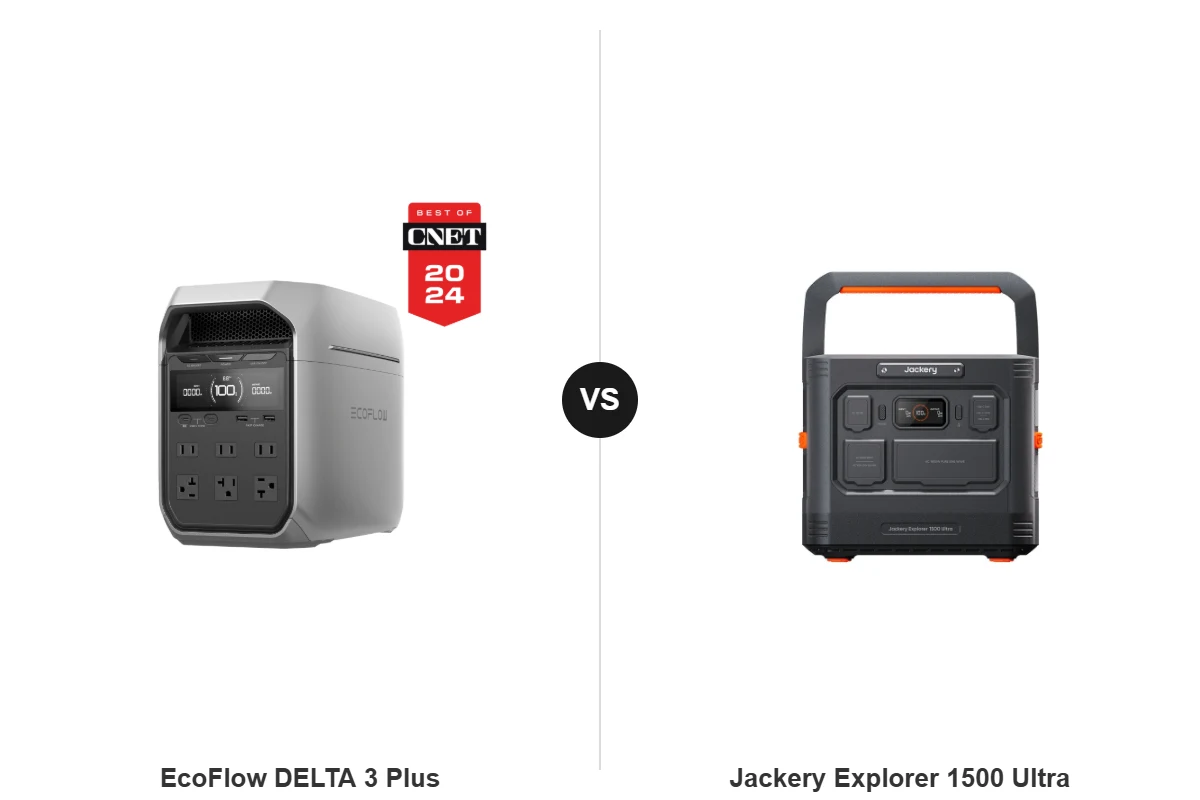

Both of these units land in that awkward “more than a weekend charger, less than a home-backup box” zone, which is exactly why I keep getting asked to compare them. The EcoFlow Delta 3 Plus and the Jackery Explorer 1500 Ultra aren’t identical on paper, but they compete for the same buyer: someone who wants real appliance-running power without hauling around a 60-pound brick. Here’s how they actually stack up once you get past the marketing copy.
This article may include affiliate links — if you buy through them we may earn a small commission at no extra cost to you, but our recommendations are based on our own independent research.
Spec Sheet Face-Off
- EcoFlow Delta 3 Plus: 1,024Wh capacity, 1,800W continuous output, 3,600W surge, roughly $799 list price
- Jackery Explorer 1500 Ultra: 1,536Wh capacity, 1,800W continuous output, 3,600W surge, roughly $999–$1,299 depending on bundle, about 38.6 lbs
Right away, the capacity gap jumps out: the Jackery holds about 50% more energy than the EcoFlow. That’s not a small difference if you’re running a CPAP overnight or trying to keep a mini-fridge cold through a multi-day outage.
Capacity and Runtime: 1,536Wh vs 1,024Wh
On paper this looks like an easy win for Jackery, and for pure runtime, it is. But capacity isn’t free — the Explorer 1500 Ultra is a noticeably heavier, bulkier unit as a result. If you’re optimizing for grab-and-go portability over raw runtime, the Delta 3 Plus’s smaller footprint might matter more to you than the extra 500Wh. This is the classic tradeoff in this category, and neither brand has found a way around basic physics yet.
Output and Surge Power
Both units are rated at 1,800W continuous and 3,600W surge, so they’re evenly matched here — running most single appliances (a microwave, a coffee maker, a space heater on low) or absorbing the startup spike from a compressor fridge or power tools with brushed motors won’t meaningfully favor one over the other on paper. If you’re deciding between them, this isn’t the spec to weigh heavily; look at capacity, charging speed, and price instead.
Charging Speed and UPS Response
EcoFlow has historically been aggressive about fast charging, and the Delta 3 Plus continues that trend — it’s built to top up in about an hour under the right conditions, and its UPS switchover is rated around 10 milliseconds, which is fast enough that most electronics won’t even blink during a grid outage. Jackery’s UPS response on the Explorer 1500 Ultra sits around 20 milliseconds, still fast enough for most sensitive electronics, but not quite class-leading. If your top priority is protecting a home office setup during outages, EcoFlow’s faster switchover is a genuine point in its favor.
Noise: Worth Asking About Before You Buy
This is the detail I think gets buried in most spec-sheet comparisons. Compact, fast-charging power stations in this class tend to run their cooling fans harder and more often than their capacity would suggest, and EcoFlow’s Delta series has drawn specific criticism on this front from independent testers — fans kicking on even for light loads and staying on well after charging finishes. If this unit is going to live somewhere quiet, like a bedroom or home office, it’s worth reading recent owner reviews on fan behavior for both units before you commit, since this is exactly the kind of thing that doesn’t show up on a spec sheet but absolutely affects day-to-day satisfaction.
Build Quality and Portability
Jackery built the Explorer 1500 Ultra with rugged, outdoor-ready construction in mind, including dust and water-resistance ratings that hold up to job-site or campsite abuse better than most units in this range. That ruggedness comes with weight, though — at 38.6 lbs, it’s not a unit you’re casually tossing in a backpack. The Delta 3 Plus is the more travel-friendly of the two, with a compact, stackable design that’s easier to tuck into a car trunk or closet.
Price
This is where the comparison gets interesting: the EcoFlow Delta 3 Plus typically lists for roughly half the price of the Jackery Explorer 1500 Ultra, despite both sharing the same 1,800W continuous rating. If your loads don’t require the Jackery’s extra capacity or surge headroom, the Delta 3 Plus is hard to argue with on value alone.
Who Should Buy the Jackery Explorer 1500 Ultra
- You need more total runtime for overnight medical devices, fridges, or multi-day outages
- You want rugged, weather-resistant build quality for job sites or rough outdoor use
- Higher surge headroom for compressor-based appliances matters to your use case
Who Should Buy the EcoFlow Delta 3 Plus
- Budget and portability matter more to you than maximum capacity
- Fast UPS switchover for home office or networking gear is a priority
- You want the option to add EcoFlow’s stackable expansion battery later rather than buying more capacity upfront
The EcoFlow DELTA 3 Plus (1024Wh, 1800W) is currently available through Outbound Power. Check current price on Outbound Power →
My Take
If I had to pick one for a friend without knowing much else about their situation, I’d lean Jackery Explorer 1500 Ultra for anyone treating this as a home-backup-first purchase, since the extra capacity and surge headroom genuinely matter when the power’s out for more than a few hours. But for camping, travel, or as a secondary unit, the Delta 3 Plus’s price and portability are hard to beat, and I wouldn’t feel like I was settling by choosing it. Just go in with realistic expectations about fan noise on the EcoFlow side, and about the Jackery’s weight if you’re planning to move it around a lot.
Side-by-Side Spec Comparison
- Capacity: Jackery 1,536Wh vs EcoFlow 1,024Wh — Jackery ahead by about 50%
- Continuous output: Tied at 1,800W
- Surge output: Jackery 3,600W vs EcoFlow 2,600W
- UPS switchover: EcoFlow ~10ms vs Jackery ~20ms — EcoFlow faster
- Weight: Jackery roughly 38.6 lbs vs EcoFlow’s lighter, more compact build
- Price: EcoFlow roughly half the cost of the Jackery
Frequently Asked Questions
Is the Jackery Explorer 1500 Ultra worth the higher price?
If you need the extra capacity, surge headroom, or rugged build quality, yes. If your loads are modest and portability or budget matter more, the EcoFlow Delta 3 Plus covers most of the same ground for roughly half the price.
Can either of these run a full-size refrigerator?
Both can run a compressor fridge for a meaningful stretch, but neither is designed for multi-day, whole-fridge backup the way larger, expandable platforms are. Check the fridge’s startup wattage against each unit’s surge rating first.
Which one charges faster from a wall outlet?
EcoFlow has generally prioritized fast charging across its Delta lineup, and the Delta 3 Plus is built to top up quickly under ideal conditions. Always check current charging specs directly, since both brands update firmware and hardware periodically.
Related Reading
- EcoFlow Delta Pro 3 Review
- Jackery Explorer 2000 Plus Review
- How to Choose the Right Power Station Capacity (Wh) for Your Needs
Khalid Zirari is the founder of Marjajo, where he researches and compares portable power stations, solar generators, and related backup power gear to help readers cut through spec-sheet marketing and find the right fit for their needs.