
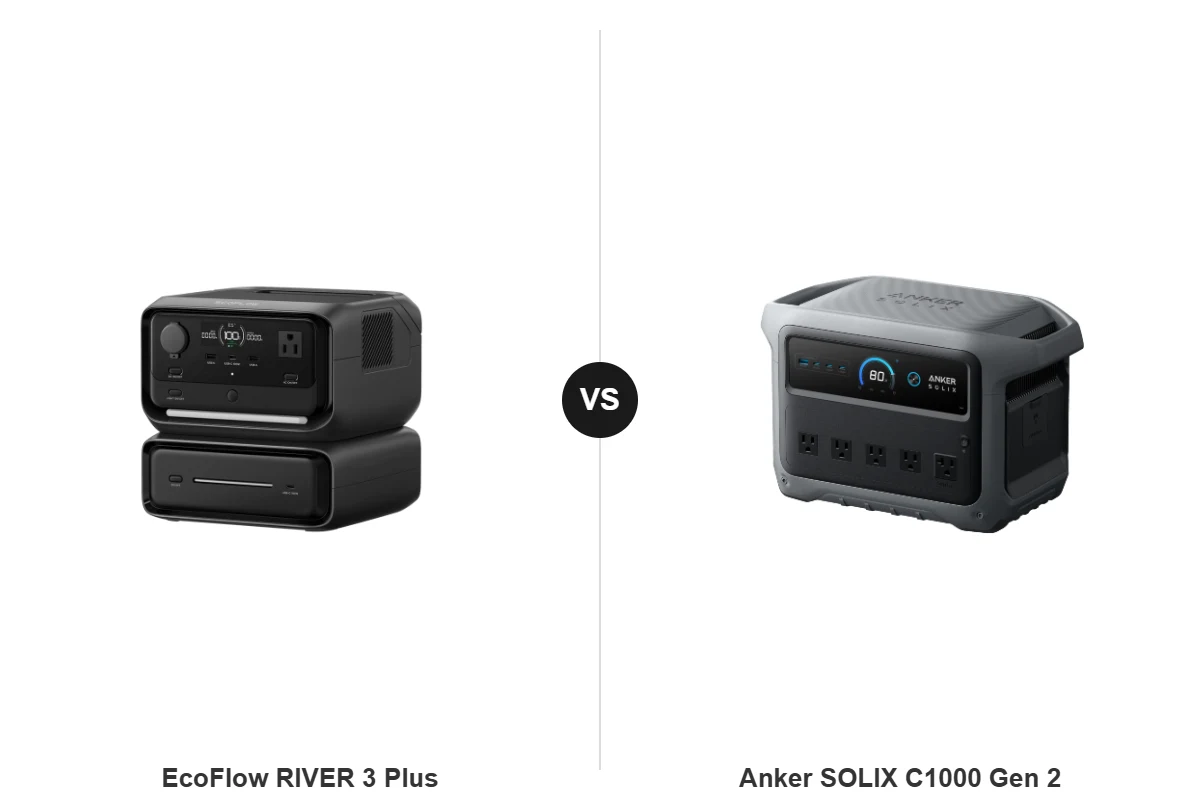

These two power stations aren’t really competing for the same buyer — one is built to disappear into a backpack, the other is built to run more of your camp. Comparing them side by side for tent camping specifically comes down to a simple question: are you packing light for a weekend, or setting up a basecamp you’ll actually live out of for a few days?
Quick comparison
| Spec | EcoFlow RIVER 3 Plus | Anker SOLIX C1000 Gen 2 |
|---|---|---|
| Capacity | 286Wh | 1,024Wh |
| Continuous output | 600W | 2,000W |
| Weight | 10.4 lbs | 24.9 lbs |
| AC recharge time | ~18 minutes | ~48 minutes |
| Solar input (max) | 220W | 600W |
| Price | $271 | $529.99 |
The capacity gap is bigger than the price gap
The Anker C1000 Gen 2 holds roughly 3.5 times the energy of the RIVER 3 Plus, and its 2,000W continuous output is more than triple the RIVER 3 Plus’s 600W — but it only costs about twice as much. If you’re trying to run anything beyond phones, lights, and small electronics — a portable fridge, a CPAP with a heated humidifier, a coffee maker in the morning — that output ceiling matters more than it might seem from the spec sheet alone. The RIVER 3 Plus’s 600W is genuinely limiting for anything with a heating element or compressor motor that draws a real surge on startup.
Weight: where the RIVER 3 Plus wins outright
At 10.4 lbs versus 24.9 lbs, the RIVER 3 Plus is less than half the weight of the C1000 Gen 2 — a real difference if you’re hiking any distance to a tent site rather than driving up to it. Solar Waypoint’s comparison specifically calls out the RIVER 3 Plus’s compact size as a fit for “long nights powering CPAP machines and other small devices,” which is a fair summary of its actual lane: it’s built for keeping small, essential electronics alive overnight, not for running a camp kitchen.
Recharge speed: RIVER 3 Plus is faster, but it has less to fill
The RIVER 3 Plus recharges via AC in about 18 minutes against the C1000 Gen 2’s roughly 48 minutes — but that’s a smaller battery filling faster, not necessarily a practical advantage. In absolute terms, the C1000 Gen 2 is refilling nearly four times the energy in about 2.5 times the duration, which works out to a faster effective recharge rate. Where the RIVER 3 Plus’s speed genuinely helps is topping off during a short window — a quick stop at a car charger or a gas station outlet on a road trip between camp days.
Solar charging for multi-day trips
If you’re planning to recharge via solar panel over a multi-day trip rather than relying on a single full charge, the gap widens further: the C1000 Gen 2 accepts up to 600W of solar input against the RIVER 3 Plus’s 220W max. For anyone camping somewhere without vehicle access to recharge, that higher solar ceiling on the C1000 Gen 2 means meaningfully faster replenishment from the same afternoon of sun.
Which one actually fits your trip
Pick the RIVER 3 Plus if your camping power needs are genuinely small — charging phones and headlamps, running a string of lights, keeping a CPAP running overnight without a humidifier — and you’re prioritizing pack weight over headroom. Pick the Anker SOLIX C1000 Gen 2 if you’re running a basecamp setup for multiple people, want real headroom for anything with a motor or heating element, or you’re camping in situations where solar is your main recharge method and a bigger panel input matters.
If Neither Fits: When to Look Elsewhere Entirely
Both units target roughly the same general “compact camping companion” niche within the broader portable power category, and if your actual trip profile falls outside what either handles well, it’s worth looking beyond this specific matchup rather than forcing a fit. If you’re genuinely backpacking — carrying everything on your back for miles, not car camping or setting up a basecamp — both of these units, and especially the 24.9-lb C1000 Gen 2, are heavier than what makes sense on foot. Our guide to lightweight power stations for backpacking and hiking covers units built specifically around the ounces-matter priorities that tent camping and car camping don’t share. On the other end of the spectrum, if you’re setting up a stationary basecamp for a week or more and want to run a fridge continuously rather than just top off phones and small devices between hikes, both of these units are meaningfully undersized — that’s a job for something closer to the 1,500-2,000Wh-plus class covered in our roundup of large-capacity solar generators for extended off-grid living.
Cold-Weather Camping Changes the Calculation
If your camping season extends into genuinely cold weather, both units share the same LiFePO4 charging-below-freezing limitation, but the practical impact differs slightly given their different roles. The RIVER 3 Plus, as the more genuinely portable option, is more likely to end up carried into a cold tent overnight rather than left in a warmer vehicle — worth planning around specifically if you’re a three-season or winter camper rather than a fair-weather-only camper who can simply avoid the issue by not camping in freezing conditions. Our full breakdown of how cold weather affects your power station’s battery covers the charging floor and capacity-loss basics that apply to either unit equally in cold conditions.
FAQ
Can the RIVER 3 Plus run a portable fridge overnight?
It can run small, efficient 12V coolers, but a standard compressor fridge’s startup surge and continuous draw will eat through 286Wh fast — this is a case where the C1000 Gen 2’s higher capacity and output ceiling makes a real difference.
Is the C1000 Gen 2 too heavy for backpacking?
At 24.9 lbs, it’s realistic for car camping or a basecamp you set up once and don’t relocate, but it’s a poor fit for a trip where you’re carrying everything on your back to the site.
Do both units support pass-through charging for CPAP use?
Both EcoFlow and Anker build pass-through charging into their current lineups, but always confirm on the specific model’s spec sheet, especially if you’re running life-sustaining equipment.
Which one holds its charge better if it just sits in the car between trips?
Both use LiFePO4 battery chemistry, which is known for slow self-discharge and long shelf life compared to older lithium-ion designs — neither should lose meaningful charge sitting for a few weeks between trips.
Which one is quieter?
Neither unit has an internal fan running continuously under light loads, so both are effectively silent for typical device charging. Under heavier sustained loads, the C1000 Gen 2’s cooling fan is more likely to engage given its higher output ceiling, but this only matters if you’re pushing it near its rated capacity.
Can I use either unit as a UPS for sensitive electronics while camping with a CPAP or medical device?
Both support pass-through/UPS-style charging with fast switchover times, making either a reasonable choice for that use case — the choice between them then comes down more to portability needs than to UPS performance specifically.
Is it worth buying both instead of choosing one?
For frequent campers who regularly do both backpacking-adjacent trips and longer basecamp stays across a full camping season, owning a smaller unit like the RIVER 3 Plus alongside a larger one for bigger trips isn’t at all unreasonable, but for a more occasional camper, matching a single unit to your most common trip type — rather than buying for the rare edge-case trip — is the more practical and cost-effective starting point.
Bottom line
This comparison isn’t really “which is better” — it’s “which trip are you actually taking.” The RIVER 3 Plus is the pack-light, small-device answer; the C1000 Gen 2 is the basecamp answer with real headroom to spare. Match the unit to your trip’s actual power draw, not to whichever spec sheet has bigger numbers.
The EcoFlow RIVER 3 Plus is not currently available through our affiliate partners — we will add a link back if that changes.
This post may include affiliate links — if you buy through them, we may earn a small commission at no extra cost to you. It doesn’t change what we cover or how we rank anything.