

Prices and specs in this review are approximate and current as of July 2026 — battery pricing moves fast, so check EcoFlow’s product page for the latest numbers before you buy.
This EcoFlow Delta Pro 3 review looks at a unit that sits in a different category than most of what we cover on this site. It isn’t a “top off your phone at the campsite” unit — it’s built and marketed as genuine whole-home backup, and after digging through the spec sheet plus a stack of owner and lab reports, I think that positioning mostly holds up.
This article may include affiliate links — if you buy through them we may earn a small commission at no extra cost to you, but our recommendations are based on our own independent research.
EcoFlow Delta Pro 3 Review: What You’re Actually Getting
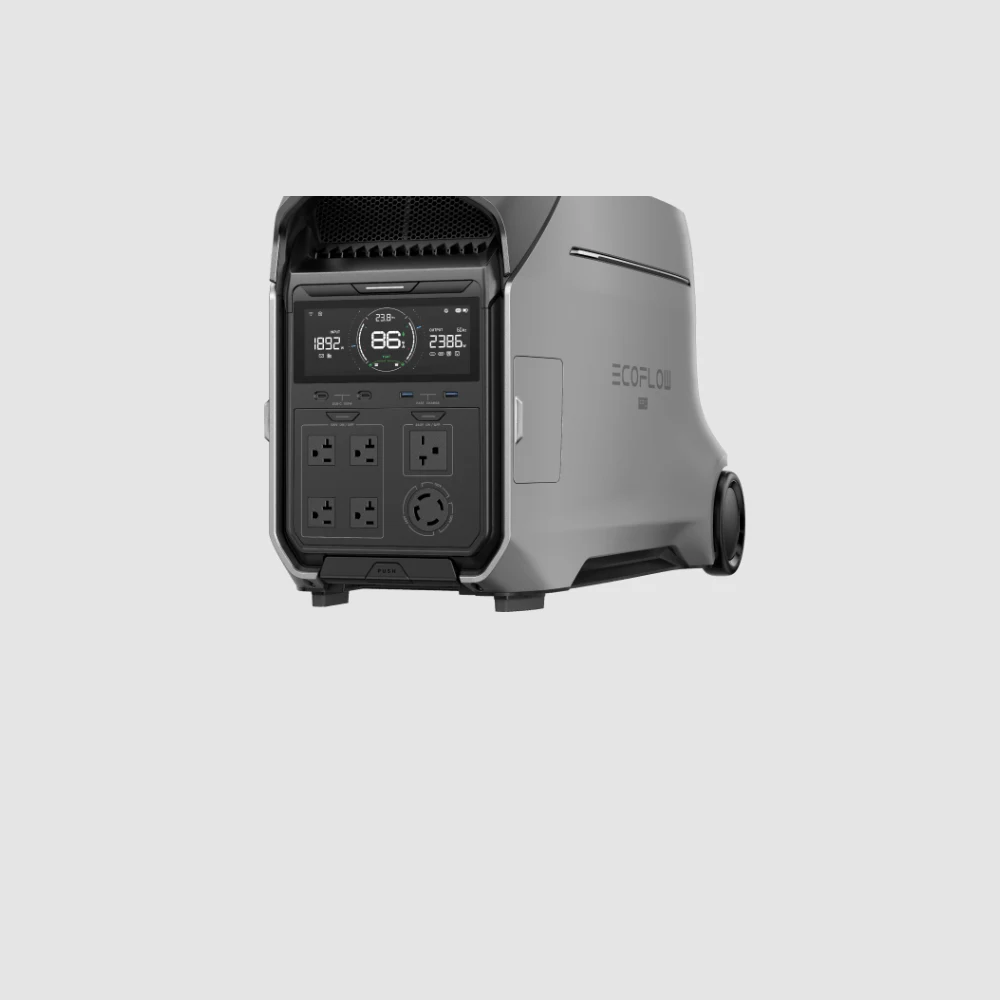
The battery capacity lands in the roughly 4,000Wh class, paired with a continuous inverter output around 4,000W and a surge rating around double that. What sets it apart from most competitors is that the inverter supports split-phase output at both 120V and 240V — the same basic setup a whole-home generator uses. That’s the detail that lets the Delta Pro 3 realistically power something like a 240V well pump or a small HVAC circuit, not just standard household outlets.
Charging speed is genuinely one of its strong points — EcoFlow’s own figures put a meaningful AC recharge at well under an hour, which matters if you’re trying to squeeze in a full charge during a lull between waves of a storm.
Outlets and Expansion
You get four 120V outlets, an L14-30 generator-style plug, a dedicated 30A plug that RV owners will appreciate, and a handful of 12V options. On the expansion side, the system can scale up considerably with additional battery modules — we’re talking “power a home through a multi-day grid failure” territory, not “keep a cooler cold at a tailgate” territory.
What It Costs
List pricing on this one is steep — it sits up in the mid-to-high $3,000s at MSRP. Real-world street pricing has tended to land noticeably lower, though exactly how much lower depends on when and where you’re shopping, so treat any number you see here as a snapshot rather than a promise. At full list price, I’d tell you to wait; this category discounts often enough that patience usually pays off. Once it drops meaningfully below list, it starts looking like genuinely strong value for the output and dual-voltage support you’re getting.
Who This Actually Makes Sense For
- Homeowners in storm-prone regions who want to keep major appliances running, not just lights and a phone charger
- RV owners who need serious, sustained wattage rather than occasional convenience power
- Anyone building an off-grid or hybrid solar setup who wants a unit that can scale up over time
Honestly, this is overkill for a casual camper — I’d steer that buyer toward something in a smaller capacity class instead. The Delta Pro 3 is a tool for people with a specific, serious power problem to solve: a big house, storm season, or an off-grid property.
Where It Falls Short
It’s heavy, it’s expensive even on sale, and the full home-integration hardware — transfer switches, panels — adds real cost on top of the unit itself. What stood out to me digging through aggregated owner feedback is how few complaints show up about the inverter failing to deliver its rated continuous output under sustained load. That’s not something every “flagship” power station can claim, and it’s the kind of spec I’d trust the least at face value from most other brands.
My Take
If genuine whole-home resilience is the goal and you’re prepared to pay for it, the Delta Pro 3 is one of the only single-unit power stations that can credibly deliver on that promise. Just don’t buy it at full list — wait for a sale, and budget separately for the home-integration accessories if that’s the route you’re taking.
Full Spec Rundown
Specs below are manufacturer-listed and approximate — confirm exact figures on EcoFlow’s product page before purchasing.
- Capacity: roughly 4,000Wh LFP, expandable well into the tens of kWh with additional battery modules
- Continuous output: around 4,000W, with roughly double that in surge capacity
- Voltage support: 120V and 240V split-phase
- AC charge time: well under an hour to a meaningful state of charge on fast AC input
- Weight: around 113 lbs (51.5 kg) — this is a unit you position once and largely leave in place, not one you carry between rooms
What Expanding the System Costs You
Scaling this system up isn’t cheap. Each additional battery module adds a significant amount on top of the base unit price, and getting anywhere near the maximum expansion ceiling means a total investment well into five figures — so treat that ceiling as a theoretical maximum, not a realistic shopping target. Most homeowners who expand at all add one extra module, using it to cover a specific gap like an extra day of runtime or one additional high-draw circuit, rather than chasing the max. Go in understanding the base unit is the real product here; the expansion ceiling is more of a “nice to know it’s possible” detail for most buyers.
Installation Considerations
If your goal is automatic backup for specific circuits in your home — rather than manually plugging appliances into the unit — you’ll need a transfer switch installed by a licensed electrician. That’s an additional cost and project on top of the unit itself, worth budgeting and planning for before you buy rather than treating as an afterthought once the Delta Pro 3 is already sitting in your garage.
Frequently Asked Questions
Can I move the Delta Pro 3 around my house easily?
It has wheels and a handle for exactly this reason, but given its weight, “easily” is relative. Expect to roll it deliberately across flat surfaces rather than lift or carry it any real distance.
Is the 240V output compatible with any well pump?
It depends entirely on your specific pump’s starting (surge) wattage, not just its running wattage. Check your pump’s nameplate specs against the Delta Pro 3’s surge rating before assuming compatibility — don’t guess on this one.
How loud is it while charging or under load?
Internal cooling fans spin up under heavier load or fast charging, producing a noticeable hum that’s far from disruptive — nowhere near gas generator noise, but not silent either.
Is the split-phase feature overkill for you?
Before paying the premium this unit commands, be honest about whether you actually need 240V split-phase output. If your home backup needs are limited to a fridge, some lighting circuits, a router, and maybe a window AC unit, you don’t need this feature — a 120V-only unit at a lower capacity and price point would serve you just as well day to day. The 240V support earns its keep specifically if you’re trying to back up something like a well pump, an electric dryer circuit, or part of a central HVAC system — genuinely demanding loads that a standard 120V power station simply can’t touch, regardless of its wattage rating. One last practical note: if you go with the Delta Pro 3 for its split-phase capability, get a licensed electrician to confirm your specific panel and circuits are compatible before you buy the transfer switch hardware. A quick consultation up front avoids a returned or mismatched purchase down the line.
Related Reading
- Jackery Explorer 2000 Plus Review: Is It Worth It in 2026?
- Budget Power Station Showdown: Best Options Under $500 in 2026
- EcoFlow Delta 3 Plus vs Jackery Explorer 1500 Ultra: Which Power Station Wins in 2026?