

You don’t need to spend a small fortune to find a power station under $500 that’s actually worth having. That’s the biggest shift in this category over the last couple of years — LiFePO4 batteries, once found mostly on pricier units, are now standard even in the budget tier. At the low end of this list you’re buying a phone-and-laptop charger with a battery in it; at the top end of the range you’re buying something that can actually keep a fridge running through a bad afternoon. The gap between those two is bigger than it looks on a spec sheet. Prices and specs below are approximate and current as of July 2026 — always check the manufacturer’s own product page for today’s numbers before buying.
This article may include affiliate links — if you buy through them we may earn a small commission at no extra cost to you, but our recommendations are based on our own independent research.
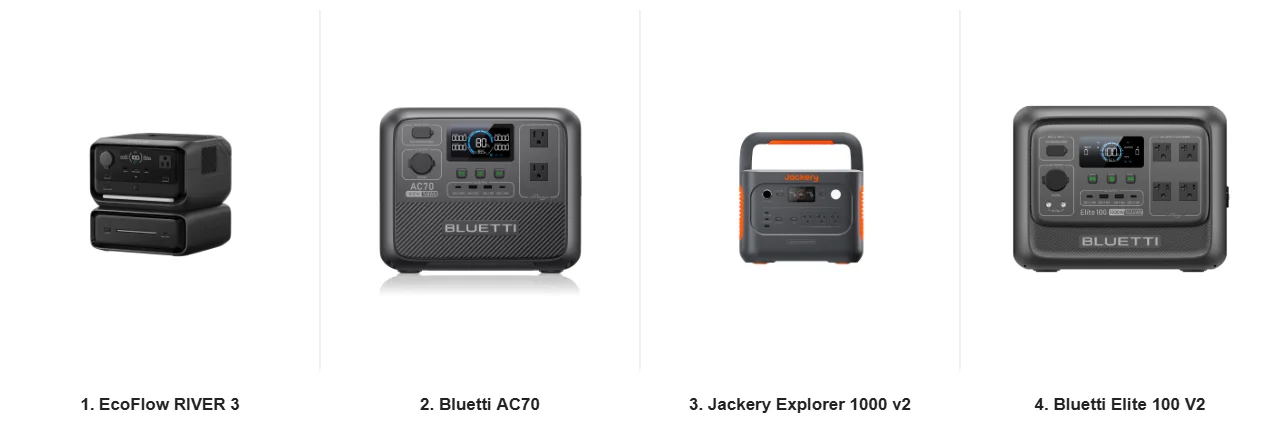
EcoFlow RIVER 3 — Most Affordable
The RIVER 3 sits at the bottom of this list on purpose. It’s priced around the $200 mark, with roughly 250Wh of capacity and about 300W of output — not enough to run a fridge, so don’t buy this expecting appliance backup. (Check EcoFlow’s product page for current pricing and exact specs, since both shift over time.) What it’s actually good for: keeping phones, a laptop, and maybe a CPAP topped up through a short outage. I’d point a first-time buyer here only if the budget is genuinely tight and the use case is modest.
The EcoFlow RIVER 3 was previously available through Outbound Power, but it is no longer listed in their current catalog. We will add a link back if it returns to stock through one of our affiliate partners.
Bluetti AC70 — Best Mid-Range Pick
Step up a tier and you land on the AC70, generally priced in the high-$300s to low-$400s, with capacity in the roughly 750-800Wh range and output around 1,000W — confirm current numbers on Bluetti’s site before buying. This is where the category starts pulling its weight: enough to run a mini-fridge, charge several devices at once, and handle small power tools without flinching. Honestly, if someone asked me for one recommendation under $500, this would be it more often than not.
Jackery Explorer 1000 v2 — Best Capacity for the Price
The Explorer 1000 v2 offers roughly 1,000Wh-plus of capacity and continuous output in the 1,500W range. Its standard list price is $799, but it frequently drops under $500 during sales and promotions, which is when it’s worth grabbing. Verify current specs and pricing on Jackery’s page, since both are subject to change. On a pure capacity-for-the-money basis when it’s on sale, it stands out in this price range.
The Jackery Explorer 1000 v2 is available directly from Jackery. Check current price on Jackery →
Bluetti Elite 100 V2 — Best Price-to-Capacity Ratio
At roughly 1,000Wh-plus capacity, the Elite 100 V2 consistently comes up as one of the better cost-per-watt-hour options in this bracket — though you’ll want to check Bluetti’s current listed price to do that math yourself, since sale pricing shifts often. If you’re the type who runs the numbers before buying rather than eyeballing the price tag, put this on the shortlist.
Other Solid Options
The EcoFlow Delta 3, Anker C1000, and Bluetti EB70S round out the category, and none of them are a bad choice. The real decision usually comes down to weight, capacity, or whether you already own solar panels or accessories from one of these brands — matching your ecosystem saves you from buying adapters later. Check each brand’s site directly for current specs and pricing before comparing.
The EcoFlow DELTA 3 and Anker SOLIX C1000 Gen 2 are both available through Outbound Power: Check current price on the EcoFlow DELTA 3 → or Check current price on the Anker SOLIX C1000 Gen 2 → For a closer look at what makes it worth considering at this price, see our full review of the Anker SOLIX C1000 Gen 2.
How to Choose a Power Station Under $500
If your needs are light — charging devices, nothing more — the RIVER 3 covers it. Want to actually run something that matters if the power goes out? Look at the AC70 or the Explorer 1000 v2. And if you’re purely optimizing for capacity per dollar on a power station under $500, the Elite 100 V2 tends to win that math, though it’s worth checking Bluetti’s current pricing before you decide.
Full Comparison at a Glance
Specs and pricing below are approximate and change often — always confirm current numbers on the manufacturer’s own product page before buying.
- EcoFlow RIVER 3: lightest and most affordable in this lineup — device charging only
- Bluetti AC70: the first tier that comfortably handles a mini-fridge and small tools
- Jackery Explorer 1000 v2: best raw capacity-to-price ratio on this list
- Bluetti Elite 100 V2: best cost-per-watt-hour value based on current pricing at time of writing
- EcoFlow Delta 3, Anker C1000, Bluetti EB70S: comparable alternatives worth cross-shopping based on current sales
Where to Actually Find Deals
This category discounts often. Prices fluctuate seasonally, especially around Black Friday, Prime Day, and clearance windows ahead of new model releases — so if your need isn’t urgent, waiting for one of those windows can meaningfully lower what you’d pay. I don’t have hard data on typical discount depth, so treat any specific percentage you see elsewhere with some skepticism until you check it against the current listed price yourself.
Budget Doesn’t Mean You Should Ignore Chemistry
Every unit on this list runs LiFePO4 chemistry, which is well known for holding up over far more charge cycles than older lithium-ion batteries — check each manufacturer’s spec sheet for the exact cycle rating, since that number is worth confirming rather than assuming. If you come across a suspiciously cheap deal that doesn’t specify LiFePO4 chemistry, treat that as a reason for extra scrutiny, not excitement.
What You Give Up Compared to Pricier Units
Nobody selling a power station under $500 volunteers this, so I will: you’re trading real capability for that price, not getting a shrunk-down version of the expensive stuff. Continuous output tops out meaningfully lower than pricier units, which rules out anything with a compressor running for long stretches — check each unit’s spec sheet for its exact continuous wattage rating. Solar input ceilings are modest too, so recharging via panels takes noticeably longer than pairing a premium unit with a larger panel array. Most budget units give you one or two AC outlets, not four or five, and the plastic housing, while functional, doesn’t feel as reassuring dropped on concrete as a much pricier, metal-reinforced unit does.
None of that makes these bad purchases. It makes them purchases for a specific job. Keeping a phone, a CPAP, some lights, and a laptop alive through a weekend outage or a car-camping trip? A budget LiFePO4 unit handles that as reliably as something costing much more. Where I’d steer you toward spending more: if a fridge, a window AC unit, or genuinely simultaneous heavy loads are part of the actual plan. That’s where the lower continuous wattage stops being a minor inconvenience and starts being a real limitation — the battery in these budget units will likely outlast the rest of the electronics either way, which is the real headline of this category, more than any single spec number.
Frequently Asked Questions
Is it worth spending a bit more for more capacity?
Usually, yes. Moving up from an entry-level unit like the RIVER 3 to a mid-tier option like the AC70 unlocks real appliance-running capability for a relatively modest price difference — check current prices to see exactly how much that step costs today. Either way, a power station under $500 can still be the smarter buy if your actual needs stay modest.
Do budget units skip safety certifications to hit their price?
Not from the brands covered here — EcoFlow, Bluetti, Jackery, and Anker maintain proper certifications across their whole lineup, budget tiers included. Where certification gaps actually show up is on no-name marketplace brands, not these.
Can I return a budget unit if it doesn’t work out?
Buy from a major retailer or directly from the brand and you’ll typically get a standard return window — exact terms vary, so check the specific policy before buying. That’s one more reason to skip ultra-discount marketplace listings from sellers you don’t recognize, where return policies can be murky or unenforced.
Don’t Forget Accessory Costs
The sticker price isn’t the whole story at this budget tier. Want solar charging? Budget extra for a compatible panel — costs vary a lot by wattage, so check current panel pricing rather than assuming a fixed number. Some brands bundle a panel at a discount if you buy together, which is worth checking before buying separately. Cables, car-charging adapters, and a case add up too if you actually plan to use this regularly instead of leaving it in a closet.
One more thing: check whether the retailer offers a price-match or price-drop refund policy. This category discounts often enough that buying today and seeing the price drop next week is a genuinely common frustration, and a price-match policy is the only thing that saves you from it. Keep your receipt, register the product with the manufacturer, and any future warranty claim goes faster.
Related Reading
- Bluetti Premium 100 V2 Review: Compact Power for Everyday Use
- Anker SOLIX C2000 Gen 2 Review: A Strong Jackery Alternative?