
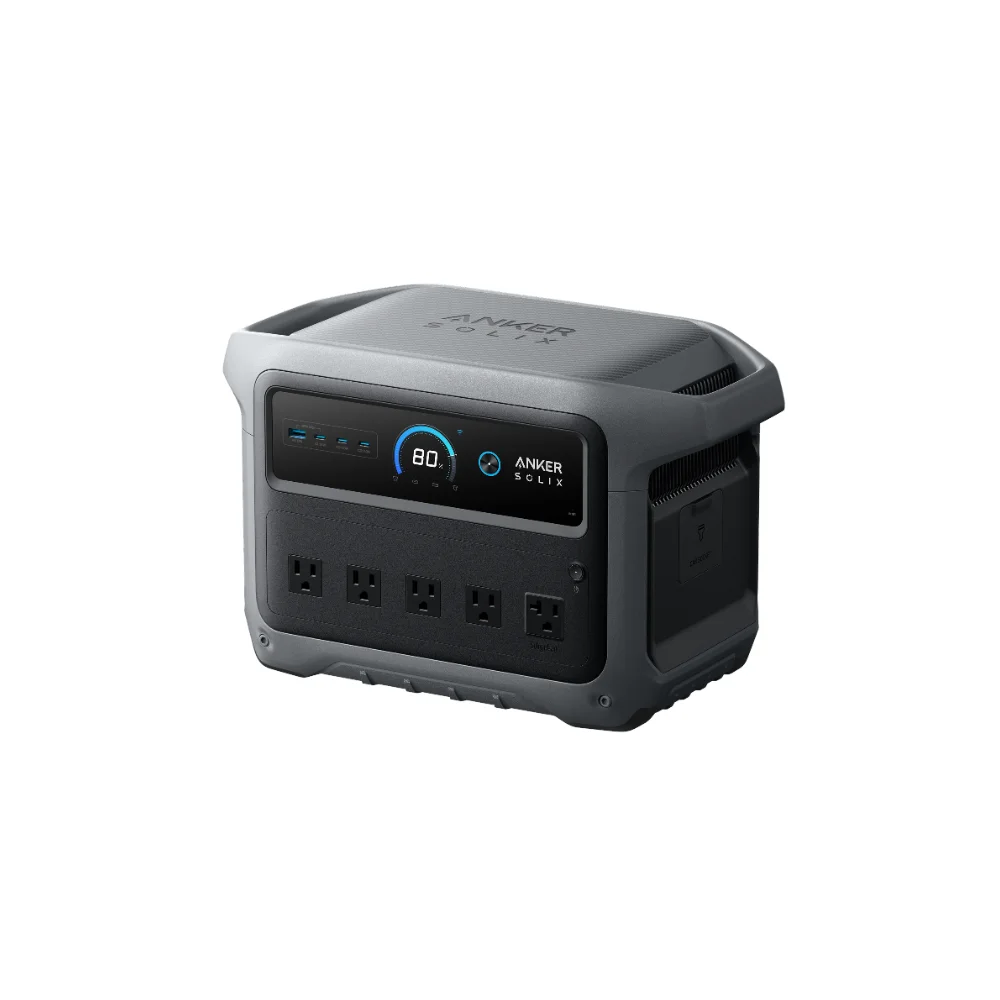

Continuous vs peak watts power station specs trip people up constantly: a unit listed as “1,000W / 2,000W peak” gets read as “I can run a 2,000W device on this.” That’s not what it means, and misunderstanding continuous vs peak power is probably the single most common mistake I see buyers make before they even own the thing.
This article may include affiliate links — if you buy through them we may earn a small commission at no extra cost to you, but our recommendations are based on our own independent research.
Continuous vs Peak Watts Power Station: The Number That Matters Day to Day
Continuous (or “running” or “rated”) power is the steady output the inverter can sustain over time. If a device draws 800W running, and your station’s continuous rating is 1,000W, you’re fine — with some margin. This is the number you should compare against your device’s actual running wattage, printed on most appliance labels or in the manual.
Peak Power: A Very Short Burst, Not a Ceiling You Can Live In
Peak (or “surge”) power is the higher number the inverter can supply for a fraction of a second — usually under one second — to handle the startup spike that motor-driven devices produce. A fridge compressor idling at a couple hundred watts can spike to well over double that the instant it kicks on. A pancake air compressor running at over 1,000W can briefly demand several times that at startup. If the station’s peak rating can’t cover that instant, the inverter trips and the device simply won’t start — even though it would run fine once going.
My take: peak power is a pass/fail gate for motor-driven devices, not extra continuous capacity you can plan around. Don’t buy a station based on the peak number matching your device’s continuous draw — that’s backwards.
Which Devices Actually Care About This
- Fridges and freezers — compressor startup spike, often a couple times the running wattage
- Power tools with motors — drills, saws, compressors
- Sump pumps and well pumps — can spike dramatically at startup
- Air conditioners — compressor-driven, similar spike behavior to fridges
Purely resistive loads — heaters, most lighting, phone and laptop chargers — don’t really have a meaningful surge, so continuous power is basically the only number that matters for those.
How to Actually Check Before You Buy
Find your device’s running watts and, for anything with a motor or compressor, its startup/surge watts if listed (many appliance manuals or spec plates include this, or you can find typical figures for that device category online). Compare running watts against the station’s continuous rating, and surge watts against its peak rating. Both need to clear — not just one.
Our Recommendation
Never size a power station off the peak number alone. Match your device’s continuous running wattage against the station’s continuous rating first, then double-check the surge/peak rating against your device’s startup spike if it’s motor-driven. Getting this backwards is the most common — and most avoidable — mistake in this category.
FAQ
Why won’t my fridge start even though the wattage looks fine?
The station’s peak/surge rating likely can’t cover the compressor’s startup spike, even though its running wattage is well within the continuous rating.
Does peak wattage mean I can run that much continuously?
No — peak power is available only for a fraction of a second at startup, not as a sustained output level.
Real Devices: Running vs Surge Wattage
Figures below are typical ballpark examples, not specs for any specific product — actual wattage varies by model, so check your own device’s label.
| Device | Running Watts | Typical Surge Watts |
|---|---|---|
| Mini fridge / cooler | 60-150W | 200-400W |
| Full-size fridge | 150-400W | 800-1,200W |
| Sump pump (1/3 HP) | ~800W | 1,300-2,000W |
| Window AC unit | 500-1,200W | 1,800-3,600W |
| Circular saw | 1,200-1,400W | 2,500-3,000W |
| Space heater | ~1,500W | ~1,500W (resistive, no real surge) |
Notice the space heater at the bottom — a purely resistive load has essentially no surge above its running wattage, which is exactly why it is the easy case. Everything above it with a motor or compressor is where the peak-versus-continuous distinction actually decides whether your setup works at all.
What Actually Happens When You Exceed the Rating
This is not a gradual degradation — it is a hard cutoff. Exceed the continuous rating for more than a few seconds and the inverter will typically shut down entirely as an overload protection measure, cutting power to everything connected, not just the offending device. Exceed the peak/surge rating for that split-second startup moment, and the device simply will not start; you will hear the motor try and fail, or see an error code on the station itself. Neither of these damages the power station in a properly designed unit — the protection circuitry exists specifically to prevent damage — but it does mean a failed, jarring interruption at exactly the moment you needed the device to work, which is worse in practice than it sounds on paper.
What I have found genuinely useful: test any motor-driven device you plan to rely on before you need it in a real situation, not during an actual outage or on day one of a trip. A five-minute test run at home tells you everything the spec sheet cannot.
A Note on Pure Sine Wave vs Modified Sine Wave
Almost all current-generation power stations in this niche output pure sine wave power, which matters for this discussion because modified sine wave inverters (common in older or cheaper units) can cause motor-driven devices to run hotter, less efficiently, or in some cases refuse to start at all, independent of the wattage numbers being technically sufficient. If you are looking at an older or budget unit, confirm it is pure sine wave before assuming the continuous/peak numbers alone tell the full story.
Where do I find my device’s actual surge wattage if it is not printed anywhere?
Search the specific model number plus “starting watts” or “surge watts” — manufacturer support pages, appliance forums, and generator sizing guides often list this figure even when it is missing from the device’s own label.
Can I add a soft-start device to reduce a compressor’s surge?
Yes, for some fridges, AC units, and pumps, an aftermarket soft-start device can meaningfully reduce startup surge, which can let a smaller power station run a device it otherwise could not — worth researching if you are right on the edge of a unit’s peak rating for one specific appliance.
Bottom line: two numbers, not one. Check continuous rating against running watts, check peak rating against startup surge, and only trust a station for a motor-driven device when both comfortably clear.
Get this right once, at purchase time, and it stops being a recurring source of confusion every time you add a new appliance to your setup.
Related Reading
- How to Choose the Right Power Station Capacity (Wh) for Your Needs
- When to Buy: Best Time of Year for Power Station Deals in 2026