

Quick Verdict
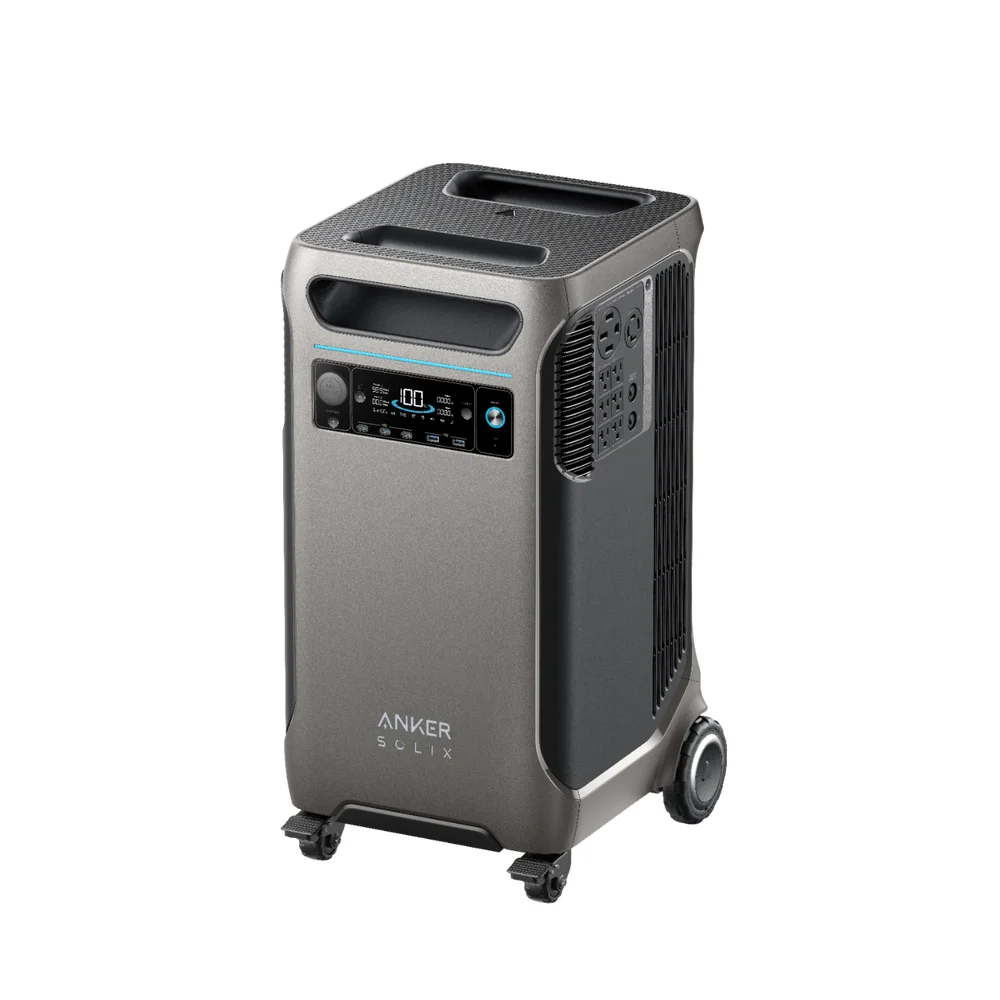
The Anker SOLIX F3800 is built for one job: replacing a chunk of your home’s electrical panel during an outage, not just keeping your phone charged at a campsite. With a 3,840Wh base capacity, a 6,000W continuous output (12,000W with dual-unit stacking), and a 2,400W solar input, it sits in the same weight class as EcoFlow’s DELTA Pro Ultra and Bluetti’s AC500 system. It’s heavy, it’s expensive, and it’s genuinely one of the fastest-charging large power stations on the market right now. If you want portable, look elsewhere. If you want a battery that can run your fridge, well pump, and half your outlets at once, keep reading.
How We Evaluated This Review
This review draws on Anker’s published specifications and official product documentation for the SOLIX F3800, cross-checked against verified owner reports and independent discussion threads covering real-world charge times and expansion setups. We have not physically tested this specific unit ourselves. Where we’re making an inference rather than restating a manufacturer number — runtime estimates, comparative positioning against competing systems, or what a typical installation looks like — we say so directly. Our full editorial approach is outlined on our About page.
Anker SOLIX F3800 Specs at a Glance
| Capacity | 3,840Wh (expandable to 26,912Wh with BP3800 expansion batteries) |
| Continuous output | 6,000W (12,000W split-phase with two units) |
| Surge output | Up to 12,000W |
| Solar input | Up to 2,400W |
| AC charging | 0-80% in roughly 43 minutes on the fastest setting |
| Battery chemistry | LiFePO4 (LFP) |
| Weight | Around 99 lbs (45 kg) for the base unit |
Who It’s Actually For
Forget throwing this in a truck bed for a weekend at the lake. At nearly 100 lbs, the F3800 is a stationary or semi-stationary unit — the kind you wheel into a garage or utility room and leave plugged into a wall or a transfer switch. Anker is positioning it directly against whole-home backup systems, and the spec sheet backs that up: 6,000W continuous is enough to run a well pump, a refrigerator, a window AC unit, and a handful of outlets simultaneously without careful load management.
Where it separates itself from competitors is charge speed. A full recharge from a wall outlet in under an hour is unusual at this capacity — most large power stations in this class take two to three hours for a comparable charge. If you’re prepping ahead of a forecasted storm, that speed difference matters more than most spec-sheet numbers.
The 99-lb weight is also worth sitting with before buying. Moving it between rooms is realistic with the included wheels, but it is not something one person carries up a flight of stairs without the wheeled base doing the work. Plan its home location around where you can roll it, not carry it.
Real-World Runtime: What the Base 3,840Wh Actually Covers
Using Anker’s published capacity and standard LiFePO4 efficiency assumptions (85-90% delivered after inverter losses), here’s roughly what the base unit gets you before adding expansion batteries:
| Appliance / Load | Typical draw | Approx. runtime on base 3,840Wh |
| Refrigerator (cycling compressor) | ~150W average | ~20-22 hours |
| Well pump (intermittent use) | ~1,000W when running | ~3-3.5 hours of active pump time |
| Window AC unit | ~1,200W | ~2.5-3 hours continuous |
| Combined essentials (fridge, lights, router, a few outlets) | ~500W combined | ~6.5-7 hours |
Add BP3800 expansion batteries and total capacity scales up to 26,912Wh, which stretches a multi-circuit setup across several days of intermittent use rather than hours — the expansion path is really what turns this from a large power station into genuine whole-home-adjacent backup.
Solar Recharge: Topping Up During an Extended Outage
With a 2,400W solar input and a properly sized array, the F3800 can pull in meaningful daytime charge even while running loads, which matters for a multi-day outage scenario where wall power isn’t an option. As with any solar-paired system, actual recharge speed depends on matching your installed panel wattage to the unit’s input ceiling — a common point of confusion for buyers who assume the rated maximum applies regardless of what panels they connect. A full recharge purely from solar will take considerably longer than the 43-minute AC figure, and realistic timing depends heavily on panel wattage, sun hours, and weather.
Setting Up the F3800 for Home Backup
For buyers who want it to power specific circuits automatically during an outage, the F3800 can be paired with a transfer switch and wired into a sub-panel, similar to a portable generator hookup, though many buyers simply run extension cords or a manual interlock setup instead of a full electrical installation. Unlike the DELTA Pro Ultra, Anker does not market the F3800 primarily as a hardwired whole-home solution, so most owners run it as a large portable unit they wheel into place and connect directly to what they need powered, rather than a permanent fixture wired into the panel.
How It Compares
Against the EcoFlow DELTA Pro Ultra, the F3800 charges faster from empty but starts with less expandable ceiling per unit before you’re buying multiple expansion batteries. Against Bluetti’s AC500 system, the F3800 wins on continuous wattage out of the box, while the AC500’s modular battery packs give you more granular control over how much capacity you actually pay for upfront. None of these three is a bad choice — the right one comes down to whether charge speed, output headroom, or upfront modularity matters most for your specific circuit setup.
Buyers weighing this purchase should also factor in noise and maintenance: like the other battery systems in this comparison, the F3800 runs silently with no fuel, exhaust, or scheduled maintenance, which is a meaningful quality-of-life difference from a gas generator even before comparing output or price.
Strengths and Weaknesses, Beyond the Spec Sheet
Pros: Very fast AC recharge time, high continuous wattage for whole-circuit backup, expandable capacity for growing needs, strong solar input for daytime recharging during extended outages.
Cons: Heavy and not realistically portable, premium price tag, expansion batteries add significant additional cost, app and smart-home integration still trail EcoFlow’s ecosystem.
The charge speed is the single biggest differentiator here, and it’s a genuinely practical one rather than a spec-sheet vanity number. A household that can top off from near-empty to 80% in under an hour has real flexibility during a rolling-blackout scenario or a last-minute storm warning that a slower-charging competitor doesn’t offer. That said, buyers should weigh charge speed against total cost of ownership once expansion batteries enter the picture — the F3800’s per-Wh cost climbs as you scale toward its 26,912Wh ceiling, similar to the tradeoff modular systems generally carry.
Anker’s app ecosystem and smart-home integrations are improving but are still generally considered less mature than EcoFlow’s, which matters if remote monitoring and automation are a priority alongside raw output and charge speed.
FAQ
Can the Anker SOLIX F3800 run a whole house? It can run a meaningful portion of a home’s essential circuits — fridge, well pump, some lighting and outlets, a window AC — but “whole house” backup for central HVAC and an electric range typically needs a hardwired system with a transfer switch and often more than one unit.
How long does the battery last before it needs replacing? Anker rates the LFP cells for thousands of charge cycles before dropping to 80% of original capacity, which in practical terms means many years of regular use before you’d notice meaningful degradation.
Is it worth it over a smaller, cheaper power station? Only if your use case genuinely needs 6,000W of continuous output. For camping, RV trips, or basic blackout backup for a few devices, a unit in the 1,000-2,000Wh range will save you a lot of money.
Does it need a transfer switch to work during an outage? Not necessarily — it can run appliances directly via its outlets like any portable power station. A transfer switch is only needed if you want it to automatically power specific home circuits the way a hardwired generator or the DELTA Pro Ultra’s hardwired mode does.
Is the 43-minute charge time achievable on a standard home outlet? Yes, according to Anker’s specs it’s achieved via a standard AC wall connection on the fastest charging setting, not a specialized industrial circuit — though drawing that much power quickly does mean the charger itself pulls close to the maximum a typical 15-20A household circuit can supply.
Can two F3800 units really be combined for 12,000W? Yes, via split-phase stacking, which is how Anker markets the path to genuine whole-home coverage for larger houses — at the cost of buying and housing two full units instead of one.