
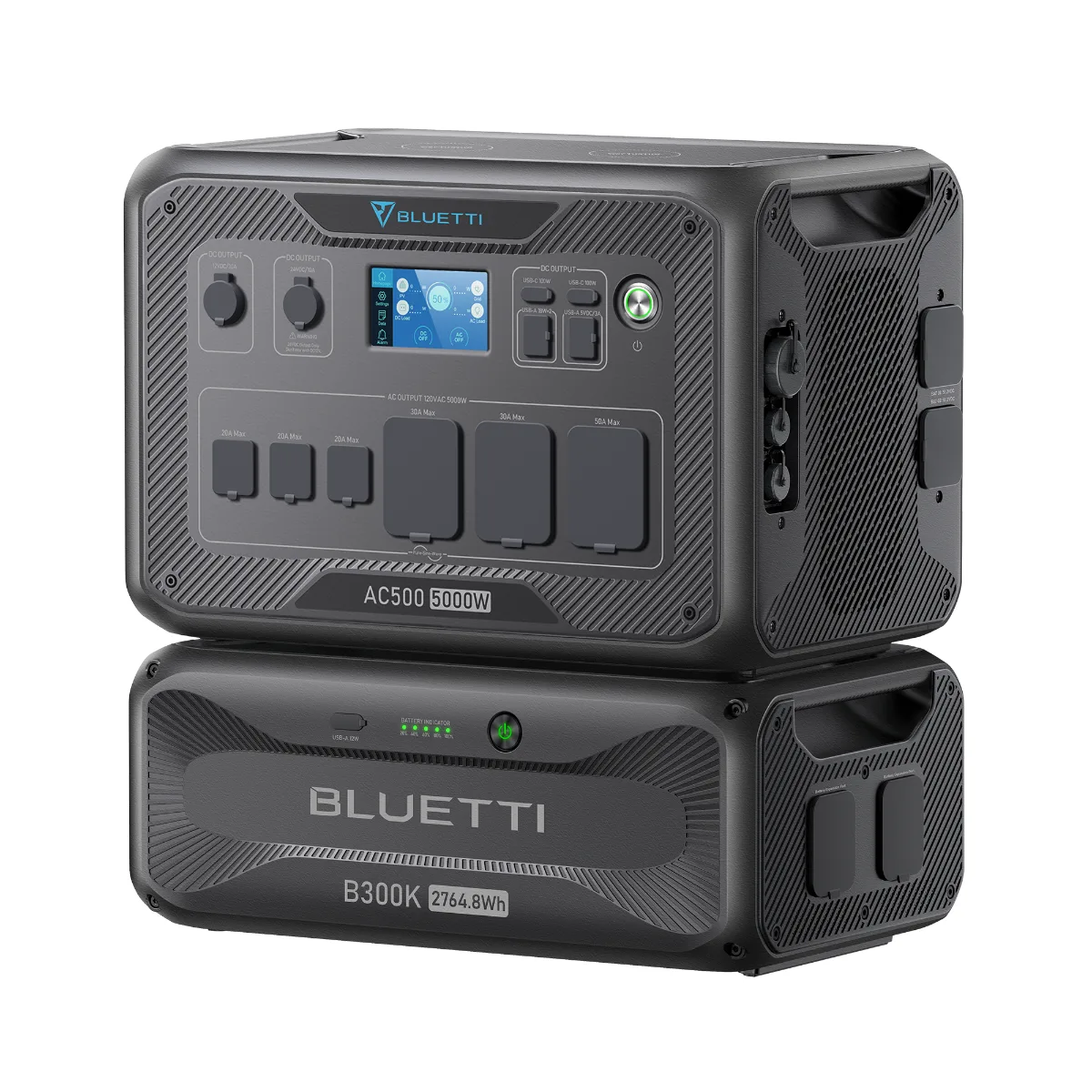

Quick Verdict
The Bluetti AC500 inverter unit paired with B300K battery modules is Bluetti’s answer to the same question Anker and EcoFlow are answering with their largest units: how do you build a power system that scales with the buyer instead of forcing an all-or-nothing purchase? The AC500 delivers 5,000W of continuous pure sine wave output on its own, and each B300K module adds meaningful capacity on top, letting you buy exactly the amount of backup your household needs rather than paying for headroom you’ll never use. It’s a system built for buyers who’d rather grow into a setup over a year or two than commit to one fixed-capacity box on day one.
How We Evaluated This Review
This review is based on Bluetti’s published specifications and official product documentation for the AC500 and B300K modules, cross-checked against verified owner feedback and discussion threads from real users running this setup for home backup and off-grid use. We have not physically tested this specific unit in our own facility. Where we make a judgment call — on ease of use, real-world runtime, or how it stacks up against competing modular systems — we say so explicitly, and we flag the difference between a manufacturer-stated spec and something we’ve inferred from user reports. Our full editorial approach is outlined on our About page.
Bluetti AC500 + B300K Specs at a Glance
| Inverter output | 5,000W continuous pure sine wave |
| Surge output | Up to 10,000W |
| Per-module battery capacity | Roughly 5,100Wh per B300K unit, stackable for multiple modules |
| Battery chemistry | LiFePO4 (LFP) |
| Solar input | High-wattage MPPT input for fast daytime recharging |
| Expansion | Fusion box available for connecting multiple AC500 units for higher combined output |
Who It’s Actually For
The modular approach makes the most sense for buyers who aren’t sure yet how much capacity they’ll eventually want. Start with the AC500 and a single B300K, cover your immediate essentials, and add a second or third battery module later without replacing the inverter unit you already own. That’s a meaningfully different financial commitment than buying a single fixed-capacity unit that’s either more than you need today or not enough for tomorrow.
5,000W continuous is enough for most single-appliance-at-a-time backup scenarios — a fridge and some lighting, a well pump on its own circuit, or a window AC unit — without the higher price tag of the 6,000W-plus units from Anker and EcoFlow’s top tier. It’s a reasonable middle ground for a household that wants real backup capacity without committing to a whole-home transfer-switch installation right away.
It also suits buyers who split their power needs between home backup and mobile use — RV owners or off-grid cabin owners who want a system they can partially relocate. Because the B300K modules are separate, physically portable units, it’s possible to run a leaner configuration most of the time and add a module temporarily for a specific trip or event, something a single fixed-capacity unit doesn’t allow.
Real-World Runtime: What a Single B300K Module Actually Powers
Manufacturer capacity numbers only mean something once you translate them into how long your actual appliances would run. Using Bluetti’s published 5,100Wh per module and standard efficiency assumptions (LiFePO4 systems typically deliver 85-90% of rated capacity to your devices after inverter losses), here’s roughly what one B300K module gets you:
| Appliance / Load | Typical draw | Approx. runtime per B300K module |
| Refrigerator (cycling compressor) | ~150W average | ~26-30 hours |
| Well pump (intermittent use) | ~1,000W when running | ~4-5 hours of active pump time |
| Window AC unit | ~1,200W | ~3.5-4 hours continuous |
| CPAP machine | ~40W average | ~4-5 nights |
| Laptop + Wi-Fi router + a few LED lights | ~100W combined | ~40+ hours |
Stack two or three B300K modules and those numbers scale roughly linearly — a two-module setup covering a fridge continuously for a multi-day outage while still leaving headroom for lights and device charging is a realistic scenario, which is the core appeal of the modular design over a fixed-capacity competitor.
Solar Recharge: Refilling a Module Off-Grid
The AC500’s high-wattage MPPT solar input is one of its stronger selling points for buyers planning off-grid or outage-resilient setups rather than pure grid-charging. With a full-sized solar array matched to the unit’s rated input, a single B300K module can realistically recharge from empty in roughly 4-6 hours of good direct sunlight — closer to a full day if you’re relying on a smaller portable panel setup or working through partial cloud cover. That matters most for the buyer planning around a multi-day grid outage: a system that can meaningfully top up during daylight hours, even partially, extends how long your backup actually lasts without needing every module charged to 100% before the outage starts.
Solar recharge speed scales with how much panel wattage you actually connect, not just the unit’s rated maximum input — a common point of confusion for first-time buyers who assume the spec-sheet number is guaranteed regardless of what panels they pair it with. Matching your solar array size to the AC500’s input ceiling is what gets you the fast recharge times Bluetti advertises.
How the AC500 + B300K Compares
The AC500 + B300K isn’t the only modular, high-output system on the market, and buyers cross-shopping this category are usually also looking at EcoFlow’s and Anker’s equivalent offerings.
Against the EcoFlow DELTA Pro Ultra, the AC500 is the more accessible entry point — the Pro Ultra starts at a larger base capacity and higher output ceiling (7,200W vs. the AC500’s 5,000W), which makes it the better fit for genuine whole-home ambitions, but it also asks for a bigger upfront commitment. The AC500’s lower entry cost and smaller per-module capacity increments give buyers finer-grained control over how much they spend before they’ve confirmed they need more.
Against the Anker SOLIX F3800, the comparison is closer: both are modular, LiFePO4-based systems aimed at the same buyer. The F3800’s 6,000W continuous output gives it an edge for households running larger simultaneous loads, while the AC500’s 5,000W ceiling is the more budget-friendly path if you don’t need that extra headroom. Battery module pricing and availability between the two systems shift often enough that it’s worth checking current numbers on both before deciding.
Strengths and Weaknesses, Beyond the Spec Sheet
Pros: True pay-as-you-grow modularity, strong solar input for off-grid recharging, pure sine wave output safe for sensitive electronics, fusion box option for households that eventually want more than 5,000W.
Cons: Reaching very high total capacity means buying several B300K modules, which adds up in cost; the fusion box for combining multiple AC500 units is a separate purchase; overall footprint gets large once you’ve stacked several modules, so this isn’t a discreet, closet-friendly setup once it’s fully built out.
The modularity is the whole story here, for better and worse. It’s genuinely useful if your budget or your needs are still evolving — you’re not locked into a purchase decision you have to get exactly right on day one. But that flexibility comes with a tradeoff: buyers who already know they want, say, 15,000Wh of capacity will typically pay less per watt-hour buying a single large fixed-capacity unit than assembling the equivalent from several B300K modules. The AC500 + B300K rewards uncertainty and gradual scaling; it doesn’t reward buyers who already have a firm, large capacity target in mind.
Worth noting too: because each module is a physically separate unit, a multi-module setup takes up meaningfully more floor or shelf space than a single large power station with equivalent total capacity. If space is tight, that’s a real practical consideration, not just a spec-sheet footnote.
Frequently Asked Questions
Can I add more B300K batteries later? Yes — that’s the core idea behind the modular design. You can start with one module and add more as your budget or backup needs grow.
Is 5,000W enough for home backup? For most single-circuit or partial-home backup scenarios, yes. For simultaneous heavy loads like central air plus a well pump plus a fridge, you’d want to check your total wattage needs against that 5,000W ceiling first.
Do I need the fusion box? Only if you plan to combine multiple AC500 inverter units for output above 5,000W. A single AC500 with one or more B300K batteries doesn’t need it.
How does the cost per Wh compare to buying a single larger unit? Generally, assembling a large total capacity from multiple B300K modules costs more per watt-hour than buying one large fixed-capacity power station outright. The AC500 + B300K’s value proposition is flexibility and gradual scaling, not the lowest possible cost per Wh at high total capacity.
Can the AC500 run alongside solar panels and grid power at the same time? Yes — the unit is designed to accept solar input while also charging from a wall outlet or running a connected load, which is standard behavior for this class of inverter-based power station and useful for keeping modules topped up during an extended outage with intermittent sun.
Check the current price on the Bluetti AC500 (base unit — B300K battery module sold separately) →