
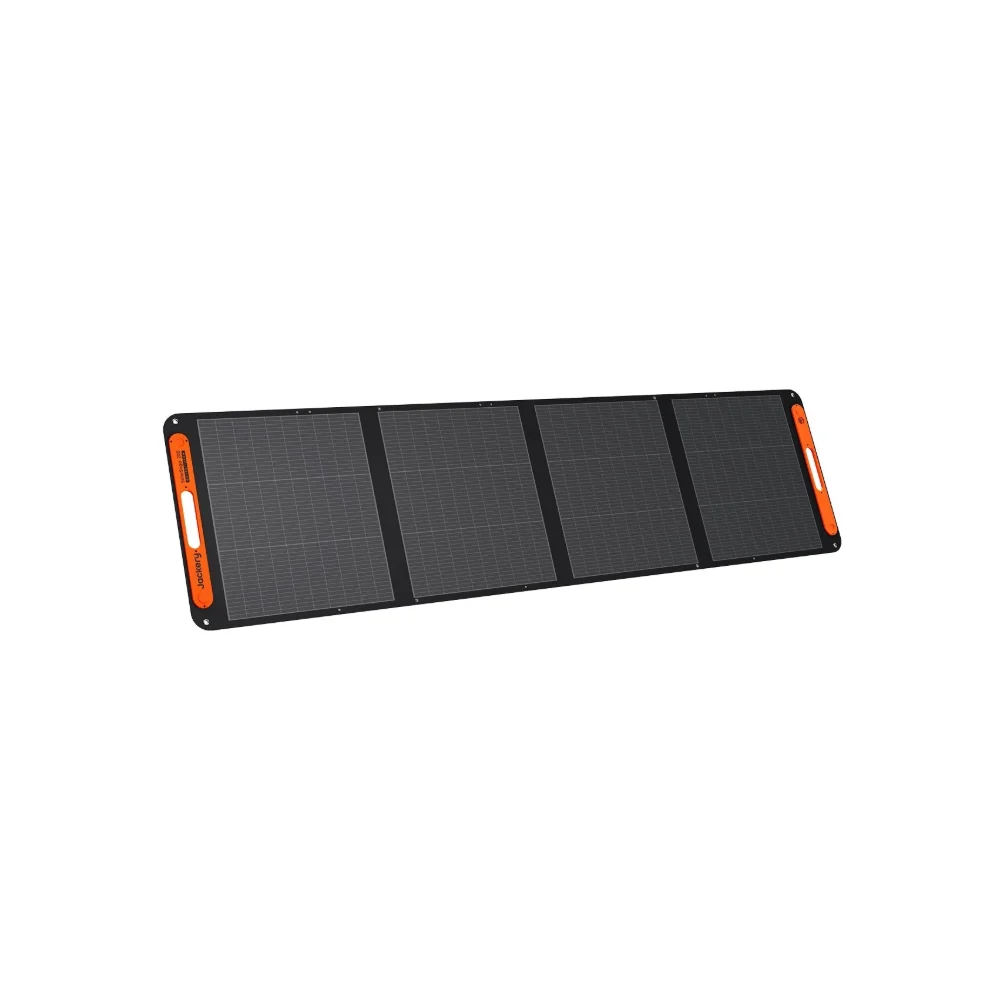

Bifacial solar panels generate power from both faces instead of just one, and the marketing around them makes it sound like free extra watts for no downside. The reality is more conditional than that. A bifacial panel’s rear-side gain depends almost entirely on what’s underneath it — the reflectivity of the ground, how far off the surface it’s propped, and how direct the light is that reaches the back. On a dark tarp or dirt, a bifacial panel might barely outperform a standard monofacial one. On light gravel or snow, propped at a good angle, the gap can be meaningful. Before paying the premium — and bifacial panels do usually cost more per watt — it’s worth understanding exactly what you’re paying for.
How bifacial panels actually work
A standard monofacial panel has an opaque backing behind the cells — light that isn’t absorbed on the front is simply lost. A bifacial panel uses a transparent or semi-transparent rear layer instead, so the cells can also absorb light that’s been reflected off the ground and hits the panel from behind. The front side still does the bulk of the work; the rear side is a bonus that depends entirely on ambient reflected light, not direct sun.
What actually determines the gain
- Ground albedo (reflectivity) is the dominant factor. Dark asphalt reflects roughly 10-15% of incoming light, green grass around 20-25%, light gravel or sand 35-50%, and fresh snow can reflect 80% or more. Doubling the ground’s reflectivity roughly doubles the rear-side gain, so the surface you set the panel on matters more than almost anything else in the equation.
- Elevation off the ground helps. A panel propped higher on its kickstand gives reflected light a wider angle to reach the rear cells; one laid nearly flat on the ground blocks its own rear-side light almost entirely.
- Typical real-world gains land in a fairly wide range. Across ground-mounted bifacial installations generally, published gains commonly fall somewhere in the 5-15% range over an equivalent monofacial panel, with well-positioned setups on reflective surfaces reaching higher. Portable bifacial panels used casually — propped on a folding kickstand rather than professionally elevated and spaced — tend to land toward the lower-to-middle end of that range rather than the best-case scenarios you’ll see quoted in bifacial marketing.
When the premium is worth paying
Bifacial makes the most sense when you can actually engineer conditions in its favor: setting the panel up on light gravel, sand, a reflective tarp, or snow, with good clearance underneath. If you regularly camp or park on reflective terrain, or you’re running a semi-permanent setup where you control the panel’s footing, the extra generation is real and compounds over a season. A panel like the Anker SOLIX PS200 bifacial panel or the smaller Anker SOLIX PS100 bifacial panel gives you that upside without committing to a huge rig, and modular options like the EcoFlow NextGen 220W bifacial panel let you scale up incrementally. For a larger fixed or semi-permanent setup, the high-output SunGold Power 590W bifacial panel is built for exactly this kind of deliberate installation where you can control ground reflectivity and elevation.
When it’s not worth it
If you’re mostly setting panels up on dirt, a dark tarp, forest floor, or grass, and you’re not going to fuss over elevation and angle, a comparable monofacial panel will get you most of the performance for less money. The rear-side gain physically cannot exceed what the ground in front of it reflects — no amount of premium cell technology changes that. Bifacial is also a harder sell on ultralight backpacking setups where the panel gets laid flat out of necessity, since a flat panel blocks its own rear light almost completely regardless of how reflective the technology is.
A simple way to decide
- Ask where the panel will actually sit. If the honest answer is dirt, dark tarp, or grass most of the time, skip bifacial and put the budget toward more front-side wattage instead.
- Ask whether you’ll actually elevate it. Bifacial gains scale with clearance off the ground — if the panel usually ends up nearly flat, you’re not capturing the technology’s advantage.
- Treat the price premium as buying a bonus, not a guarantee. Budget for the front-side performance you’d get from an equivalent monofacial panel, and consider any rear-side gain a nice-to-have rather than the reason you bought it.
Frequently asked questions
Do bifacial panels work if I never elevate them?
They’ll still function as a normal panel from the front side, but you’ll see little to none of the rear-side bonus that justifies the extra cost. A bifacial panel laid flat on the ground is functionally close to a monofacial one.
Is bifacial technology more fragile than standard panels?
Not inherently. The rear layer is typically a durable transparent backsheet or glass rather than a weaker material, so day-to-day durability is comparable to a well-built monofacial panel of similar construction quality.
Can I get bifacial-like gains by just putting a reflective tarp under a regular panel?
That improves the light hitting the front and surroundings, but a monofacial panel still can’t absorb light through its opaque backing — the reflective surface only helps a bifacial panel capture that bounced light on its rear cells. A reflective tarp under a standard panel mostly just brightens the area, it doesn’t add rear-side generation.
Do bifacial panels cost significantly more per watt?
Generally yes, there’s a real premium over an equivalent monofacial panel, though it varies by brand and has narrowed as the technology has matured. Whether it pencils out depends entirely on the ground-reflectivity math above, not on the sticker price alone.