
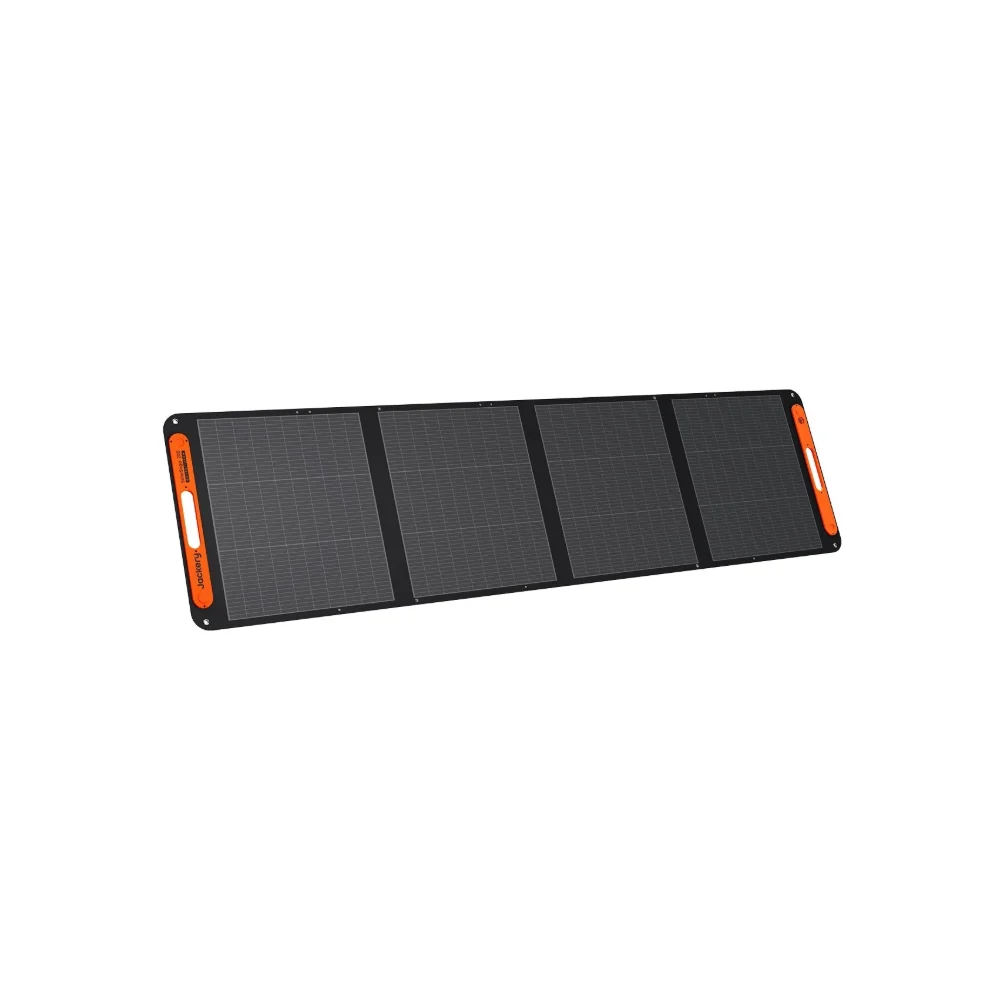

A power station is only as fast as the sunlight reaching its input jack, and for most people that means a foldable solar panel, not a roof-mounted array. Foldable panels pack down to the size of a laptop bag, unfold into two, three, or four hinged sections, and prop themselves up with a built-in kickstand — no tools, no wiring, no permanent mount. The catch is that “foldable solar panel” now covers everything from a 40-watt backpacking panel that weighs less than a water bottle to a 400-watt briefcase that can nearly max out a power station’s solar input. Picking the wrong one means either overpaying for capacity you’ll never use in a tent site, or standing around waiting for a battery that’s charging at a fraction of its potential speed. Here’s how to tell the difference, and which panels on the market right now actually earn their price tag.
What actually separates a good foldable panel from a mediocre one
The wattage printed on the panel is a lab number, measured under Standard Test Conditions that don’t exist outside a lab — full sun, cool cell temperature, panel aimed dead-on at the light source. Real-world output is usually 70-85% of the rated figure once you account for haze, imperfect angle, and cells that run hotter than the 25°C test standard. That’s normal and every brand deals with the same physics. What actually separates panels is everything around the cells.
- Cell type and lamination. Monocrystalline cells under an ETFE laminate (rather than PET) hold up better to UV exposure and flex without micro-cracking over years of folding. ETFE is more expensive but noticeably more durable outdoors.
- Connector type. Nearly every panel uses an MC4 connector at the cable end — that’s the real industry standard for solar. The power station side is where brands diverge, using proprietary DC barrel plugs, XT60, or Anderson connectors, so check what adapter (if any) ships in the box before assuming a panel will plug straight into your station.
- Weight-to-wattage ratio. A 100W panel that weighs 9 lbs is a very different travel companion than one that weighs 4.7 lbs. Ultralight panels use thinner backing and fewer layers of protection, which is a fair trade for backpacking but a bad one for a truck bed that gets tossed around.
- Kickstand and fold count. More panels folding into more segments generally means a smaller packed size but more hinges that can wear out. A sturdy adjustable kickstand matters more for charging speed than most buyers realize, since it’s what lets you actually angle the panel toward the sun instead of laying it flat.
Best foldable panels by use case
There’s no single “best” panel because the right choice depends entirely on how you’re going to carry and use it.
- Best for maxing out a large power station: the Anker SOLIX PS400 puts out a genuine 400W of rated capacity, which is enough to push a station like the Anker SOLIX C1000 Gen 2 close to its 600W solar input ceiling when you pair two panels, or comfortably feed a single 400W-input station on its own.
- Best all-around mid-size panel: the EcoFlow 400W portable panel folds down compactly for its output and pairs naturally with EcoFlow’s own DELTA series, though the MC4 output works with any brand that accepts a standard adapter.
- Best for ultralight backpacking or bikepacking: the Jackery SolarSaga 100W Air trims weight aggressively without dropping to a toy-sized wattage, making it one of the few panels that’s genuinely pleasant to carry for miles.
- Best mid-weight option for weekend camping: the BLUETTI PV350 sits in a useful middle ground — enough wattage to charge a mid-size station in an afternoon, still foldable enough to strap to a pack or truck rack.
- Best for families or car camping who want fast top-offs: the Jackery SolarSaga 200W is an easy single-panel companion for stations in the 1,000-1,500Wh range, refilling a depleted battery in roughly half a day of decent sun.
How much wattage do you actually need
A rough rule that holds up across most portable setups: divide your power station’s battery capacity in watt-hours by 5 (a conservative estimate for real-world peak sun hours in most of the US) to get a target panel wattage for a full recharge in one day. A 1,000Wh station wants roughly 200W of panel to top up from empty within a single sunny day; double that if you’re regularly starting from a low battery and need a faster turnaround, or if you camp somewhere with shorter, hazier days. Don’t just match the panel to the battery size, either — check the power station’s maximum solar input rating, since exceeding it wastes the panel’s extra capacity. Buying a 400W panel for a station that only accepts 200W of solar input doesn’t hurt anything, but the extra wattage is dead weight you’re paying for and carrying for nothing.
Mistakes that quietly cut your charging speed
- Laying the panel flat on the ground. A flat panel at midday loses very little, but in morning or evening sun a flat panel can be capturing under half of what an angled one would. Use the kickstand.
- Ignoring shade on even one cell. A single shaded cell in a series string can drag down output from the entire panel, not just that section — bypass diodes limit the damage but not the lost production.
- Buying based on rated watts alone. Two 200W panels from different brands can perform noticeably differently once you factor in cell quality, connector losses, and how well the kickstand actually holds an angle in wind.
Frequently asked questions
Can I use a foldable panel from one brand with a power station from another?
Usually yes, as long as you match connectors and stay within the station’s voltage and current limits. Almost every foldable panel ends in a standard MC4 connector, and most power stations accept an MC4-to-barrel or MC4-to-XT60 adapter cable. The main thing to verify is the panel’s open-circuit voltage against your station’s rated solar input voltage range.
Do foldable panels work well on cloudy days?
They still produce power, just a lot less of it — often 10-25% of rated output under heavy overcast, since diffuse light lacks the direct-beam intensity cells are optimized for. Don’t plan a trip around cloudy-day charging; treat any output on those days as a bonus rather than the plan.
How long do foldable solar panels actually last?
A well-built panel with ETFE lamination and decent hinges should hold up for several years of regular outdoor use, though the folding points are the first thing to wear. Cell output itself degrades slowly, similar to rooftop panels, so the more common failure mode is physical — a cracked laminate corner or a worn connector — rather than the cells simply stopping work.
Is a higher-wattage panel always better?
Not if it exceeds what your power station can accept, and not if the extra size and weight work against how you actually travel. Match the panel to your station’s solar input ceiling and to your real daily energy use, not to the biggest number on the shelf.