
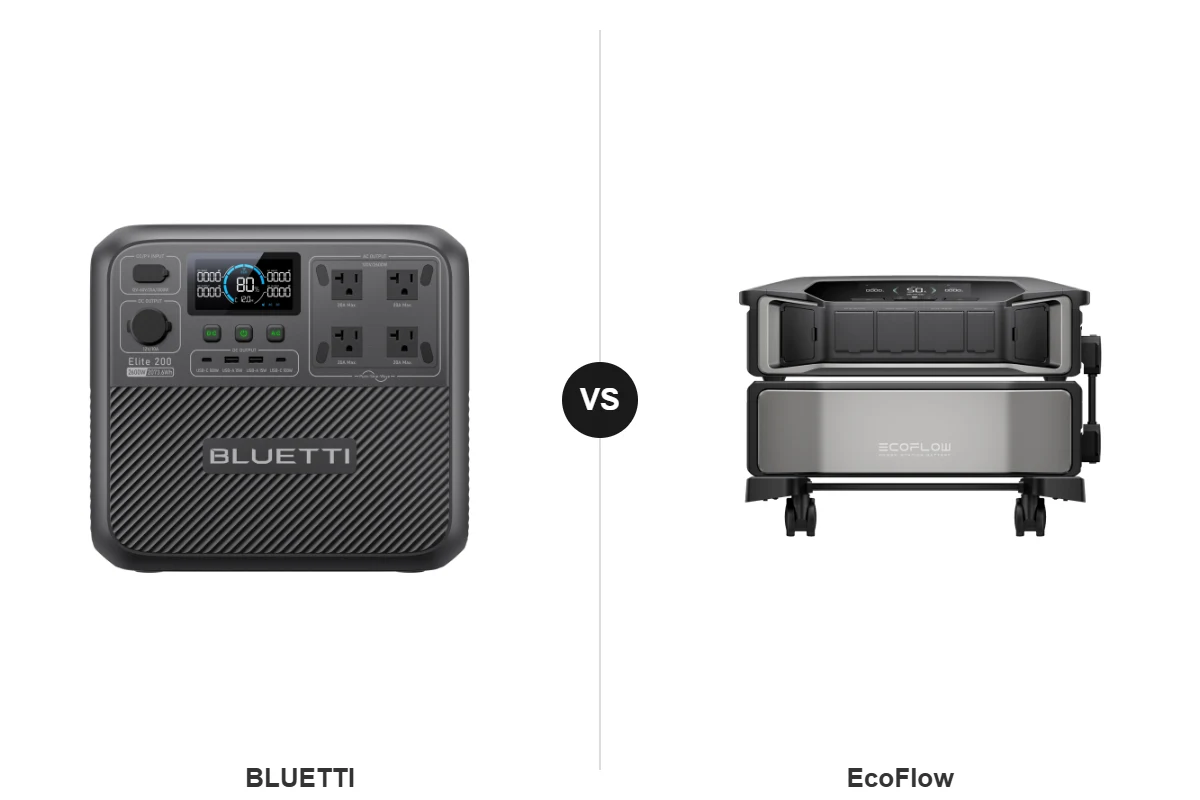

Bluetti and EcoFlow are arguably the two most technically ambitious brands in the portable power station space, and picking between them causes more hesitation than any other matchup we get asked about. Both make excellent hardware. Both push out new models faster than most buyers can track. The real differences show up in charging philosophy, ecosystem thinking, and where each brand puts its engineering budget. Here’s how they actually compare once you look past the marketing pages.
Bluetti vs EcoFlow at a Glance
- Battery chemistry: Both use LiFePO4 (LFP) across their current lineups — a wash
- Charging speed: EcoFlow generally has the edge on ultra-fast AC recharge across its Delta line
- Expansion ecosystem: Bluetti’s expansion battery lineup is broader and often cheaper per added kWh
- App and smart home integration: Both offer solid apps; EcoFlow’s is slightly more polished and adds smart-plug integrations
- Warranty: Both typically offer 4-6 year warranties depending on the model, among the best in the industry
- Price positioning: Bluetti tends to undercut EcoFlow slightly at equivalent capacity, though frequent sales narrow the gap on both sides
Battery Technology and Longevity
There’s no meaningful chemistry advantage here — both brands moved to LiFePO4 across nearly their entire current lineup years ago, and both rate their batteries for thousands of cycles to 80% capacity. If you’re choosing based on “which battery lasts longer,” you’re choosing based on marketing, not chemistry. The real longevity differences come down to build quality and thermal management on individual models, which varies more within each brand’s lineup than between the two brands as a whole.
Charging Speed: Where the Real Difference Shows Up
This is the category where EcoFlow has built its reputation. The Delta Pro 3 and Delta 3 series charge from empty to full via AC in under an hour in several configurations, which is genuinely class-leading. Bluetti has closed the gap significantly with recent releases like the Elite series, but EcoFlow’s flagship charging speed claims still tend to edge out Bluetti’s equivalent-capacity units on paper.
Where Bluetti pulls ahead is total flexibility: many of its units accept a wider combined input (AC plus solar simultaneously) at higher combined wattages, which matters more than peak AC speed alone if you’re trying to recharge fast during a multi-day outage with mixed power sources.
App Control and Smart Features
Both apps let you monitor charge level, control output ports remotely, and schedule charging windows to take advantage of off-peak electricity rates. EcoFlow’s app has generally received better reviews for polish and reliability, and its smart plugs and smart home integrations are a genuine differentiator if you’re building out a broader home energy setup. Bluetti’s app has improved substantially over the past couple of years and covers the essentials well, but it’s playing catch-up in this specific area.
Which Models to Actually Consider
If you’re comparing at the mid-capacity level, it’s worth looking at the Bluetti Elite 300 against the EcoFlow Delta 3 Plus, or the compact Bluetti AC180 against the EcoFlow River 3 Plus. At the high-capacity end, Bluetti’s Apex 300 and EcoFlow’s Delta Pro 3 trade blows depending on whether you prioritize expansion flexibility (Bluetti) or raw charging speed (EcoFlow).
Who Should Choose Bluetti
- Buyers who want to build out a larger capacity system over time using expansion batteries
- Anyone prioritizing simultaneous solar plus AC input for faster recharge during outages
- Shoppers who want slightly better pricing at equivalent capacity
Who Should Choose EcoFlow
- Anyone who wants the fastest possible single-source AC recharge time
- Buyers already invested in smart home ecosystems who want tighter integration
- Shoppers who prioritize app polish and long-term software support
My Take
If you forced me to pick one brand to recommend without knowing anything else about the buyer, I’d lean EcoFlow for its charging speed and app experience, which tend to matter every single day you own the unit. But Bluetti’s expansion ecosystem and combined-input charging make a genuinely strong case for anyone who thinks they’ll want to scale their capacity up later rather than buy their “forever unit” on day one. Neither choice is wrong — this is one of the closer brand rivalries in the category for a reason.
Frequently Asked Questions
Is Bluetti or EcoFlow more reliable?
Both brands have strong reliability track records with modern LiFePO4 units, and reported failure rates are low for both once you stick to models released in the last two to three years. Individual unit reliability tends to vary more by specific model than by brand as a whole.
Which brand charges faster, Bluetti or EcoFlow?
EcoFlow generally holds the edge on pure AC recharge speed across its Delta lineup, with several models charging from empty to full in under an hour. Bluetti has narrowed the gap with recent releases and often wins on combined AC-plus-solar input speed instead.
Can I mix Bluetti and EcoFlow gear in the same setup?
Not directly — expansion batteries, smart panels, and proprietary charging cables are brand-specific and generally won’t cross over. Standard solar panels with MC4 connectors and basic AC devices will work with either brand’s units without issue.
Which brand is better for home backup power?
Both offer capable home-backup options, but Bluetti’s broader and often more affordable expansion battery ecosystem gives it a slight edge for buyers planning to scale up capacity for whole-home backup over time.
Related Reading
- Jackery vs EcoFlow vs Anker SOLIX 2026
- Bluetti Elite 300 Review
- EcoFlow Delta Pro 3 Review
- LiFePO4 vs Lithium-Ion Power Stations
This post may include affiliate links — if you buy through them, we may earn a small commission at no extra cost to you. It doesn’t change what we cover or how we rank anything.
About the Author
Khalid Zirari is the founder of Marjajo, where he researches and compares portable power stations, solar generators, and related backup power gear to help readers cut through spec-sheet marketing and find the right fit for their needs.