
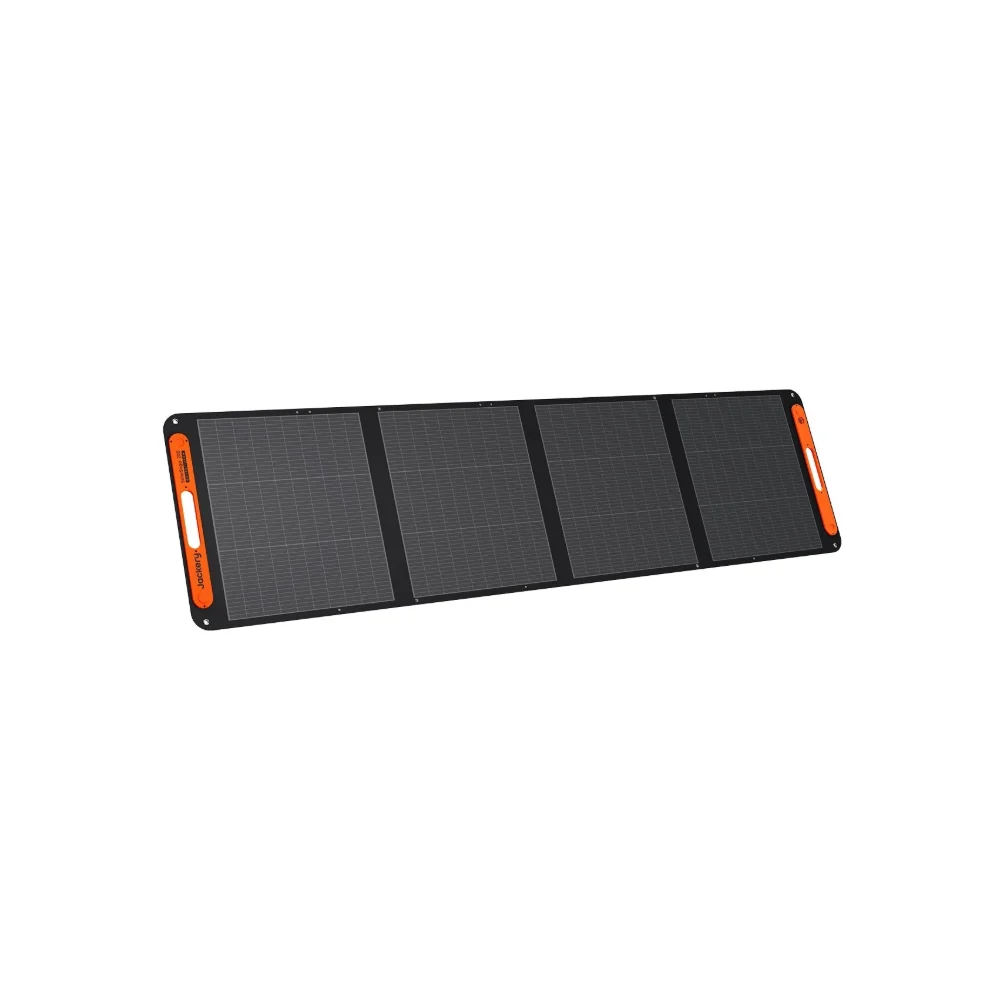

Efficiency is probably the most misunderstood number on a solar panel’s spec sheet. Shoppers see “22% efficient” next to “25% efficient” and assume the second panel makes noticeably more power. Sometimes it does. Often it doesn’t matter much at all for how you’ll actually use the panel. Efficiency measures one specific thing — how much of the sunlight hitting the cell surface gets converted into electricity — and that number interacts with physical size, price, and use case in ways that aren’t obvious from the percentage alone. Here’s what the figure actually means and when it should genuinely factor into a buying decision.
What the efficiency percentage actually measures
Solar cell efficiency is the ratio of electrical power a cell outputs to the total solar energy hitting its surface, measured under Standard Test Conditions — 1,000 W/m² of light, a 25°C cell temperature, and a specific light spectrum. A cell rated at 22% efficient converts 22% of the sunlight hitting it into usable electricity; the rest is reflected, converted to heat, or lost to internal resistance. This is fundamentally a measure of power output per unit of surface area, not a measure of total output or “how good” a panel is in any broader sense.
Where today’s panels actually land
Commercial monocrystalline panels on the market today generally run in the 20-26% efficiency range, with anything at 22% or above typically marketed as “high efficiency.” The best commercial monocrystalline cells push toward the high-24% to 26% range, getting closer to silicon’s theoretical single-junction ceiling — a limit that sits around 29% under standard conditions, a boundary set by fundamental physics (the Shockley-Queisser limit) that silicon cells can approach but not exceed without exotic multi-junction designs. Polycrystalline cells, once common in budget panels, typically run lower, in the high teens, which is part of why monocrystalline has become the default for nearly all portable solar panels sold today. Portable foldable panels sometimes report slightly lower whole-panel efficiency than the bare cell rating would suggest, since the number for a finished product accounts for the frame, gaps between cells, and lamination losses, not just the raw cell.
Why a higher percentage doesn’t always mean more usable power
- Total wattage matters more than efficiency for most buyers. A larger 22%-efficient panel can easily out-produce a smaller 25%-efficient one in absolute watts. Efficiency tells you how much power you get per square foot, not how much power you get, period — those are only the same question if panel size is fixed.
- Efficiency mainly matters when space or weight is the constraint. If you need to fit maximum wattage into a limited roof area, or minimize weight per watt for backpacking, a higher-efficiency panel genuinely earns its premium. If you have room to simply add more panel area, chasing an extra couple of efficiency percentage points is often not worth the added cost.
- Real-world output depends on far more than the cell’s rated efficiency. Angle, temperature, shading, and dust all move actual output more than the difference between a 21% and a 23% efficient cell typically does in day-to-day use.
When efficiency should actually drive your decision
Efficiency earns its keep in space- or weight-constrained situations. On an RV roof with limited usable area, a higher-efficiency rigid panel like the Rich Solar MEGA 200W monocrystalline panel lets you extract more wattage from the same footprint than a lower-efficiency alternative would. For backpacking, where every gram counts, an ultralight, efficient design like the Jackery SolarSaga 40W Air packs meaningful output into a genuinely portable footprint. But if you’re setting a panel out in an open campsite with plenty of room, don’t let a one- or two-point efficiency gap between two panels override other considerations like build quality, connector type, or price per watt.
Reading a spec sheet without getting misled
- Compare price per rated watt, not price per efficiency point. A cheaper, lower-efficiency panel with more surface area can deliver the same total wattage for less money if you have room for it.
- Check whether the efficiency figure is for the cell or the whole panel. Whole-panel efficiency is always a bit lower than bare-cell efficiency because of framing, spacing, and lamination — make sure you’re comparing like with like across brands.
- Weigh efficiency against your actual constraint. If neither weight nor mounting area is limited, efficiency is a secondary spec — total rated wattage, durability, and connector compatibility matter more day to day.
Frequently asked questions
Is 25% efficiency close to the maximum solar cells can achieve?
For standard single-junction silicon cells, yes — the theoretical physics-based ceiling sits around 29%, so a 25%-efficient commercial cell is already well into diminishing-returns territory. Going meaningfully higher generally requires different, far more expensive multi-junction cell technology not typically used in consumer portable panels.
Does higher efficiency mean a panel lasts longer?
Not directly. Efficiency and durability are separate specs driven by different aspects of manufacturing — a highly efficient cell can still be housed in a poorly built panel, and a lower-efficiency cell can be in a very durable one. Check build quality and lamination separately from the efficiency number.
Why do some cheap panels list surprisingly high efficiency numbers?
Be skeptical of efficiency claims that seem out of line with a panel’s price and cell type — verify whether the figure is measured under real Standard Test Conditions and whether it refers to the cell or the whole panel. Inflated or selectively-measured efficiency claims are a known issue in the budget end of the market.
Should I ever choose a lower-efficiency panel on purpose?
Yes, when it’s cheaper per watt and you have the physical space to accommodate its larger size. Efficiency is a tool for solving a space or weight constraint, not an inherent measure of quality, so paying a premium for it when you don’t have that constraint isn’t usually the best use of your budget.