

If you’ve bought a portable power station in the last year or two, you’ve probably noticed the confusing part isn’t the battery — it’s figuring out which solar panel actually pairs with it. Search for a portable solar panel buying guide and you’ll get a wall of terms like monocrystalline, polycrystalline, foldable, rigid, and ETFE laminate, with very little explanation of which of those actually matters for someone who just wants to keep a power station topped off at a campsite or during a power outage. I’ve put a lot of in-depth research into cross-referencing panel spec sheets against real owner reports, so let’s walk through what’s actually worth paying attention to.
This article may include affiliate links — if you buy through them we may earn a small commission at no extra cost to you, but our recommendations are based on our own independent research.
Monocrystalline vs. Polycrystalline: Is There Really a Difference?
Almost every portable solar panel sold today for use with power stations is monocrystalline, and there’s a good reason for that. Monocrystalline cells are cut from a single silicon crystal, which gives them higher efficiency per square foot than older polycrystalline cells made from multiple crystal fragments melted together. In portable applications, where you’re trying to squeeze as much wattage as possible out of a panel you can actually fold up and carry, that efficiency advantage matters a lot more than it would on a fixed residential rooftop array.
Practically speaking, you’re unlikely to even find a polycrystalline panel marketed for power station charging anymore — the category has mostly moved on. So this isn’t really a decision you need to agonize over; it’s more useful to know as background so panel marketing copy makes sense to you.
Foldable vs. Rigid: The Decision That Actually Matters
This is the real fork in the road for most buyers. Foldable panels — the briefcase-style units that unfold into a flat array and fold back down for storage — dominate the camping and portable power market for good reason. They pack into a bag or trunk, prop up at an adjustable angle with built-in kickstands, and typically include a short cable that plugs straight into your power station’s solar input port.
Rigid panels, by contrast, are the kind you’d permanently mount to a van roof, cabin, or shed. They’re more durable over the long run since they’re not being folded and unfolded hundreds of times, and they don’t have the hinge points that are usually the first thing to wear out on a heavily used foldable panel. But they’re a poor fit if your use case is “toss it in the car for the weekend” rather than a permanent installation.
My take: if you’re buying a panel to pair with a portable power station for camping, tailgating, or emergency backup, get a foldable panel. Save rigid panels for a genuine van-life or off-grid-cabin build where the panel lives in one place.
What a Panel Like the Jackery SolarSaga 200W Tells You About the Category
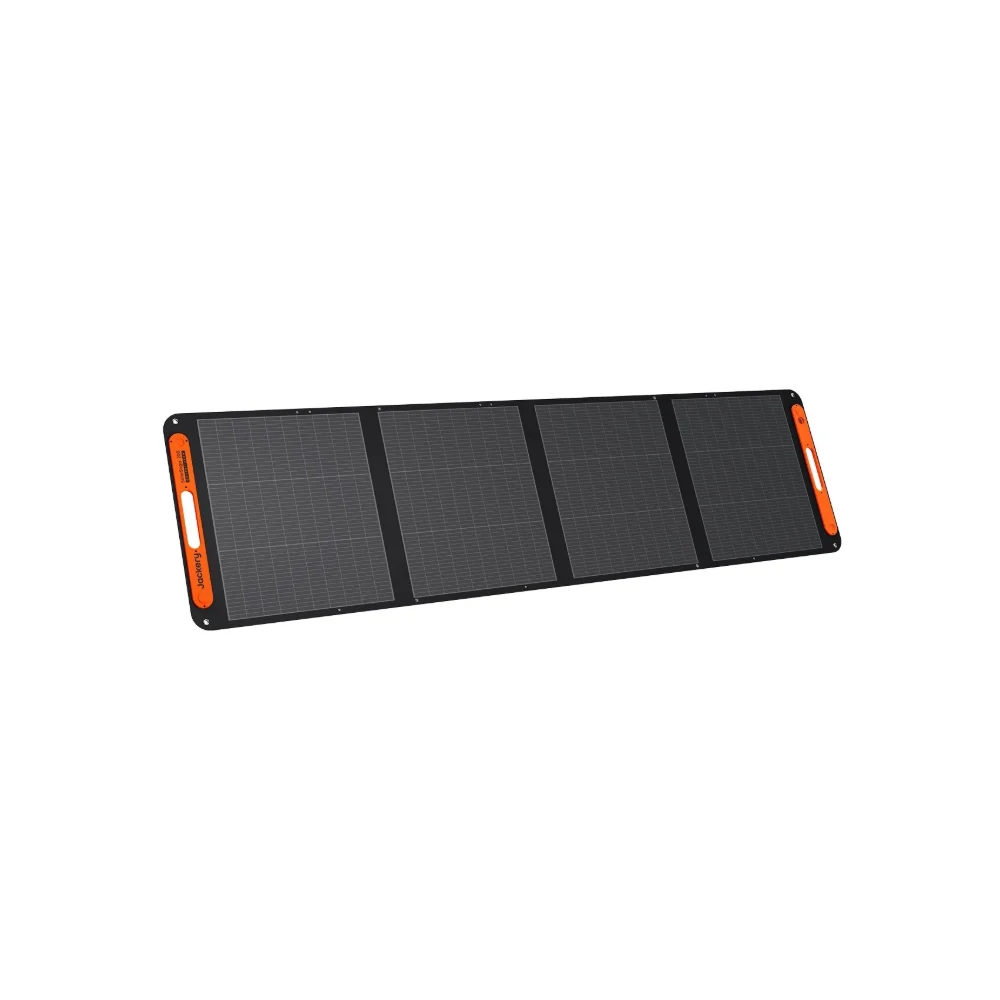
It’s useful to look at a specific, well-documented panel to see what “good” looks like on a spec sheet. Jackery’s SolarSaga 200W is a 200-watt monocrystalline foldable panel rated at around 25% conversion efficiency, which is toward the high end for this category. It’s IP68 water resistant, weighs about 14.3 lbs, and folds down to roughly 23.6 x 23.5 x 1.6 inches — small enough to slide behind a car seat. Jackery lists it at $379 at the time of writing, though panel pricing shifts with sales fairly often, so check Jackery’s page for the current number before you buy.
Check current price on Jackery →
Wattage: Bigger Isn’t Always Better
It’s tempting to assume you should just buy the highest-wattage panel you can afford, but the panel’s rated wattage only matters relative to what your power station can actually accept. Every power station has a maximum solar input rating — if your unit tops out at 200W of solar input, pairing it with a 400W panel doesn’t get you a faster charge; the extra capacity just goes unused. Before buying a panel, check your power station’s spec sheet for its maximum solar input wattage, and buy accordingly, with maybe a little headroom since panels rarely hit their full rated output in real-world conditions.
That real-world gap is worth setting expectations around, too: cloud cover, panel angle, temperature, and time of day all reduce actual output well below the rated number on the box. A “200W” panel producing 130-150W on a clear day with a reasonably good angle to the sun is a completely normal, unremarkable result — not a defective unit.
Connectors and Compatibility
This is the detail that trips up more first-time buyers than anything else on this list. Solar panels use a handful of different connector types — MC4 is the most common industry-standard connector, but many power station brands ship their panels with proprietary 8mm DC barrel connectors instead, and adapters aren’t always included or obvious to find. Before you buy a panel from a different brand than your power station, confirm the connector type on both ends and whether an adapter cable is included or needs to be bought separately. We cover this in more depth in our guide to power station connector types if you want the full breakdown.
Durability Features Worth Checking
A few durability specs are worth a quick look before you buy, especially if the panel is going to see regular outdoor use: an IP65 or higher water-resistance rating tells you it can handle rain and splashing without an issue, and a listed operating temperature range is useful if you’re using it somewhere with real seasonal extremes. None of these are dealbreakers if a panel doesn’t list a headline-grabbing number, but a complete absence of any water-resistance rating on the spec sheet is worth noticing.
Frequently Asked Questions
Can I use a solar panel from one brand with a power station from another brand?
Often, yes, but only if the voltage and connector type are compatible, and sometimes with an adapter cable. Check both the panel’s output specs and your power station’s solar input specs before assuming they’ll work together — mismatched voltage in particular can prevent charging entirely or, in rare cases, damage equipment.
Do I need more than one solar panel?
That depends on your power station’s maximum solar input rating and how fast you want to recharge. Many portable power stations support connecting two panels for faster charging, up to their input ceiling. We break down the math in our guide on how many solar panels you actually need.
Is a more expensive panel always more efficient?
Not necessarily — price differences often come down to brand, included accessories, and build quality rather than raw efficiency. That said, extremely cheap panels sometimes cut corners on cell quality or weatherproofing, so it’s worth reading recent owner reviews rather than shopping on price alone.