
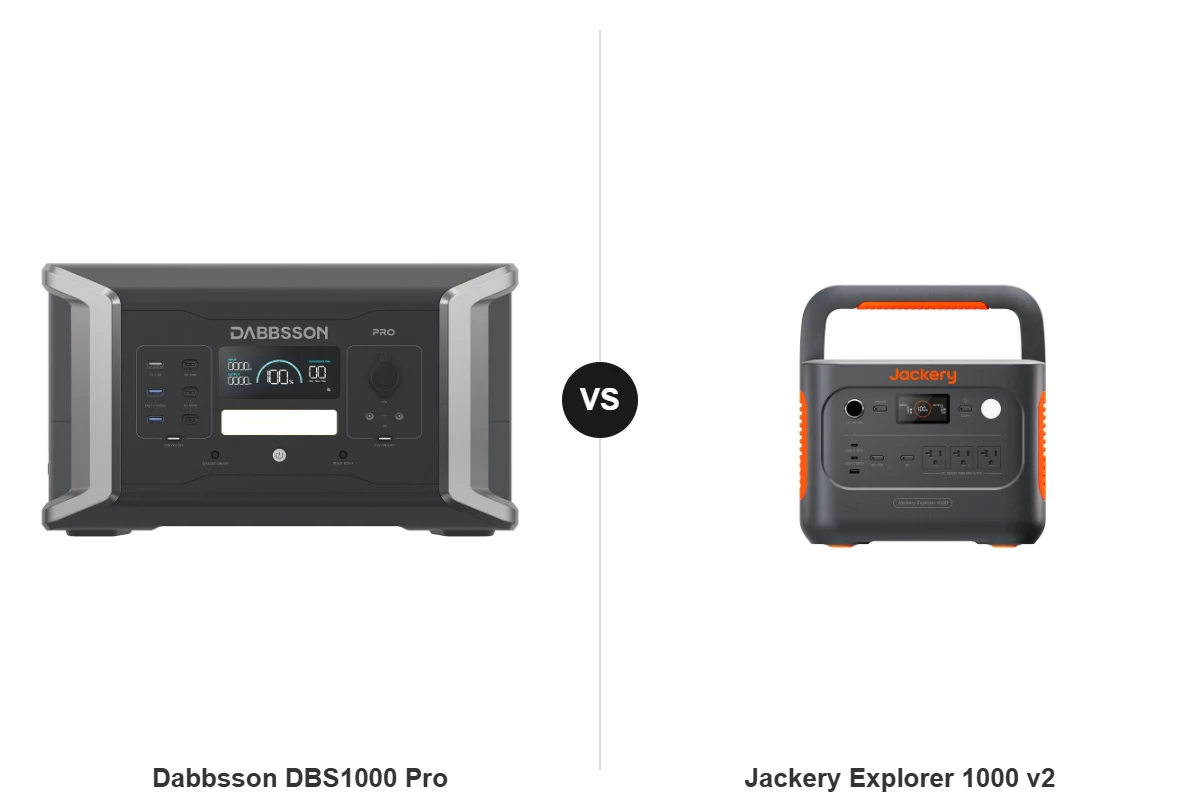

Quick Verdict
Dabbsson isn’t a household name the way Jackery is, but the DBS1000 Pro has been picking up fresh reviews from outlets like WIRED and IGN, and it’s increasingly getting compared directly to established 1kWh-class units. I pulled specs from Dabbsson’s own product pages and Jackery’s site to see how the DBS1000 Pro actually stacks up against the Jackery Explorer 1000 v2, rather than relying on marketing copy from either side.
Affiliate disclosure: This article may include affiliate links — if you buy through them we may earn a small commission at no extra cost to you, but our recommendations are based on our own independent research.
How We Evaluated This Comparison
This comparison is built from Dabbsson’s and Jackery’s own published specifications and product pages, cross-checked against third-party coverage from outlets like WIRED and IGN and verified owner discussion where available. We have not physically tested either unit side by side ourselves. Where we’re drawing a conclusion rather than quoting a spec — which brand has the stronger track record, or how the two would perform in a specific use case — we say so explicitly rather than presenting it as measured data. Our full editorial approach is outlined on our About page.
Specs at a Glance
| Model | Dabbsson DBS1000 Pro | Jackery Explorer 1000 v2 |
| Capacity | 1,024Wh | 1,070Wh |
| Continuous output | 2,000W (3,000W Power-Boost) | 1,500W |
| Surge output | 4,000W | 3,000W |
| Battery chemistry | Semi-solid-state LiFePO4, ~4,500 cycles to 80% | Standard LiFePO4, ~4,000 cycles to 70%+ |
| Weight | ~34.4 lbs | ~23.8 lbs |
| AC charge time | 0-80% in ~60 min (1,200W AC input) | 0-100% in ~1 hour |
The Spec Comparison
Capacity and Output
The Dabbsson DBS1000 Pro carries 1,024Wh of capacity with a 2,000W continuous output (up to 3,000W in Power-Boost mode, 4,000W surge). The Jackery Explorer 1000 v2 comes in slightly higher on capacity at 1,070Wh, but lower on output at 1,500W continuous with a 3,000W surge peak. If you regularly run higher-draw tools or appliances, Dabbsson’s higher continuous wattage is a real advantage on paper.
Battery Chemistry and Cycle Life
Dabbsson markets the DBS1000 Pro’s battery as a semi-solid-state LiFePO4 cell, rated for roughly 4,000 cycles plus an additional 500 cycles managed by the battery management system before dropping to 80% capacity, with a claimed 15-year lifespan. Jackery’s Explorer 1000 v2 uses standard LiFePO4 rated for 4,000 cycles to 70%+ capacity. Both are solidly in the same league here — Dabbsson’s claims are slightly more aggressive, but I’d want to see longer-term independent testing before treating the “semi-solid-state” branding as a settled advantage over standard LiFePO4.
Weight and Portability
This is where Jackery pulls ahead. The Explorer 1000 v2 weighs around 23.8 lbs, while the DBS1000 Pro comes in noticeably heavier at about 34.4 lbs. If you’re moving the unit in and out of a vehicle regularly, that’s more than a 10-pound difference you’ll feel.
Charge Speed
Jackery’s Explorer 1000 v2 charges 0-100% in about 1 hour via AC. Dabbsson advertises a similar fast-charge claim — 0-80% in about 60 minutes — but on Dabbsson’s own site that figure is tied to AC input at 1,200W, not solar; their solar charge time is the slower one, around 1.3 hours. So the two claims are more comparable than they might first appear, though Jackery’s is a full 0-100% versus Dabbsson’s 0-80%.
Real-World Runtime: How the Two Compare on Actual Use
Both units land in a similar capacity class, so runtime differences mostly come down to output ceiling rather than raw watt-hours. Using standard LiFePO4 efficiency assumptions (85-90% delivered after inverter losses):
| Appliance / Load | Typical draw | DBS1000 Pro (1,024Wh) | Explorer 1000 v2 (1,070Wh) |
| Refrigerator (cycling compressor) | ~150W average | ~5-6 hours | ~5.5-6.5 hours |
| CPAP machine | ~40W average | ~2-3 nights | ~2-3 nights |
| Circular saw or similar power tool | ~1,500W running | Runs within continuous rating | At its continuous ceiling — less headroom |
| Laptop + Wi-Fi router + lights | ~100W combined | ~8-9 hours | ~8.5-9.5 hours |
The two units are close enough in raw capacity that runtime for low-draw electronics is nearly identical. The meaningful difference shows up with higher-draw tools and appliances, where the DBS1000 Pro’s extra continuous wattage gives it more headroom before hitting its ceiling.
Solar Recharge Compared
Both units accept solar input for off-grid recharging, though neither is marketed primarily around solar speed the way some competing brands are. Jackery has a broader ecosystem of matched folding solar panels and a longer history of published real-world solar charge times across independent reviews. Dabbsson\u2019s solar input specs are newer to the market and have less independent verification behind them, which is worth factoring in if solar recharging is your primary use case rather than an occasional backup option.
Price and Track Record
Dabbsson’s DBS1000 Pro is generally priced lower for the base unit, which is part of its appeal as a “challenger” pick. But Jackery has a much longer market track record, a larger installed base of reviews, and an established customer support and warranty history. That matters more than it sounds like on a spec sheet — when something goes wrong two years in, brand longevity and support responsiveness are a real part of the value equation.
Warranty Comparison
Jackery backs the Explorer 1000 v2 with a warranty supported by years of established RMA and customer service infrastructure across multiple countries. Dabbsson\u2019s warranty terms are competitive on paper, but the company\u2019s support network is newer and smaller, which can mean longer resolution times if something goes wrong. For a device you may be depending on during an actual emergency, that difference in support maturity is a real part of the total value calculation, not just a footnote.
Who Should Buy Which
Pick the Dabbsson DBS1000 Pro if you want the higher continuous output for running power tools or appliances near the 2,000W mark, you don’t mind the extra weight, and you’re comfortable being an early adopter of a newer brand backed by generally positive early press coverage.
Pick the Jackery Explorer 1000 v2 if portability matters more than peak output, you want the reassurance of a longer-established brand’s warranty and support network, or you’re buying this specifically as emergency backup where reliability history outweighs a spec-sheet edge.
My Take
Dabsson’s DBS1000 Pro is a legitimate challenger, not a knockoff — the output advantage is real and the reviews from mainstream outlets suggest it performs as advertised. But “legitimate challenger” is a different claim than “clearly better,” especially once you weigh in the track record Jackery has built up. If you want the higher output and don’t mind the extra weight, Dabbsson is worth a serious look. If you’d rather have the lighter unit and the more established brand backing it, especially for something you’re relying on in an emergency, the Explorer 1000 v2 is the safer bet. Check current price on Jackery →
FAQ
Is Dabbsson a reliable brand?
It’s newer and less established than Jackery, EcoFlow, or Anker, but it’s getting reviewed by mainstream tech outlets and appears to be a real, functioning product line — not an obscure unknown. I’d still weigh the shorter track record against the spec advantages.
Which has better output, the DBS1000 Pro or Explorer 1000 v2?
The DBS1000 Pro has a higher continuous rating (2,000W vs 1,500W), which matters if you plan to run higher-draw tools or appliances.
Which is lighter?
The Jackery Explorer 1000 v2, by roughly 10 pounds.
Is the DBS1000 Pro’s semi-solid-state battery actually better than standard LiFePO4?
On paper, its cycle-life claims are slightly higher, but semi-solid-state LiFePO4 marketing is newer to this category and hasn’t had the years of independent, long-term field data that standard LiFePO4 has. We’d treat the claim as promising rather than proven until more third-party testing accumulates.
Can I use either unit for home backup during an outage?
Both work for partial backup — a fridge, some lighting, charging devices — but at roughly 1,000Wh capacity, neither is sized for multi-day, multi-circuit whole-home backup. For that, you’d want a larger, expandable system.
Does either brand offer expansion batteries?
Jackery offers expansion battery options across parts of its lineup, giving the Explorer 1000 v2 a clearer upgrade path if your capacity needs grow. Dabbsson\u2019s expansion ecosystem for the DBS1000 Pro is newer and less established, so buyers planning to scale up later should confirm current expansion options directly before assuming feature parity with Jackery.