
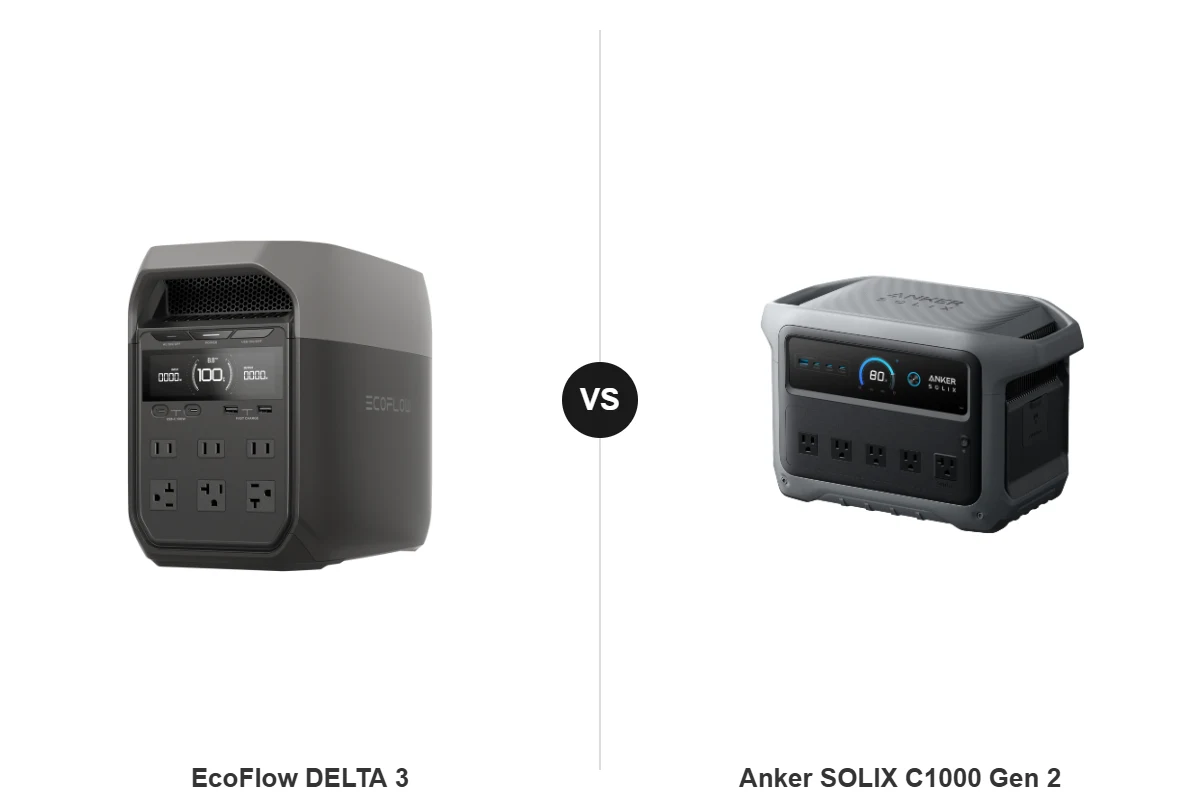

Choosing between two similarly-sized power stations usually comes down to a handful of specs that actually matter in daily use, not the full marketing spec sheet. Both of these landed around the same time in the same rough capacity class, and both are currently running attractive discounts, which makes them a natural head-to-head for anyone shopping the sub-$650, roughly 1,000Wh segment. Here’s how the EcoFlow Delta 3 and Anker SOLIX C1000 Gen 2 actually compare on the specs that matter.
This article may include affiliate links — if you buy through them we may earn a small commission at no extra cost to you, but our recommendations are based on our own independent research.
Capacity and Output
Both units share the same 1,024Wh LiFePO4 capacity, so runtime for a given load will be nearly identical between them. Output is where they diverge: the Anker SOLIX C1000 Gen 2 delivers 2,000W continuous output (3,000W peak), while the EcoFlow Delta 3 is rated at 1,800W continuous, extendable to 2,200-2,400W with EcoFlow’s X-Boost feature (which lets you run higher-wattage appliances at reduced efficiency). On paper, the Anker has a clear edge in continuous rated output without needing a boost mode.
Charging Speed
Both brands lead with fast charging as a headline feature. Anker advertises “49-minute UltraFast Recharging” for the C1000 Gen 2. EcoFlow’s Delta 3 is commonly cited at around 60 minutes to reach 80% on AC. These numbers are close enough that either will comfortably top up during a lunch break, and the practical difference is smaller than the marketing framing suggests.
Switchover and UPS Performance
The Anker SOLIX C1000 Gen 2 lists a 10-millisecond UPS switchover time, which is fast enough for most sensitive electronics not to notice a grid drop. We don’t have an equally specific, independently verified switchover figure for the base Delta 3 at the time of writing, so if UPS performance for something like a desktop PC or networking gear is your primary use case, that’s worth confirming directly with EcoFlow before buying.
Weight and Portability
The Delta 3 comes in at roughly 27 lbs, which is fairly typical for this capacity class. Anker’s C1000 Gen 2 is frequently praised in reviews specifically for being unusually light and compact for its output — Android Authority called it out as a standout for portability in this segment. If you’re moving the unit frequently rather than leaving it in place, that’s a real point in Anker’s favor.
Price
Price is often the deciding factor once specs are this close, so it deserves its own honest look rather than a passing mention. Pricing moves around constantly with both brands running frequent promotions, so treat any specific number as a snapshot. As of this writing, Outbound Power lists the Anker SOLIX C1000 Gen 2 at $479.99 (down from $799.99) and the EcoFlow Delta 3 at $629.00 (down from $699.00). That’s a modest gap in the Anker’s favor at current pricing — around $150 — though both prices fluctuate on other retailers and during other sale events, so it’s worth comparison shopping before deciding based on price alone.
Solar Input and Recharge Flexibility
Both units accept solar input, which matters if you’re planning to use either as camping or off-grid backup rather than purely an indoor emergency unit. The Anker SOLIX C1000 Gen 2 is rated for up to 600W of solar input, while the EcoFlow Delta 3 accepts up to 500W. Neither gap is large enough to be decisive on its own, but the Anker’s slightly higher ceiling means a marginally faster solar recharge if you’re running multiple panels.
App and Ecosystem Considerations
Both brands have companion apps for monitoring charge level, output, and settings remotely, and both have built out broader ecosystems of expansion batteries, solar panels, and accessories. If you already own EcoFlow gear — a Delta-series expansion battery, an existing set of EcoFlow solar panels — sticking with the Delta 3 avoids compatibility headaches, even if the raw specs slightly favor Anker on paper. Ecosystem lock-in is a legitimate reason to pick the specs-second option, and it’s worth weighing honestly rather than chasing whichever unit wins the fewest spec comparisons.
Which Should You Buy?
Based on current specs and current pricing, the Anker SOLIX C1000 Gen 2 is the stronger pick for most buyers in this comparison: higher continuous output, lighter weight, a faster and independently-confirmed UPS switchover spec, and a notably lower price at the time of writing. Check current price on Outbound Power →
The Delta 3 still makes sense if you’re already invested in EcoFlow’s ecosystem (their expansion batteries, solar panels, or app are cross-compatible across their lineup) or if you find it at a meaningfully lower price during a future sale.
My Take
Spec sheets can only tell you so much, and both of these are recent enough releases that long-term reliability data is still thin for both brands at this specific model. I don’t think there’s a dramatically wrong choice here — both are competent, similarly-sized units from established brands. But going purely on the numbers in front of me right now, Anker’s combination of more output, less weight, and a lower price makes the C1000 Gen 2 the easier recommendation, unless brand ecosystem loyalty or a specific sale changes the math for you.
Frequently Asked Questions
Do the EcoFlow Delta 3 and Anker SOLIX C1000 Gen 2 have the same capacity?
Yes, both are rated at 1,024Wh, so runtime for identical loads will be very close between them.
Which charges faster?
They’re close: Anker advertises about 49 minutes for its UltraFast mode, while EcoFlow’s Delta 3 is commonly cited around 60 minutes to 80%.
Which is better for portability?
The Anker SOLIX C1000 Gen 2 is frequently cited in reviews as unusually light and compact for its output class, giving it an edge for frequent carrying.