
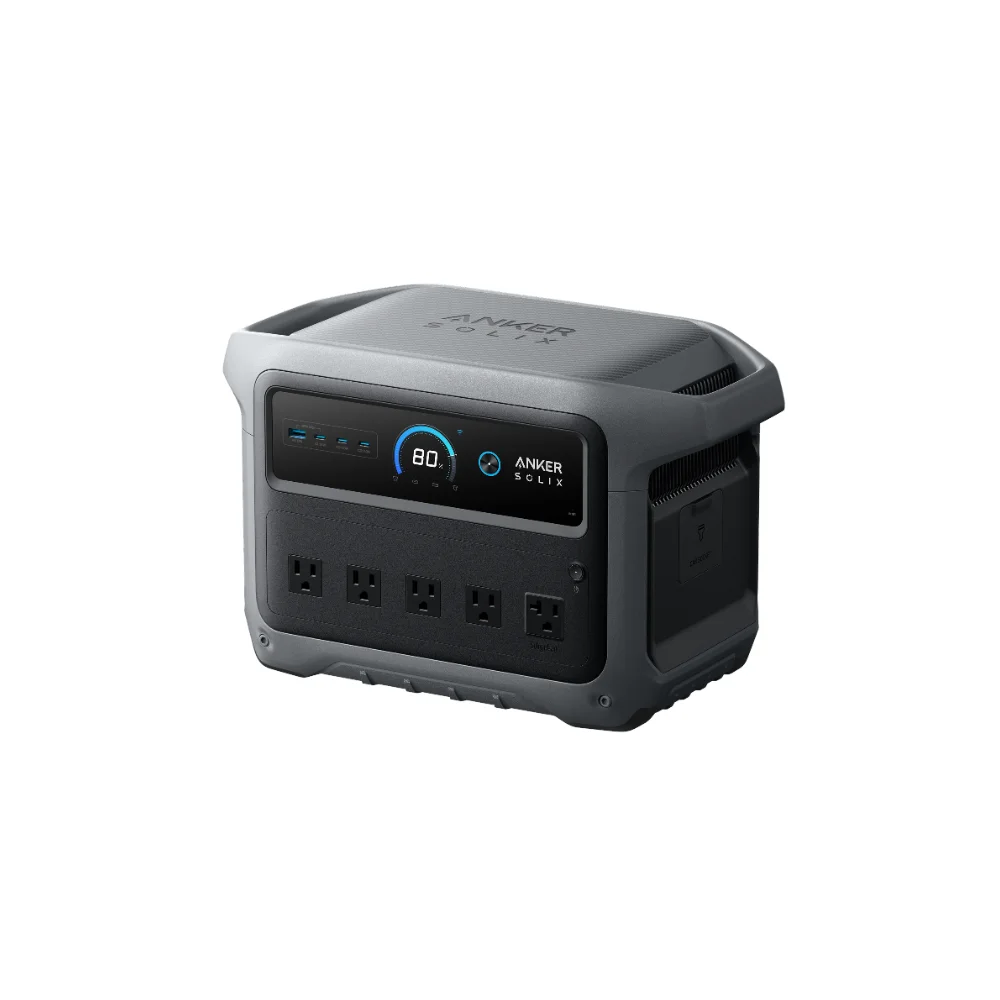

If you’ve ever run a laptop or a string of string lights off a fully-charged power station and watched the percentage drop faster than the math seemed to justify, you’re not imagining it. Anker SOLIX just published the first detailed multi-load efficiency data we’ve seen from a major brand, and the numbers are a little uncomfortable: at light loads, a lot of the energy you paid for simply turns into heat instead of usable power.
This article may include affiliate links — if you buy through them we may earn a small commission at no extra cost to you, but our recommendations are based on our own independent research.
What “Discharge Efficiency” Actually Means
Every power station has to convert the DC power sitting in its battery into the AC power your devices actually use, and that conversion isn’t free. Some energy is lost as heat in the inverter, the cooling fan, and the internal electronics that keep everything stable. The rated capacity on the box — say, 1,000Wh — is what’s stored, not what you get out the other end.
The efficiency loss isn’t constant. It gets dramatically worse at low wattages, because a power station’s inverter and standby electronics draw roughly the same amount of overhead power whether you’re running a 10W phone charger or a 1,000W space heater. At high loads, that overhead is a rounding error. At low loads, it can be the majority of what the battery is spending.
What Anker’s New Data Actually Shows
According to Anker’s own published testing, its SOLIX S Series (powered by a new OptiSave 2.0 system) reaches about 88% discharge efficiency at a 100W load and 96% at 400W. Those are strong numbers for a light-to-moderate load. The more striking part of the release is Anker’s own head-to-head comparison at very light loads: at a 10W draw, Anker says the S2000 holds around 69% efficiency, while it measured roughly 36% for a EcoFlow Delta 2 Max and 32% for a Delta 3 Max under the same conditions.
We want to be careful with that comparison — it’s Anker’s own internal testing of competitor products, not an independent lab’s numbers, so treat the specific competitor figures as a manufacturer’s claim rather than verified third-party data. That 10W result is also where this article’s headline number comes from: even Anker’s own best-in-class S2000 gives up roughly 30% of its energy to overhead at that load (69% efficiency, meaning about 31% is lost before it reaches your device) — and that’s the best case among the units in Anker’s comparison, not the worst. What we can verify independently is that Anker has published its own multi-load efficiency numbers for the first time, which is a genuinely new level of transparency for this category, and it’s been covered independently by multiple outlets in the past week.
How OptiSave 2.0 Tries to Fix It
Anker says OptiSave 2.0 dynamically adjusts internal circuitry based on load, rather than running the inverter the same way regardless of whether you’re drawing 10W or 1,000W. The company claims this cuts idle power consumption by 40-70%, down to under 6W of standby draw, which mostly matters if you leave a unit plugged in and trickling power to something small for hours or days at a time — think a router, a security camera, or a CPAP machine overnight.
The Anker SOLIX S2000 (2,010Wh, 1,500W output) is the model at the center of this efficiency data, and it’s currently discounted from $1,199.99 to $649.99. Check current price on Outbound Power →
Why This Actually Matters for Everyday Use
This isn’t just a spec-sheet curiosity. If you’re running a power station overnight for a small load — a mini fridge, a CPAP, a few USB devices — efficiency at low wattage is arguably more important than peak output, because that’s the load profile you’ll actually see most nights. A power station that’s excellent at 1,500W but mediocre at 15W will quietly cost you real runtime on exactly the use case a lot of buyers care about most: quiet, overnight, low-draw backup.
How to Get Better Real-World Efficiency from Any Power Station
Regardless of which brand you own, a few habits genuinely help: consolidate small loads onto one station instead of running several partially-loaded units, use DC output (USB-C, car ports) instead of the AC inverter when your device supports it since DC skips the inversion step entirely, and avoid leaving a station powering something trivial for days when a small power bank would do the job with far less overhead.
How Big a Deal Is This, Really?
It’s worth putting the numbers in context. If a 1,000Wh power station is only 32-36% efficient at a 10W load, that means for every 10 watt-hours of runtime you actually use, the battery is spending closer to 28-31 watt-hours to deliver it — the rest is lost as heat and standby overhead. Scale that up over a 12-hour overnight CPAP session or a multi-day power outage where you’re mostly running small loads, and the difference between a 35%-efficient unit and a 70%-efficient one at that wattage could mean an extra full recharge cycle, or the difference between making it through the night and not.
That said, this mostly matters for light, sustained loads. If you’re mainly running a full-size fridge, a space heater, or power tools — loads well above a few hundred watts — the efficiency gap between brands narrows considerably, and capacity and peak output matter more than low-load efficiency.
My Take
I think this is a good development for the category, even if it’s arriving as a marketing push. Efficiency at low loads has been an unspoken weak spot in portable power stations for years, and nobody was publishing numbers on it. Whether or not Anker’s specific competitor comparisons hold up to independent testing, the pressure to publish real multi-load data is good for buyers. I’d like to see EcoFlow, Jackery, and Bluetti respond with their own independently-verified numbers rather than letting one company frame the conversation.
Frequently Asked Questions
Does discharge efficiency affect all power stations the same way?
No. Efficiency curves vary by brand and even by model within a brand, largely based on inverter design and standby circuitry. That’s exactly why multi-load data, rather than a single headline efficiency number, matters.
Is a less efficient power station unsafe?
Not inherently — lost efficiency shows up as wasted energy and heat, not a safety hazard on its own, though excess heat is one more reason good thermal design matters.
Should I buy a power station based on efficiency alone?
No. Efficiency at low loads is one useful data point among many — capacity, output, weight, price, and warranty still matter more for most buying decisions.