
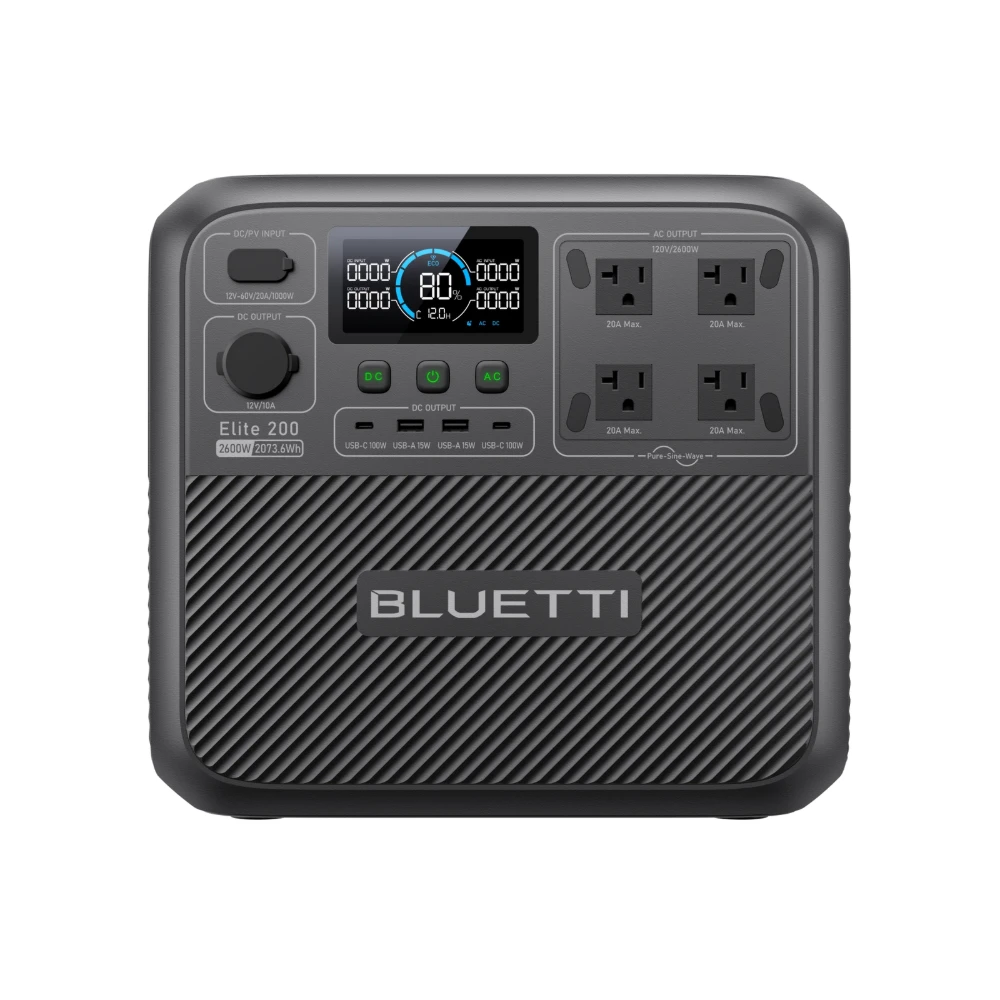

Bluetti has spent the last few years building a reputation as the brand that gets the fundamentals right even when it isn’t the flashiest name on the shelf. The Elite 200 V2 is the clearest expression of that approach yet: a mid-capacity power station that trades novelty features for a genuinely excellent battery, a fast charger, and a price that doesn’t require a second mortgage. After digging through Bluetti’s spec sheets, comparing it against the units we’ve already reviewed on this site, and running the numbers on real-world usage, here’s our honest take on whether it deserves a spot on your shortlist in 2026.
Bluetti Elite 200 V2 at a Glance
- Capacity: 2,073.6Wh (LiFePO4 / LFP chemistry)
- AC output: 2,600W continuous, 3,900W surge (power-lifting mode)
- AC recharge speed: roughly 80 minutes to full from a wall outlet
- Solar input: up to 1,000W via MPPT controller
- Weight: approximately 53 lbs
- Cycle life: rated for thousands of charge cycles to 80% capacity, well above older NMC-based units
- Estimated street price: around $899 at list, with Bluetti’s frequent promotions periodically bringing it lower
Battery and Charging: What’s Actually Inside
The Elite 200 V2 uses lithium iron phosphate (LiFePO4) cells, the same chemistry found in nearly every serious power station on the market today, and for good reason. LFP batteries trade a small amount of energy density for dramatically better safety margins and a much longer service life than the older lithium nickel manganese cobalt (NMC) cells that used to dominate this category. In practical terms, that means the Elite 200 V2 should still be holding a meaningful percentage of its original capacity after years of regular use, not just a handful of seasons.
The charging story is where this unit earns its keep. An 80-minute AC recharge time is genuinely fast for a battery just over 2kWh, and it means you can top the unit off during a lunch break rather than planning your day around it. Pair it with a 1,000W-capable MPPT solar input and you’ve got a station that can realistically refill in four to five hours of good sun, which matters a lot more than most spec sheets let on once you’re actually living off the unit for a weekend.
Real-World Runtime: What 2,073Wh Actually Gets You
Watt-hour numbers are abstract until you translate them into things you actually use. Based on typical appliance draw, here’s roughly what the Elite 200 V2’s battery translates to:
- A CPAP machine at night: 6-8 nights of use before needing a recharge
- A 60W mini-fridge: roughly 24-28 hours of continuous cooling
- A laptop (50Wh battery): around 30 full charges
- A smartphone: well over 100 charges
- A 1,000W electric kettle: about 20-25 boils
Those numbers will shift depending on the specific appliance and ambient temperature, but they give you a realistic sense of why the 2kWh capacity class has become the sweet spot for people who want more than a weekend-camping unit but don’t need a whole-home backup system.
Who Should Buy the Elite 200 V2
- Anyone who wants a single power station that covers both weekend camping trips and short home power outages
- Buyers who value fast AC recharge speed over having the absolute largest capacity on the market
- People who already own or plan to buy solar panels and want strong MPPT solar input
- Van lifers and overlanders who need real power without hauling a unit that requires two people to lift
Who Should Skip It
- Anyone planning to back up a whole house through multi-day outages — look at Bluetti’s larger Apex or AC200-class units instead
- Ultralight backpackers, for whom even 53 lbs is too much to carry
- Buyers who specifically need 240V output for larger appliances, which this model doesn’t offer
How It Stacks Up Against the Competition
In the same capacity class, the Elite 200 V2 competes directly with the Jackery Explorer 2000 Plus and the Anker SOLIX C1000 Gen 2. Compared to the Jackery, the Elite 200 V2 charges faster and edges it out on solar input, though Jackery’s ecosystem of expansion batteries is more mature. Against the Anker, the gap is closer: the C1000 Gen 2 charges even faster, but the Bluetti’s larger native capacity means less reliance on optional add-ons for most weekend use cases.
My Take
I like the Elite 200 V2 for the same reason I like a well-built pickup truck: it doesn’t try to dazzle you with features you’ll use twice, it just does the core job extremely well. The fast charging is the standout here — it’s the difference between a power station that fits into your life and one that dictates your schedule around it. If I were buying in this capacity class today without a strong brand-loyalty pull toward Jackery or Anker, this is the unit I’d put in my cart, especially if I caught it during one of Bluetti’s regular sales.
Frequently Asked Questions
Is the Bluetti Elite 200 V2 worth it in 2026?
For most people who want a single power station to cover both camping trips and short power outages, yes. Its combination of fast AC recharge, strong solar input, and a competitive price makes it one of the better all-rounders in the 2kWh class, provided you don’t need 240V output or whole-home backup capacity.
How long does the Bluetti Elite 200 V2 battery last?
Like most modern power stations, it uses LiFePO4 cells rated for thousands of charge cycles before dropping to 80% of original capacity, which typically translates to a decade or more of regular use rather than just a couple of years.
Can the Elite 200 V2 run a refrigerator?
Yes, for a limited time. A typical 60W mini-fridge can run for roughly a full day on a single charge, while a larger residential fridge with a higher startup surge will drain the battery considerably faster and should be checked against the unit’s continuous and surge wattage ratings first.
Does the Elite 200 V2 work with solar panels from other brands?
Generally yes, as long as the panels use compatible MC4 connectors and stay within the unit’s voltage and wattage input limits. Bluetti’s own panels are plug-and-play, but many third-party panels work fine with the right cable adapter.
Related Reading
- Bluetti AC180 Review
- Bluetti Elite 300 Review
- Jackery vs EcoFlow vs Anker SOLIX 2026
- How to Choose the Right Power Station Capacity
About the Author
Khalid Zirari is the founder of Marjajo, where he researches and compares portable power stations, solar generators, and related backup power gear to help readers cut through spec-sheet marketing and find the right fit for their needs.