
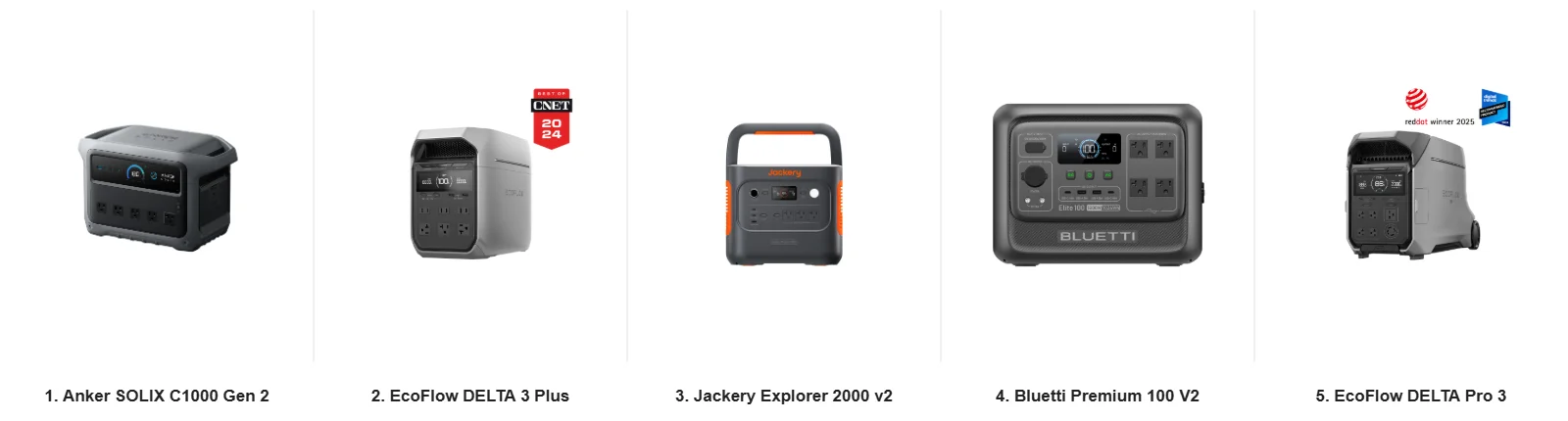

Every power station brand publishes a spec sheet that makes its own products look like the obvious choice. That’s marketing doing its job. What buyers actually need is a consistent way to weigh brands against each other on the things that matter after the purchase, not just on launch day. Here’s the framework we use internally when sizing up a brand, broken into six categories, plus how the major players tend to land once you apply it honestly.
How We Evaluated This
This framework is built from aggregated manufacturer specifications, published warranty terms, and patterns we’ve observed across a wide range of verified owner feedback for each brand’s current lineup — not a single controlled side-by-side test of every model in one room. Brand-level grades are necessarily broader strokes than a single-product review: individual models within a brand can outperform or underperform the general pattern, which is exactly why we point to specific reviews and comparisons throughout rather than asking you to take a brand grade as gospel for one particular unit. Where something below reflects our own read on a brand’s trajectory rather than a documented fact, we say so.
The Six Categories That Actually Matter
- Battery chemistry and longevity: Is it modern LiFePO4, and what’s the realistic cycle life to 80% capacity?
- Charging speed: How fast can it recharge via AC, and does it accept solar and AC simultaneously?
- Output and continuous wattage: Can it actually run the appliances its capacity suggests it should?
- Ecosystem and expansion: Are there expansion batteries, smart panels, or add-ons, and are they reasonably priced?
- App and smart features: Is the app reliable, and does it add real value beyond a battery percentage readout?
- Price-to-capacity ratio: How does the cost per watt-hour compare once you account for typical sale pricing, not just list price?
How the Major Brands Tend to Grade Out
This isn’t a per-model ranking — individual units within each brand vary — but here’s the pattern we see across each brand’s current lineup, along with how each one tends to handle reliability, warranty support, and product range.
Jackery
Strong on brand trust and retail availability, with a mature expansion ecosystem on newer Explorer models. Charging speed is solid but rarely class-leading. Jackery has been in this category the longest of the four main brands here, and that track record shows up in owner reports as a perceived reliability edge — buyers tend to describe Jackery units as predictable rather than exciting. Warranty coverage is competitive but not the longest in the category; see our full warranty comparison for exact terms. Product range spans from compact power banks through large home-backup units, giving buyers a lot of room to stay within one ecosystem as needs grow. Best for buyers who want a safe, well-supported default choice and don’t want to research a newer brand’s track record. Our Jackery Explorer 2000 Plus review covers one of its strongest current units, available through Jackery’s own store.
Bluetti
Consistently competitive pricing and a genuinely strong expansion battery lineup. Combined AC-plus-solar input is often best-in-class, which matters a lot for anyone trying to recharge quickly during an actual outage. App polish has improved but still trails EcoFlow slightly. Bluetti’s product range is unusually broad — from ultra-compact power banks to large modular systems like the AC500 — which makes it a strong pick for buyers who want to stay within one brand’s ecosystem as their power needs scale up over time. Owner feedback on reliability is generally positive, though as a brand that ships a wider variety of SKUs than some competitors, spec consistency across the lineup takes a bit more homework on the buyer’s end. Best for buyers who prioritize value and expansion flexibility over brand-name recognition. Our Bluetti Premium 100 V2 review and Bluetti Elite 200 V2 review cover two of its more popular current units.
EcoFlow
The charging-speed leader across most of its lineup, with the most polished app experience of the major brands. Pricing tends to sit a notch above Bluetti at equivalent capacity, though sales narrow the gap significantly and EcoFlow discounts aggressively around major sales events. EcoFlow’s product range covers everything from small Rivers up through the Delta Pro 3’s whole-home-capable territory, and its expansion ecosystem — extra batteries, smart home panels, EV charging accessories — is arguably the most developed of the four brands here. Reliability feedback is strong, and EcoFlow’s warranty terms are generally competitive; again, see our warranty comparison for specifics. Best for buyers who want the fastest charging and the most polished software experience and are willing to pay a modest premium for it. Our EcoFlow Delta Pro 3 review covers its flagship whole-home unit, available through Outbound Power.
Anker SOLIX
Newer to this specific category but backed by Anker’s charging expertise, which shows up in genuinely fast recharge times and strong build quality. Ecosystem and expansion options are still catching up to the more established players — fewer expansion batteries and smart-home accessories than Jackery, Bluetti, or EcoFlow currently offer. Because Anker SOLIX is the newest entrant of the four main brands here, its long-term reliability track record is the shortest, though early owner feedback has generally been positive and our own long-term reliability review of the Anker SOLIX F2000 digs into exactly that question for one of its higher-capacity units. Best for buyers who want cutting-edge charging speed and build quality and don’t mind a smaller accessory ecosystem in exchange. Our Anker SOLIX C1000 Gen 2 review and Anker SOLIX C2000 Gen 2 review cover two of its current mid-range units, with the C1000 Gen 2 available through Outbound Power.
Goal Zero
The most old-school in feel, with simple physical controls that some buyers prefer over app-first designs. Output and price-to-capacity tend to lag behind newer entrants at the same price point, and its lineup hasn’t expanded as aggressively as the four brands above. We cover this trade-off directly in our Goal Zero Yeti 700 review, including why we can’t currently offer a tracked purchase link for it through either of our affiliate partners.
Brand Comparison at a Glance
| Brand | Perceived Reliability | Value for Money | Warranty Support | Product Range | Best For |
| Jackery | Strong, longest track record | Solid, rarely the cheapest | Competitive, not category-leading | Broad, from power banks to home backup | Buyers who want a safe, well-supported default |
| Bluetti | Strong | Frequently the best price-to-capacity | Competitive | Very broad, strong expansion lineup | Value-focused buyers who want room to expand |
| EcoFlow | Strong | Good, priced slightly above Bluetti | Competitive to strong | Most developed expansion ecosystem | Buyers who want the fastest charging and best app |
| Anker SOLIX | Positive early feedback, shortest track record | Good, competitive at launch pricing | Standard, improving | Growing but still the smallest of the four | Buyers who prioritize charging speed and build quality |
How to Use This Framework Yourself
Weight the six categories based on your actual use case before you start comparing models. Someone buying primarily for home blackout backup should weight continuous output and expansion capability heavily. Someone buying for weekend camping should weight portability and price-to-capacity instead. The brand that “wins” changes depending on which categories matter most to you, which is exactly why blanket “best brand” claims are usually oversimplified.
Step one: know your numbers
A brand grade only helps once you know the capacity and output you need. Work those out with our calculator, then use this framework to pick the brand.
My Take
No brand grades out as a clean A across all six categories, and that’s normal — this is a competitive market where every company makes real trade-offs. If I had to generalize, I’d say Bluetti and EcoFlow currently lead on hard specs, Jackery leads on brand trust and support, and Anker SOLIX is the one to watch if its ecosystem catches up to its charging technology. Use the six-category framework above on the specific models you’re considering rather than picking a brand on reputation alone.
Real-World Runtime: One Representative Model Per Brand
Brand-level grades are useful for narrowing your search, but runtime is ultimately a product-level question. Here’s roughly what a well-known current model from each brand supports in practice, as a grounded reference point rather than an abstract brand comparison.
| Brand / Model | Capacity | Mini Fridge (60-80W) | Laptop + Phone, Daily |
| Jackery Explorer 2000 v2 | ~2,000Wh class | Roughly 24-30 hours continuous | A week or more of daily charging |
| Bluetti Premium 100 V2 | 1,024Wh | Roughly 10-14 hours continuous | Multiple days of daily charging |
| EcoFlow Delta Pro 3 | 4,096Wh | Multiple days continuous, plus other circuits | Multiple weeks of daily charging |
| Anker SOLIX C1000 Gen 2 | ~1,056Wh | Roughly 14-18 hours continuous | 4-5+ days of daily charging |
For a full breakdown of how to size capacity to your specific appliances, see our fridge sizing guide and our guide to choosing the right capacity for your needs.
Which Brand Fits Your Situation?
You want the safest, most predictable choice: Jackery’s long track record and broad retail presence make it the lowest-risk pick if you don’t want to research a newer brand.
You want the best value for your money: Bluetti consistently delivers strong price-to-capacity ratios and a genuinely useful expansion ecosystem without a brand-name premium.
You want the fastest charging and the most polished app: EcoFlow leads here, though you’ll typically pay a modest premium over Bluetti for equivalent capacity.
You want cutting-edge charging tech and build quality, and don’t mind a smaller accessory ecosystem: Anker SOLIX is worth a serious look, especially if Anker’s broader reputation in charging electronics matters to you.
You want simple physical controls over an app-first experience: Goal Zero remains the most old-school option, though its output and price-to-capacity generally lag the four brands above.
You’re comparing three of these brands head-to-head on specific numbers: Our direct Jackery vs EcoFlow vs Anker SOLIX comparison goes deeper on model-to-model specifics than this brand-level framework does.
Frequently Asked Questions
Which power station brand is best overall?
There isn’t a single “best” brand across every use case. Bluetti and EcoFlow currently lead on hard specs like charging speed and expansion ecosystems, while Jackery leads on brand trust and support. The right choice depends on which of the six categories above matter most for how you’ll actually use the unit.
What matters more, capacity or continuous output?
Both matter, but for different reasons. Capacity (Wh) determines how long you can run devices before recharging; continuous output (W) determines whether a given device can even run at all. A high-capacity unit with low continuous output still can’t run a high-draw appliance.
Are newer power station brands worth considering?
Newer entrants like Anker SOLIX often bring genuine technical advantages, particularly in charging speed, but tend to have smaller expansion ecosystems and less established long-term support track records than brands that have been in the category longer.
Which brand has the best warranty?
Warranty length and coverage vary by specific model as much as by brand, so check the exact terms for the unit you’re considering rather than assuming a brand-wide standard. Our warranty comparison across Jackery, EcoFlow, Bluetti, and Anker breaks down what’s actually covered.
Is Bluetti as reliable as Jackery or EcoFlow?
Owner feedback on Bluetti’s reliability is generally strong and comparable to Jackery and EcoFlow at this point. Jackery simply has the longest track record of the three, since it’s been in the category the longest — that’s a difference in data history, not necessarily a difference in current build quality.
Is Anker SOLIX a safe brand to buy from as a newer entrant?
Anker brings decades of experience in charging electronics generally, which is a meaningful trust signal even though its SOLIX power station line is newer than Jackery, Bluetti, or EcoFlow specifically. Early owner feedback has been positive, though the long-term track record is inherently shorter than more established competitors.
Do brand grades apply equally to every product in a brand’s lineup?
No — this is a brand-level pattern, not a per-model guarantee. A specific model can outperform or underperform its brand’s general reputation. Always check a dedicated review of the specific unit you’re considering rather than relying on the brand grade alone.
Which brand has the widest product range?
Bluetti and EcoFlow currently offer the broadest lineups, spanning from compact power banks to large whole-home-capable systems with extensive expansion options. Jackery’s range is also broad and well-established. Anker SOLIX has the narrowest range of the four main brands here, though it’s expanding.
Should I stick with one brand if I already own a power station?
There’s a real practical case for staying within one ecosystem if you plan to add expansion batteries or accessories later, since cross-brand compatibility is rare. If you’re buying your first unit or your existing brand doesn’t fit a new use case, don’t let brand loyalty override the six-category framework above.
Related Reading
- Jackery vs EcoFlow vs Anker SOLIX 2026
- How to Choose the Right Power Station Capacity
- Continuous vs Peak Power: What These Numbers Actually Mean
- Best Portable Power Stations of 2026: Our Top 5 Picks Ranked
- Power Station vs Standby Generator: Which Is Better for Home Backup?
- Power Station Buying Checklist
This post may include affiliate links — if you buy through them, we may earn a small commission at no extra cost to you. It doesn’t change what we cover or how we rank anything.
About the Author
Khalid Zirari is the founder of Marjajo, where he researches and compares portable power stations, solar generators, and related backup power gear to help readers cut through spec-sheet marketing and find the right fit for their needs.