
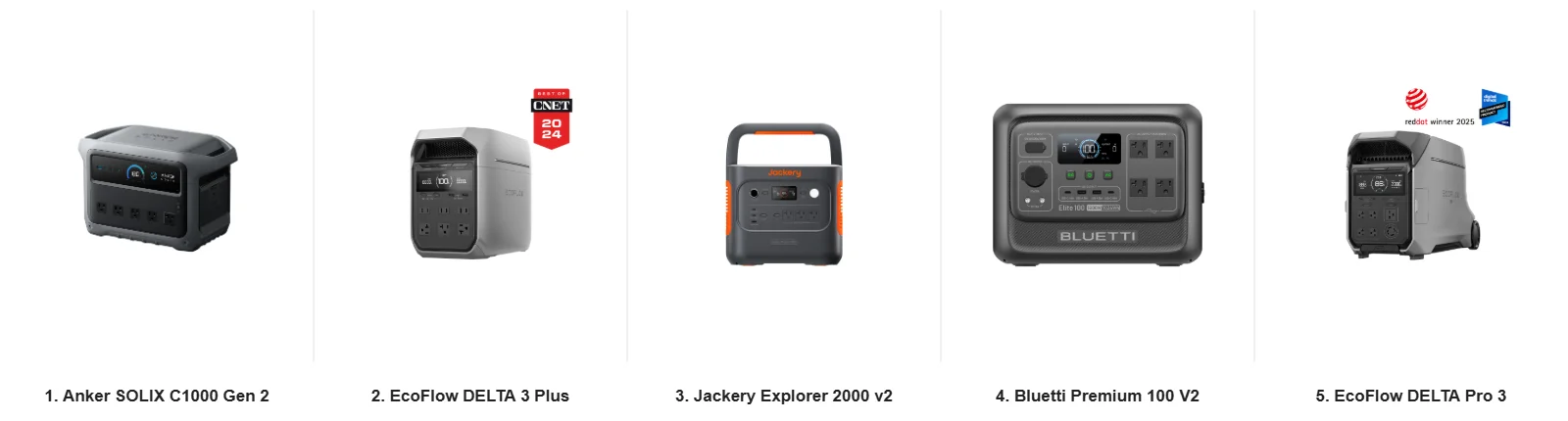

The portable power station market has genuinely shifted this year. The old formula of “bigger battery, more weight, longer charge time” is losing ground to compact, fast-charging LiFePO4 units that do more with less bulk. I pulled together the picks that keep showing up across independent testing and real owner feedback, and ranked them by who they actually make sense for — not just raw spec-sheet bragging rights.
A quick note before the list: capacities, prices, and specs below are approximate and reflect typical pricing at the time of writing — always check the manufacturer’s current listing before buying, since this category moves fast.
This article may include affiliate links — if you buy through them we may earn a small commission at no extra cost to you, but our recommendations are based on our own independent research.
How We Evaluated This Guide
These rankings are based on manufacturer specifications, official product documentation, and a wide range of verified owner reports gathered as part of our research process, not hands-on side-by-side testing of every unit in a single room. Where a claim reflects our own analysis rather than a manufacturer-stated fact — like how a unit is likely to hold up over a multi-day outage, or which use case it fits best — we say so directly. We cross-check pricing and availability against current listings rather than relying on launch-day numbers, since this category discounts and repositions constantly. Our full editorial approach is outlined on our About page.
How to Choose the Right Power Station
Before the rankings, it helps to know what actually separates a good pick from a bad one for your specific situation. Five factors matter more than anything else on a spec sheet.
Battery capacity (Wh). This is how much energy the unit stores, and it determines how long you can run devices before recharging. A 500-1,000Wh unit covers phones, laptops, and a router through a short outage. 1,000-2,000Wh comfortably handles a mini fridge and multiple devices for a day. Above 2,000Wh starts to approach true whole-home backup territory for select circuits. Match capacity to your actual use case rather than buying the biggest number you can afford — excess capacity mostly adds weight and cost.
Output (W), continuous vs. surge. Continuous output is what the unit can sustain; surge output is a brief spike some appliances need to start up (a compressor-based fridge or a power tool, for example). Check both numbers against the specific devices you plan to run — a unit can have plenty of capacity but still trip on startup surge if the continuous wattage is too low.
Battery chemistry. Nearly every unit worth buying in 2026 uses LiFePO4 (LFP) chemistry rather than older NMC lithium-ion. LFP cycles longer — typically 3,000+ full charge cycles before meaningful capacity loss — and is more thermally stable. See our deeper breakdown of what those charge-cycle numbers actually mean for day-to-day ownership.
Charging speed. Fast AC recharging (roughly 1-2 hours to full on many current units) matters most if you’re topping up between uses during an actual outage. Solar input specs matter if you plan to recharge off-grid — see our guide to real-world solar recharge speeds for how those panel-wattage numbers translate into actual hours.
Portability, warranty, and total cost. A unit you won’t move stops being “portable” in any meaningful sense — check actual weight, not just capacity. Warranty length and coverage vary more than most buyers expect between brands; our warranty comparison across Jackery, EcoFlow, Bluetti, and Anker covers what’s actually included. And total cost should account for any solar panels, expansion batteries, or accessories you’ll realistically add later, not just the sticker price on the base unit.
1. Anker SOLIX C1000 Gen 2 — Best for Most People
This one keeps landing at the top of “best overall” lists for a simple reason: it nails the balance between power, weight, and price that most buyers actually need. It’s not the biggest or most powerful unit here, but it covers a blackout comfortably, works fine for off-grid camping, and doesn’t demand a dedicated shelf in your garage. If you only need one power station and don’t have a specialized use case, start here.
The Anker SOLIX C1000 Gen 2 is available through Outbound Power. Check current price on Outbound Power → For the full breakdown of specs, charging speed, and the trade-off Anker made to get there, read our full review of the Anker SOLIX C1000 Gen 2.
2. EcoFlow Delta 3 Plus — Best Everyday Capacity
With around 1,024Wh of capacity, the Delta 3 Plus sits in the sweet spot for home use, RV trips, or jobsite power. Fast charging and a solid port selection round it out. It’s the kind of unit that quietly handles 90% of what people actually buy a power station for, without the premium price tag of the flagship-tier units.
The EcoFlow DELTA 3 Plus is available through Outbound Power. Check current price on Outbound Power →
3. Jackery Explorer 2000 v2 — Best for Multi-Day Off-Grid Trips
When you need to genuinely disconnect for several days — extended camping, remote work trips, off-grid cabins — this is the one that keeps coming up. It has the capacity to actually matter over multiple days rather than just getting you through one night.
4. Bluetti Premium 100 V2 — Best Value Under $700
I covered this one in our dedicated Bluetti Premium 100 V2 review, but it deserves a spot here too: 1,024Wh, 2,000W output, fast AC recharging, and a multi-year warranty (check Bluetti’s product page for the current cycle-life and warranty specifics), typically priced in the low-to-mid hundreds depending on sales. For anyone who doesn’t need flagship-tier power, this is one of the strongest value plays in the category this year.
5. EcoFlow Delta Pro 3 — Best for Whole-Home Backup
At 4,096Wh with 4,000W continuous output and 120V/240V split-phase support, this is genuinely in a different category than the rest of this list — it’s built to power a home, not just a campsite. It’s expensive even on sale, but if your goal is real storm-season resilience, nothing else here matches it.
The EcoFlow DELTA Pro 3 is available through Outbound Power. Check current price on Outbound Power →
For the full breakdown of specs and real-world performance, read our complete EcoFlow Delta Pro 3 review.
The Trend Worth Watching
What stands out across all five of these picks is the industry-wide move toward ultra-compact, fast-charging LiFePO4 systems. A couple of years ago, “fast charging” meant an hour and a half if you were lucky. Now a 45-to-50-minute charge to a meaningful state is becoming the norm even outside the flagship tier. That’s a real, tangible improvement for anyone who’s ever had to scramble to top off a unit between outage waves.
My Take
If I had to point one person toward one station without knowing anything else about their situation, I’d point them at the Anker SOLIX C1000 Gen 2 or the EcoFlow Delta 3 Plus — both hit that “covers almost everyone’s real needs” zone without overspending on capacity you’ll rarely use. Save the flagship-tier units for when you have a specific, serious power problem to solve.
How We Picked These Five
These picks come from cross-referencing independent lab testing, aggregated long-term owner feedback, and current real-world pricing rather than list price alone — a unit that’s technically impressive but chronically overpriced or plagued with reliability complaints doesn’t make this list no matter how good its spec sheet looks. I weighted real-world value, warranty length, and brand track record for firmware and support over raw specs in isolation, and a unit that’s merely “fine” across the board didn’t beat one that’s genuinely excellent for a specific job, even with a slightly higher average spec score.
My take: “best overall” lists that ignore use case tend to steer people toward whatever’s most popular rather than what’s actually right for them. If none of these five quite match your specific situation — extreme cold climates, genuinely tiny budget, ultra-lightweight backpacking — it’s worth checking our more specific buying guides rather than forcing one of these picks into a job it wasn’t chosen for.
Quick Comparison
| Pick | Capacity / Output | Best For |
| Anker SOLIX C1000 Gen 2 | ~1,056Wh / 1,500W+ | Best all-around balance of capacity, weight, and price |
| EcoFlow Delta 3 Plus | ~1,024Wh | Best everyday capacity sweet spot |
| Jackery Explorer 2000 v2 | ~2,000Wh class | Best for genuine multi-day off-grid use |
| Bluetti Premium 100 V2 | 1,024Wh / 2,000W | Best value under $700 |
| EcoFlow Delta Pro 3 | 4,096Wh / 4,000W (120V/240V) | Best for whole-home backup |
Real-World Runtime: What Each Pick Actually Gets You
Specs on a page don’t tell you much until you translate them into hours. Here’s roughly what each capacity class supports in practice — actual runtime varies with the specific device, ambient temperature, and inverter efficiency, so treat these as planning estimates, not guarantees.
| Capacity Class | Phone / Laptop / Router | Mini Fridge (60-80W) | CPAP (overnight) |
| ~1,024Wh (Delta 3 Plus, Premium 100 V2) | Multiple days of daily charging | Roughly 10-14 hours continuous | 3-5 nights on a typical unit |
| ~1,056-1,500Wh (SOLIX C1000 Gen 2) | 4-5+ days of daily charging | Roughly 14-18 hours continuous | 4-6 nights |
| ~2,000Wh (Jackery Explorer 2000 v2) | A week or more of daily charging | Roughly 24-30 hours continuous | 7-9 nights |
| 4,096Wh (EcoFlow Delta Pro 3) | Multiple weeks of daily charging | Multiple days continuous, plus other circuits | 2+ weeks |
For a device-by-device breakdown — including exactly what it takes to keep a full-size fridge running rather than a mini fridge — see our dedicated guide on sizing a power station to run a fridge.
What I’d Skip This Year
Without naming specific underperformers, I’d steer you away from any unit in 2026 that still uses older standard lithium-ion chemistry at a similar price point to LiFePO4 alternatives — there’s no longer a good reason to accept the shorter lifespan and weaker safety margin when LiFePO4 options exist at comparable prices across nearly every capacity tier. If a listing doesn’t clearly state the battery chemistry, treat that omission itself as a red flag worth investigating before buying.
Honorable Mentions That Almost Made the Cut
A handful of other units came close to cracking this top five and are worth a look depending on your specific priorities. The Bluetti Elite 200 V2 offers a strong middle-ground capacity between the Delta 3 Plus and the larger units on this list. If you need even more headroom, our review of the Bluetti Elite 300 covers BLUETTI’s next step up in capacity — and our full Bluetti Elite 200 V2 review has the complete breakdown. If you want Anker’s build quality at a larger capacity than the C1000 Gen 2, our long-term reliability review of the Anker SOLIX F2000 is worth reading before you decide. None of these are worse choices than what made the final five — they simply serve slightly narrower use cases or came in marginally behind on value at the time of writing. This category is genuinely competitive right now, which is good news for buyers regardless of which specific unit you land on.
One last piece of advice: don’t let any “best of” list, including this one, replace checking the current specs and price yourself before buying. Treat rankings like this as a well-researched starting shortlist, not a final verdict carved in stone.
Which Power Station Fits Your Situation?
Rankings are a starting point, but the right pick really comes down to your specific use case. Here’s how we’d point different buyers.
Tight budget, basic needs: If you mainly need to keep phones, a router, and small electronics running, start with our budget power station roundup before stretching for one of the picks above — you likely don’t need this list’s capacity.
RV, van life, or road trips: The Jackery Explorer 2000 v2 or Anker SOLIX C1000 Gen 2 both travel well and handle multi-day trips without a shore power hookup. Pair either with a portable solar panel for indefinite off-grid stretches — see our camping power setup guide for panel-pairing specifics.
Apartment or small-space living: The EcoFlow Delta 3 Plus or Bluetti Premium 100 V2 give you real capacity without demanding a dedicated storage spot — both are realistic to keep in a closet and pull out during an outage.
Home backup and storm-season prep: The EcoFlow Delta Pro 3 is the only pick here built for that job specifically, with 120V/240V split-phase support. If you’re weighing a power station against a standby generator for that role, our power station vs. standby generator comparison and our hurricane and storm season prep guide both dig into that decision in more depth.
Ultralight and backpacking use: None of these five are built for carrying on your back over distance. Check our lightweight power stations for backpacking guide instead.
Not sure which brand to trust overall: Individual products aside, our brand-by-brand grading framework breaks down how Jackery, EcoFlow, Bluetti, and Anker SOLIX compare on build quality, warranty support, and value across their full lineups — not just one product at a time.
Frequently Asked Questions
Do these rankings change based on use case? Absolutely — this list is roughly ordered for “most people, most situations,” but your specific priority (weight, whole-home backup, budget) should override the general ranking. Someone prioritizing whole-home resilience should look at the Delta Pro 3 first regardless of where it sits on this general list.
How often does this list change? This category moves fast — new models and price shifts happen regularly, so treat any “best of” list, including this one, as a snapshot rather than a permanent ranking, and check current pricing before assuming last year’s price still applies.
Should I wait for next year’s models instead of buying now? If your need is immediate — storm season approaching, an upcoming trip — buy what fits your needs now rather than waiting indefinitely for incremental improvements. This category iterates constantly, and “wait for the next version” is rarely good advice if you have a real, current need.
What’s the single best portable power station for most people in 2026? Based on the balance of capacity, weight, price, and charging speed, the Anker SOLIX C1000 Gen 2 is our top all-around pick. But “best for most people” isn’t the same as “best for you” — check the buyer-profile breakdown above if your situation is more specific.
How much power station capacity do I actually need? For basic device charging and short outages, 500-1,000Wh is usually enough. For a mini fridge plus devices over a full day, aim for 1,000-2,000Wh. For whole-home partial backup across an extended outage, look at 2,000Wh and up, ideally with expansion battery options.
Is a more expensive power station always worth it? Not necessarily. Price mostly tracks capacity and output, not build quality alone — a $300 unit and a $3,000 unit can both be well-engineered for their category. Buy for your actual use case rather than assuming higher price means better value for you specifically.
Do these prices and rankings change often? Yes — this category discounts heavily around major sales events and gets new model releases multiple times a year. Treat the specific prices here as approximate and always check the current listing before buying.
Can I run a full-size refrigerator on any of these? The EcoFlow Delta Pro 3 can, at least for a meaningful stretch; the smaller units are better suited to a mini or dorm-size fridge. See our fridge sizing guide for exact wattage math based on your specific fridge.
How long do these batteries actually last before degrading? All five picks use LiFePO4 chemistry, which is typically rated for 3,000+ full charge cycles before meaningful capacity loss — that translates to many years of regular use for most households. Our LiFePO4 cycle life explainer breaks down what that number means day to day.
Pure sine wave or modified sine wave — does it matter for these picks? All five units on this list use pure sine wave inverters, which is what you want for sensitive electronics like laptops, CPAP machines, and some refrigerator compressors. Our pure sine wave vs. modified sine wave guide explains why that distinction matters if you’re comparing against a cheaper unit not on this list.
Related Reading
- Jackery Explorer 2000 Plus Review: Is It Worth It in 2026?
- Anker SOLIX C1000 Gen 2 Review
- EcoFlow Delta Pro 3 Review
- Bluetti Premium 100 V2 Review
- Budget Power Station Showdown: Best Options Under $500 in 2026
- How We’d Grade Every Power Station Brand: A Buyer’s Framework
- Power Station vs Standby Generator: Which Is Better for Home Backup?
- Power Station Warranty Comparison 2026